The Iconic Campus Clock
Since the 19th century, Music Hall’s tower has kept the UW running on time.
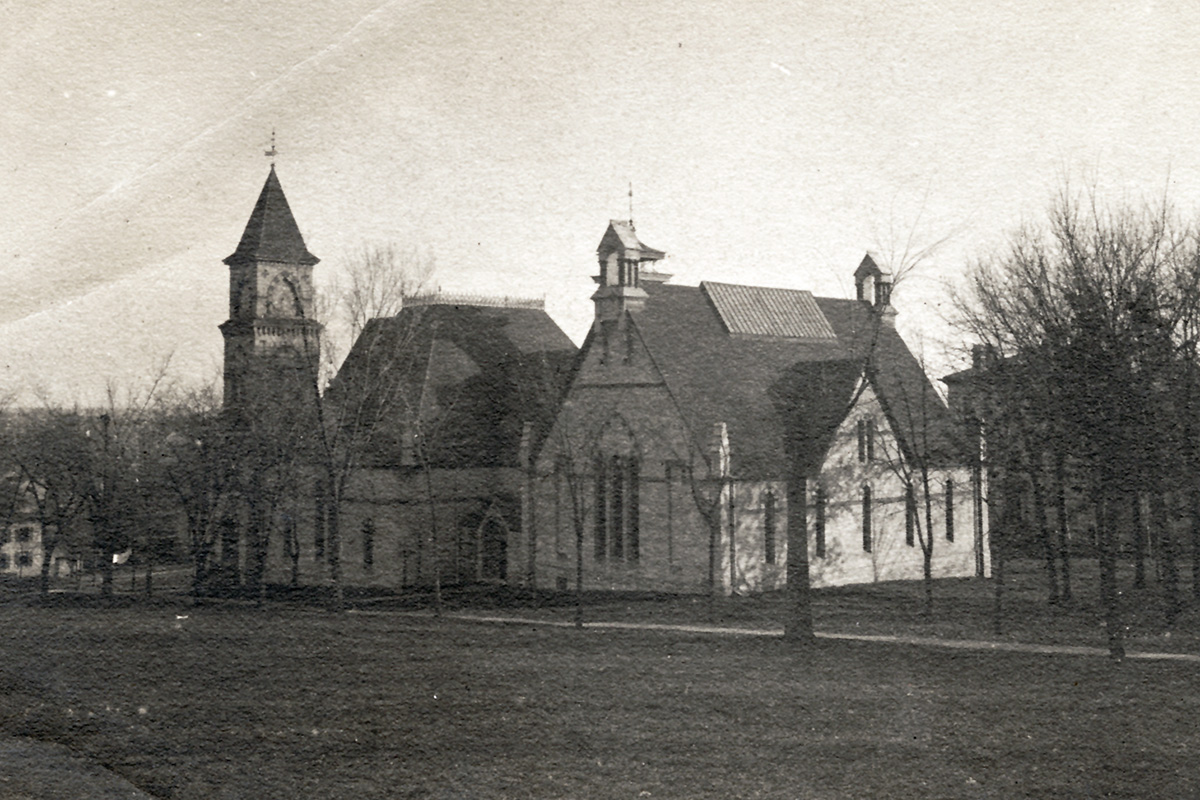
When this photo was taken around 1890, the clock’s mechanism used a 1,000-pound weight that fell to the ground every eight days. UW Archives
It’s hard to believe now, with smartphones in our pockets and smartwatches on our wrists, that UW students once relied on the Music Hall clock tower at the foot of Bascom Hill to make it to class on time.
In 1922, the Daily Cardinal offered this bit of service journalism: “It is poor policy … for a student to set his watch by looking at the hands of the tower clock, for he is below, looking up, and the perspective is such that he cannot get the exact time.”
Instead, UW students keyed their watch to the chimes of the clock tower’s bell, which marked the top of an hour — “always within 20 seconds of being correct.”
But even those students had the new luxury of wristwatches. When Music Hall was built in 1878, the 100-foot-high clock tower became one of the only places on campus to reference the official time. The clock featured four faces, with dials six feet in diameter and brass-studded Roman numerals.
To tell time, the clock tower looked to the sun and stars — or rather, to the Washburn Observatory. UW astronomers took celestial readings to calibrate the observatory’s master timepieces. Then, according to the book Chasing the Stars, they used what was likely the city’s first telephone line to listen in on the tower clock’s rhythms and note corrections. Shortly after, the observatory installed an electrical system that delivered signals regulating the Music Hall clock.
Originally, the clock’s mechanism used a 1,000-pound weight that would fall to the ground every eight days. At that point, a pair of herculean workers would spend an hour-plus cranking it up 50 feet to keep the clock ticking.
The clock was made automatic with electrical winding in 1933.
Music Hall was first called Assembly Hall and later Library Hall for its original functions — seating the whole student body in a large auditorium and housing the main book collection. It soon became home to the new School of Music and was officially renamed in 1910. Music Hall served as the school’s headquarters until 1969, after which it was largely left to the University Opera and the urban planning department.
Earlier this year, the UW announced it would use a lead gift from Herb Kohl Philanthropies to renovate Music Hall into the future home of the La Follette School of Public Affairs and rename the building after the late senator. The updates will modernize the interior while keeping the iconic exterior intact — including the clock tower. So, tomorrow’s students will still have no excuses for being late to class.
Published in the Summer 2026 issue

Comments
No comments posted yet.