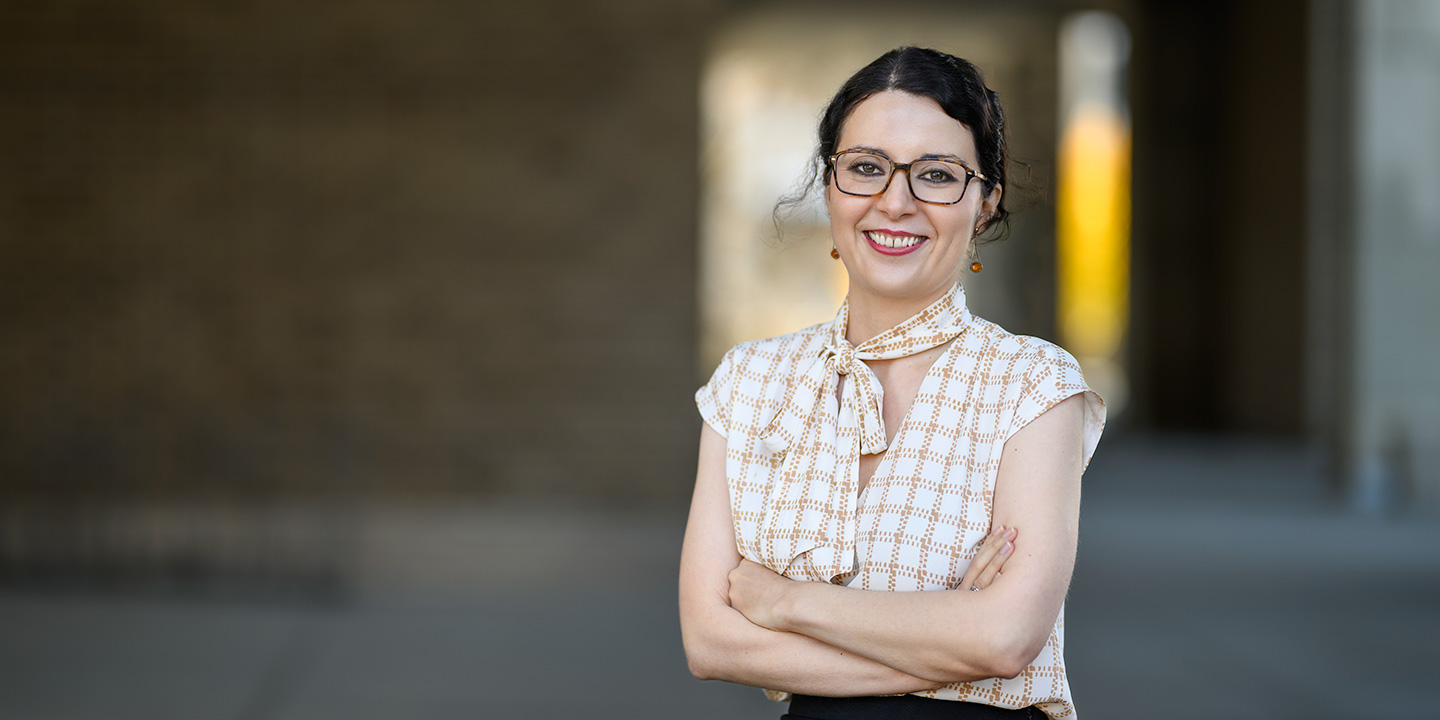
The Upside of Online Relationships
UW professor Catalina Toma reveals the unexpected benefits of social media and dating apps.
Last fall, students filed into Vilas Hall for the first session of Online Communication and Personal Relationships, a class with the potential to improve their friendships and family relationships. There was even a chance it could help them meet the love of their lives while boosting their mental health and well-being, even though that is not what it’s designed to do.
Catalina Toma, the communication arts professor readying her slides at the front of the room, is not some kind of magician. Her field of expertise is the science of online communication — how people relate to one another when interacting via technology. The first day of class had mandatory in-person attendance, but this was a blended class, which means students can come to Vilas Hall or watch live on their devices, with added online components. That’s a bit meta, Toma noted with a smile, as the topic is communication via computers.
Toma is internationally known as an expert in online communications in dating, technological interference in relationships, and the impact of social media on human well-being — topics that are a big draw for students. Given the relevance to students’ lives, Toma has no trouble finding undergrads who want to be research assistants as she develops new classes and conducts research in her rapidly evolving field.
“Personal relationships are the number one determinant of our well-being and happiness,” she told her class. And today, she said, such relationships are often inseparable from computer-mediated communication.
Is that a good thing or a bad thing? Our always-online world is often a source of criticism, so Toma’s conclusions may surprise you.
New Ways of Human Interaction
Toma describes herself as a “media psychologist.” She began this research in 2004 as a graduate student at Cornell University.
At that time, work on computer-mediated communication was new, and her job was studying such topics as impressions and deception.
Since then, technological communication has quickly evolved, and so has her research. While at Cornell, she witnessed the birth of Facebook, which at that time was limited to Ivy League campuses and consisted of creating a profile for friends to view. She witnessed the introduction of emoticons and “like” buttons. Each new platform or technology, she notes, affords new ways of human interaction.
“The study of computer-mediated communication has really ballooned, as it should, because it’s now used in organizations. It’s used by politicians. It affects societies and the democratic process. I have a tiny sliver of the pie that’s really about human connection and human interaction.”
Toma defines social media in the broadest sense of the term, encompassing such apps as Instagram and TikTok, but also emails, texts, online calls or meetings, and instant messaging — all the ways people interact socially via computers.
For Toma, the work has a personal angle, given her experiences emigrating from her native Romania to the United States.
Technology as a Lifeline
In 2000, at age 19, Toma left her home in Brasov, at the foot of the Transylvanian Alps, after receiving a scholarship to the University of Bridgeport. She felt rather overwhelmed by the experience of moving abroad, by herself, at such a young age.
“I was open to this issue of technologies, because my parents shipped me across the ocean as a freshman. I had never flown in a plane before. I hadn’t traveled anywhere by myself. And I didn’t know anybody.”
Toma discovered the joys of emailing and instant messaging.
“That’s what allowed me to stay connected to my family all the time and feel like I had emotional support as I was navigating my new life. My anchor was my family abroad, and so I came to technologies as a bit of a groupie, like, ‘Oh my God, this thing is amazing.’ ”
To this day, Toma and her mother have a standing Saturday morning FaceTime date and talk for two or three hours, sometimes cooking meals together. “It’s like she’s in my house.”
Her brother lives in France with her two nephews, a niece, and his wife. She stays in touch with them via computers too.
“When you have a spread of this nature,” Toma says, “technology becomes a lifeline.”
From a Person to a Profile
Growing up, Toma recalls her brother begging her to come outside and play, but she admits that “I usually stayed inside with my face in a book.”
Becoming an English literature major at Bridgeport was a natural fit.
Toma’s aha moment was realizing that what drew her to books was not the story or writing, but the character development — the psychology behind the characters.
After selecting psychology as a minor, she stumbled into her third area of study: communication, which she pursued in graduate school. “That’s when I started to get exposed to the idea that communication is a fundamental vehicle for understanding people,” says Toma. “That became my home.”
Platforms change, technology advances, and Toma explores new angles. But she still asks similar questions: “How do we construct versions of ourselves online? How do we take a full, complicated person and make them into a profile to send to other online daters or to people on social media?”
Toma has a very light public social media footprint and jokes that she is mostly a lurker, observing others. She hasn’t personally spent much time exploring online dating. She met her partner, Wisconsin School of Business Professor Evan Polman, on campus.
“She is very much an intellectual who loves to hang out with her friends and talk about big ideas,” says Haley Vlach, a UW professor of educational psychology and Toma’s close friend for more than a decade. “I’m wowed by her intellect, and the first impression people get is of a very serious person. Yet as a friend, she’s really warm and funny.”
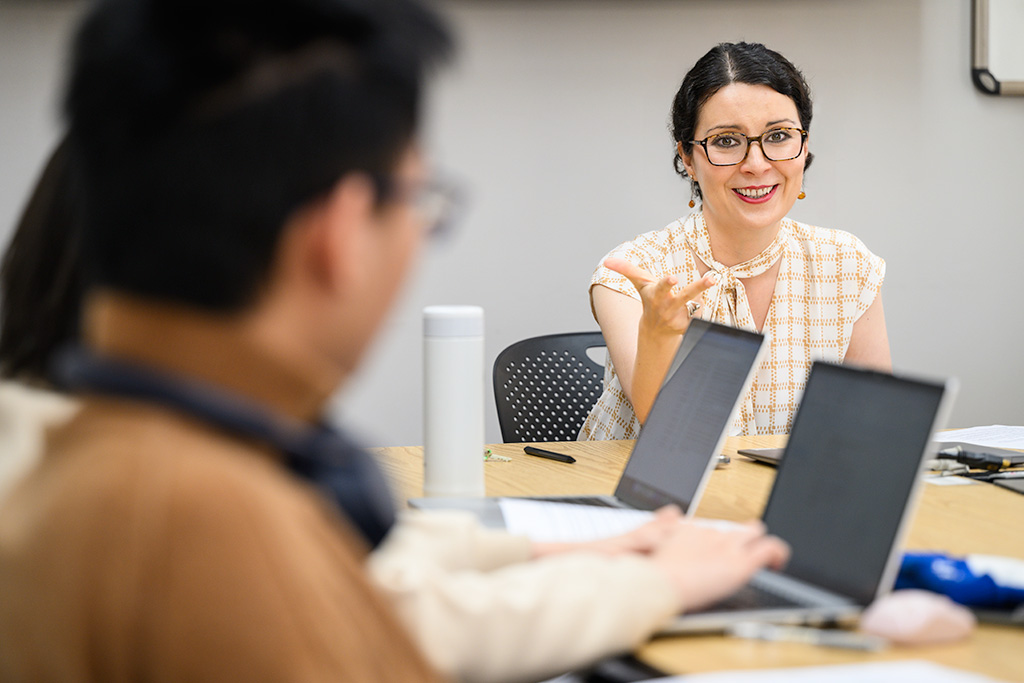
Toma and her students discuss the connections between personal relationships and online communication.
Toma, who in 2022 won a Distinguished Teaching Award, exudes enthusiasm about her students and classes. Mina Choi MS’12, PhD’18, who was Toma’s first graduate advisee and is now a professor at Kyung Hee University in South Korea, says Toma met with her every week for an entire semester just to help her discover a suitable thesis topic. That mentoring relationship grew into an enduring “deep friendship and collegial partnership,” says Choi.
“Catalina brings to her work a rare combination of intellectual rigor and genuine care for people. She communicates high standards in ways that are motivating rather than discouraging. What makes her stand out, though, is that alongside her scholarly excellence, she is approachable, empathetic, and incredibly supportive.”
Toma is a yoga practitioner and casually sits in her office chair, shoes discarded and a leg crossed underneath her, for a lengthy conversation. Talking about her research, she displays a deep passion.
She is also known to delight in such reality TV shows as Love Is Blind, which she defends as pertinent to her research on the ins and outs of modern dating — a subject that is frequently on her mind.
Online Connections
Online dating was once looked down on as a “crutch for the desperate,” Toma says, but in 2019, for the first time, more couples met each other online than through friends, the former most common introduction. Online has been ahead ever since.
Toma is often asked about online dating by reporters and sought out by corporations for consulting. She is the associate editor of Computers in Human Behaviors, a job she’s also held with Human Communication Research and the Journal of Media Psychology.
If you bemoan technology’s impact on relationships or call it cold and impersonal, Toma will disagree. She thinks human bonding happens through technologically mediated communication and seeks to understand the ways in which technology might benefit relationships.
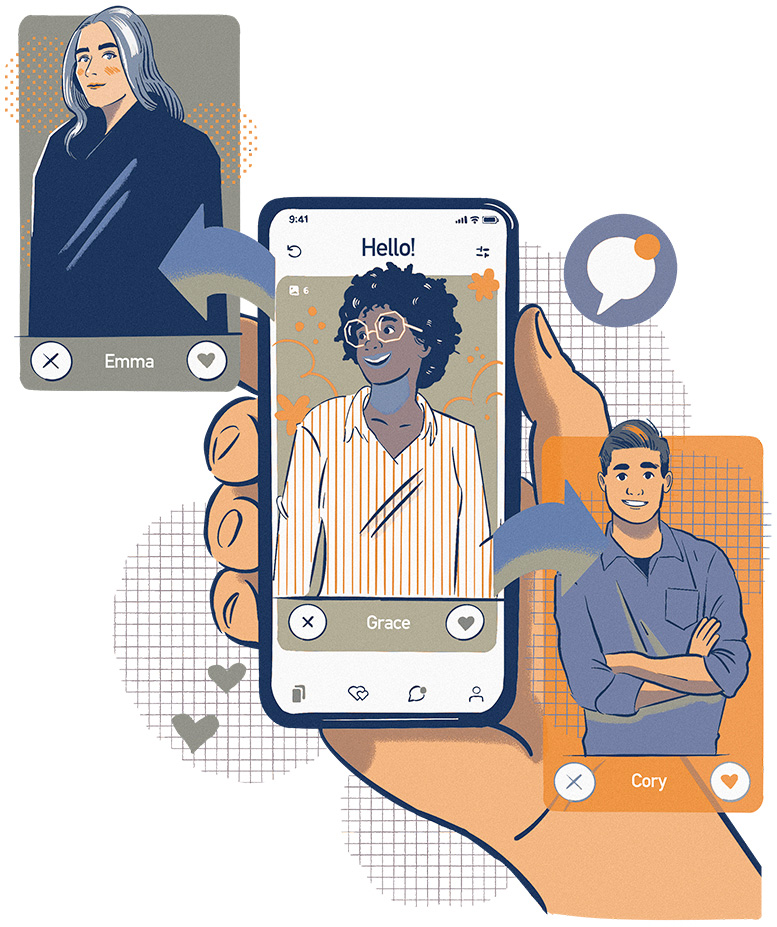
For example, she points out that when crafting a profile or sending out a query on a dating site such as Match.com, eharmony, or Hinge, people can take time pondering how to best represent themselves. They can craft thoughtful responses, an especially advantageous approach for introverts or those who have social anxiety about dating.
But online, people get away with being extremely deceitful, right? Not any more than in person, according to Toma. She has extensively researched deception and found that it is far more difficult to spot face-to-face than we think. Our chance of picking out a lie is just 54 percent, she says, “not much better than flipping a coin.”
Online dating is a misnomer because people meet online but date in person. And Toma’s research shows that technological connection is quite meaningful in maintaining a relationship. The texts, memes, or funny videos sent throughout a day make people feel connected and appreciated. (For Toma, that might be a snap of her cat Nigel, according to one friend.)
In Toma’s new course, Social Media and Psychological Wellbeing, she is using her deep knowledge of social media to explore its impact on people.
Computer-Aided Relationships
Our relationships are central to well-being, Toma says, and very few close relationships exist anymore strictly outside of email, texts, messaging, or online platforms such as Facebook or Instagram. So well-being and social media are now “quite interconnected.”
She’s found that while people often focus on the harmful aspects of social media — particularly for teens — there are also ways in which social media use can boost feelings of well-being.
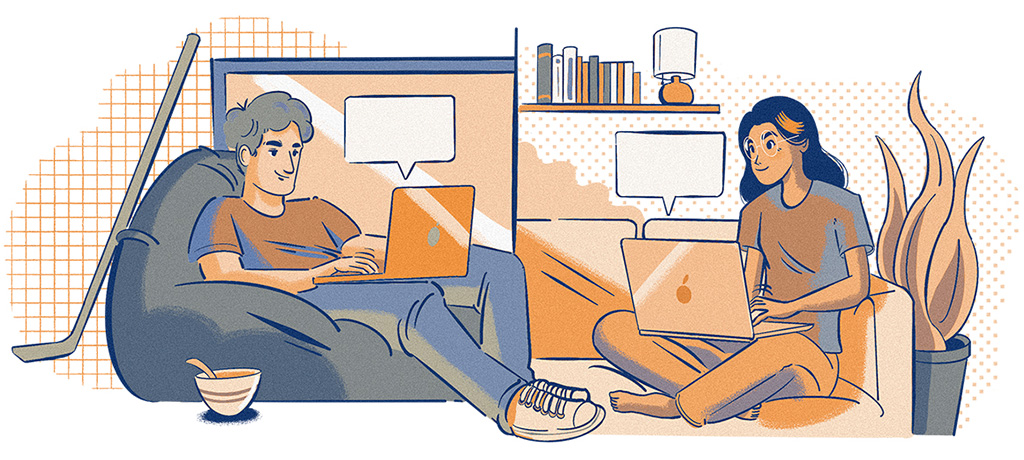
“There are very strong, entrenched beliefs people have about social media and well-being,” says Toma. “But when you look at the data, the story becomes really messy and really complicated.”
Those with depression or anxiety can use social media to combat loneliness and find community. What matters, says Toma, is how people in such situations utilize it.
Among the benefits of social media for personal well-being:
- Individuals with social anxiety can find asking someone out on a date online more comfortable than asking them in person.
- Older adults who experience loneliness can reignite old friendships, as Toma’s father, in his 70s, recently did with pals from his younger years.
- Teens have displaced seniors as the loneliest group, and they also use social media to ease feelings of isolation.
- Constructing authentic social media profiles that showcase who we really are can be self-affirming.
- Going back and viewing your posted highlights on social media can cheer you up.
- People with traumatic brain injuries, those who struggle with words, or those who have trouble interpreting in-person actions find online communication easier.
- When children leave home for school, parental communication via technology can serve as a buffer to reduce stress.
- People experiencing distressing life or health situations can find others with similar problems and anonymously discuss topics they are embarrassed to broach with friends or family.
On the other hand, Toma does not sugarcoat the negative effects of technological communication, including cyberbullying, online deception, harmful social comparison, and “technoference,” such as burying yourself in your phone during lunch with a friend.
Being more intentional about social media use can be helpful in mitigating its potential pitfalls.
For example, Toma points to research that shows it can be effective to take “micro breaks” from social media: cutting back on the time you spend online or temporarily avoiding certain apps. People can also remind themselves that online photos are merely a “glamorized glimpse” of a person’s life, sometimes boosted with a photo filter.
A micro break she recommends for students who are stressed out by searching for jobs or internships is to avoid sites where acquaintances post about the great gig they were offered, to lessen the likelihood of harmful social comparisons.
Toma predicts her research will increasingly move into the realm of artificial intelligence, particularly chatbots that provide information, conversation, or even romantic companionship.
An AI Helper
While there are extremes, such as people marrying their chatbots (go ahead and Google it), Toma is again interested in exploring the nuanced ways in which conversational chatbots may support or undermine users’ well-being.
Gemini, Microsoft Copilot, Claude, or ChatGPT can be a bit like a newspaper advice columnist, says Toma, but intensely personalized as they remember things you have told them in the past.
Toma has asked ChatGPT health and nutritional questions, mentioned that she’s a vegetarian, and returned months later with a new question, getting the response: “Since you are a vegetarian … .”
“There’s a lot of emerging research that I’m excited about on what’s called chatbot sycophancy,” says Toma. “The chatbot gives you what you want to hear and doesn’t push back or challenge, and the intention is that users feel validated and understood.”
She notes that this can backfire, especially for people with mental-health issues who need an interruption and reframing to alter their negative thoughts, particularly intentions of self-harm, rather than the affirmation a chatbot might offer. Such an intervention could come from a friend, a mental-health professional, or even a chatbot with guardrails in place.
While stressing the need for safeguards, Toma sees ways AI can boost well-being. Therapists are in short supply and cost-prohibitive for some people, so she plans to study AI’s potential benefits in this area.
“These large-language modern tools can play a big part in how people get advice, how people connect, how people get well-being and mental-health support,” she says. “I think AI is the next frontier as a helper, an assistant, and a way to augment our communication with other people.”
Melanie Conklin MA’93 is a Wisconsin journalist and political communications director.
Published in the Summer 2026 issue



Comments
No comments posted yet.