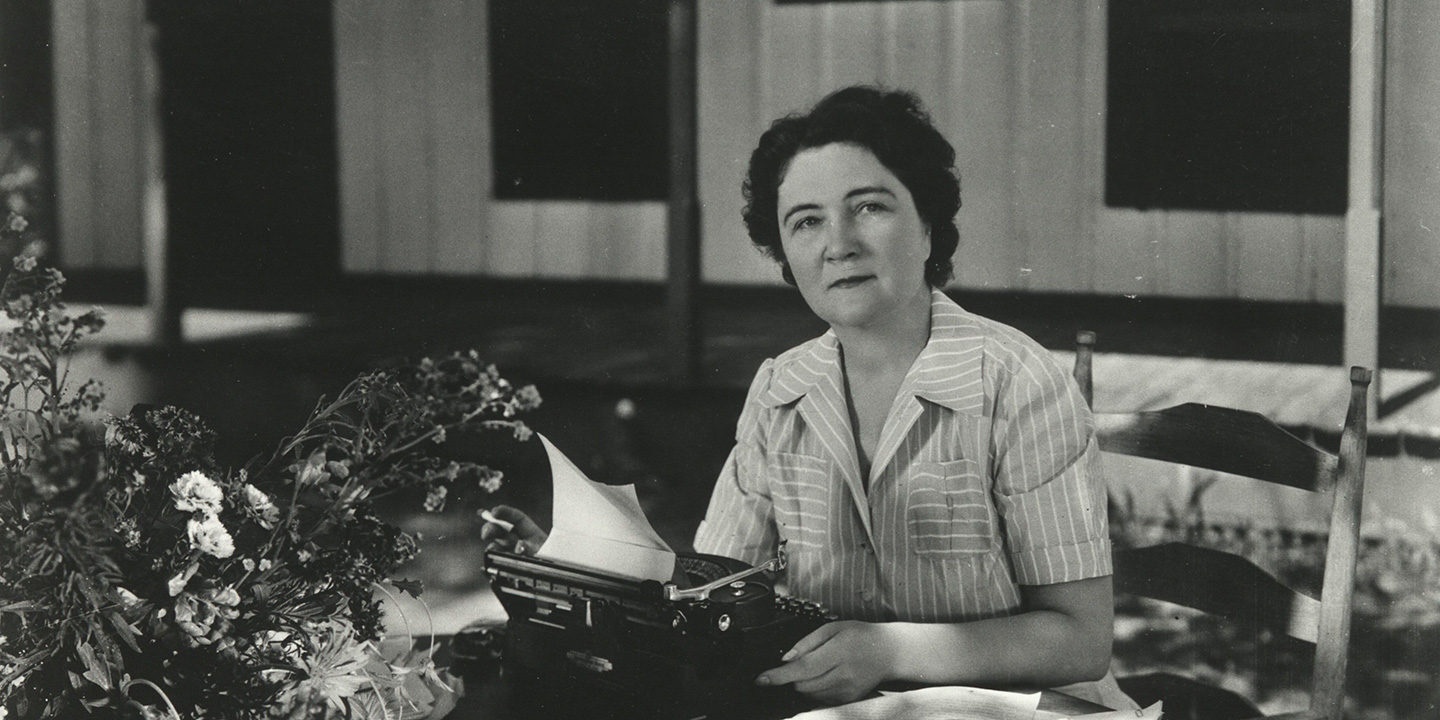
Rereading Marjorie Kinnan Rawlings
The UW alumna is influencing a new generation of environmentalists, decades after her Pulitzer Prize–winning novel The Yearling.
On a chilly January morning, the Marjorie Kinnan Rawlings homestead in Cross Creek, Florida, was unexpectedly crowded. My former UW roommate and I nabbed the last two spots on the formal tour and shuffled through the well-preserved green-and-white house and orange grove that Rawlings, who graduated from the UW in 1918, managed for decades.
Dutifully, we took pictures of the indoor bathroom the author famously installed with the proceeds of her most successful novel, and we accepted a few sour oranges from trees Rawlings herself may have planted on the estate almost a century ago.
Yet by the end of the tour, I wasn’t fully convinced that one of UW–Madison’s most famous writers is still relevant to modern audiences. After all, the descendants of the farmers and ranchers she wrote about are now losing more than 120 acres a day thanks to urban sprawl, and even Florida’s iconic orange industry is in steep decline due to citrus disease.
I asked the tour guide, “Why do you think Marjorie Kinnan Rawlings still matters today?” She seemed taken aback by the question.
“Rawlings captured the culture of this place,” she said, and moved on to demonstrate how to operate Rawlings’s cast-iron stove.
My roommate, Casey Harris ’09, nudged me along. We read the informational plaques describing Rawlings’s life and career. She was born in 1896 to a bureaucrat family in Washington, DC. Her first novel, South Moon Under, was published in 1933 and was a finalist for the Pulitzer Prize. Her third and most famous novel, The Yearling, was published in 1938 and became an instant literary classic. It won the Pulitzer and was turned into a major motion picture. She wrote three more books and died in 1953. Her widower donated her Cross Creek house and orange grove to the University of Florida, and the property is now a small state park.
On the plaques, Rawlings’s life reads like a tidy biography of early promise and sustained success — the kind that prompts (for this contemporary novelist at least) a sense of dismissive envy.
“Why her?” I asked Harris, a botanist who specializes in water quality and has made central Florida her home for a decade. “Why is she still such a big deal?”
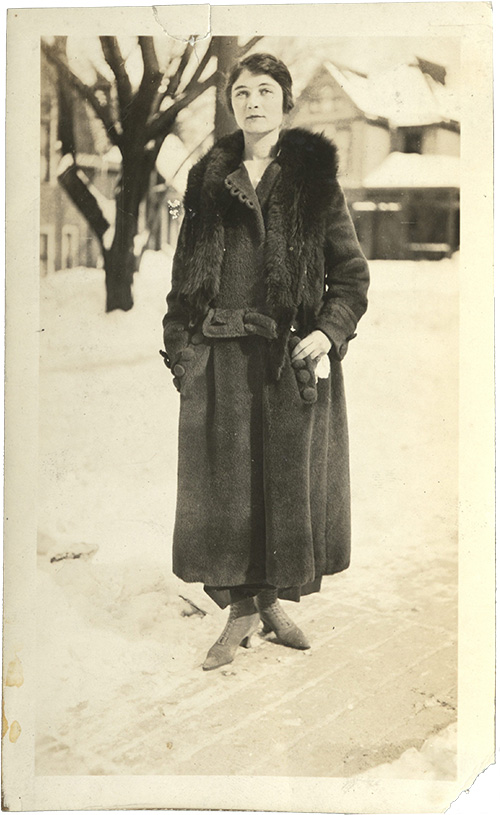
At the UW, Rawlings (shown here in 1918) threw herself into writing. Her body of work has been called a repository for the flora and fauna of Florida, and she became an advocate for the state’s environment.
Harris gave a botanist’s response. “People like to read her descriptions of what this area used to look like,” she said. “And some people really love that book about the deer.”
Like many visitors to the Rawlings homestead, we stopped for lunch nearby at the Yearling Restaurant, which has been capitalizing on Rawlings’s reputation since the 1950s. In earlier days, the restaurant had a dress code and white tablecloths, but these days, the vibe is decidedly more casual. I ordered fried frog legs and sweet tea.
On our way out, I paused to ask a young hostess who’d lived in a nearby town all her life, “Why are people still into Marjorie Rawlings?”
The hostess leaned toward me to confess, “I have no idea!”
We laughed, and she pointed to a glass case on the wall. Inside was a first edition of Rawlings’s second novel, Golden Apples, which the restaurant was selling for $200.
In Gainesville, I picked up a copy of The Yearling and a biography of Rawlings from the local library.
“Do you think she’s still important?” I asked the checkout librarian, who’d once been a volunteer at the Cross Creek homestead.
She thought for a long minute before answering. “Marjorie lived on her own terms, which was hard for a woman in those days. I admire that.”
The Maturing of an Author
Rawlings was a woman both of and ahead of her time. She evolved from a socialite student into an adventurous woman who hunted alligators and baked blackbird pies. She used racist language in her early work and had a complex relationship with her Black orchard staff, though her attitudes changed gradually in the 1940s after she befriended fellow writer and anthropologist Zora Neale Hurston. Rawlings subsequently removed racial slurs from later editions of her novels and wrote about her efforts to actively combat her own prejudices. She also struggled with alcoholism and chain smoking for much of her life, which may have contributed to her early death from a cerebral hemorrhage at 57.
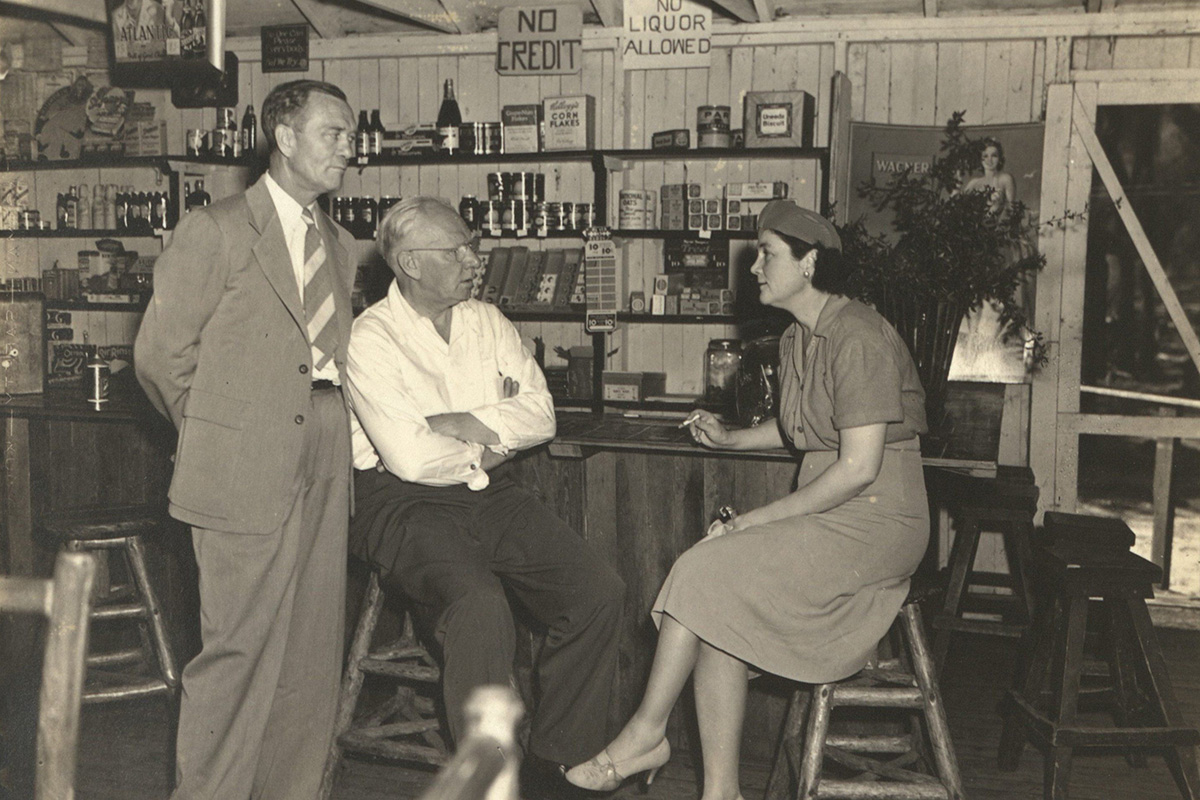
Rawlings meets with MGM executives in Salt Springs, Florida, to discuss the movie adaptation of The Yearling. Starring Gregory Peck and Jane Wyman, it became the ninth-highest-grossing film of 1946.
The biography, The Life She Wished to Live by Ann McCutchan, offers considerable detail about Rawlings’s college days in Wisconsin. In 1914, Marjorie Kinnan arrived on campus with several trunks of new clothes and a tube of scandalous red lipstick to enroll in the UW’s up-and-coming English department. She’d been a schoolmate of future politician Robert La Follette Jr. x1917 at their exclusive high school in Washington, and Rawlings’s socialite mother believed that if the UW was good enough for that illustrious family, it was good enough for her children, too.
Rawlings had only been admitted to the UW on probation, thanks to a cautionary note on her application from her former principal. “[Rawlings] has great natural ability, particularly in the line of literary work and languages. She is capable of doing rather extraordinary work — tho’ she is easily distracted by social interests,” he wrote.
Yet it didn’t take long for Rawlings to put any doubts about her academic abilities to rest. She immersed herself in advanced writing and composition courses, won campus playwriting competitions, had poetry and short fiction published in the Wisconsin Literary Journal, edited The Badger yearbook, and wrote a senior thesis about the influence of paganism on English poetry.
Her class-obsessed mother was horrified when she fell in love with a classmate named Charles Rawlings, the son of a shoe-factory foreman from upstate New York. Charles was also an aspiring writer, and he enrolled at the UW as a special student but ultimately dropped out. After Marjorie graduated, the pair moved east for her to launch her writing career in New York City while Charles enlisted in the U.S. Army and deployed near the end of World War I.
Marjorie had a letter of introduction from a UW professor to meet with Honoré Willsie 1902, a magazine editor who would go on to write 16 novels. “Well, you’ve got the gift of gab all right,” Willsie reportedly told her. “Only God Almighty can tell you whether you’ll do anything with it. … You have to have a private gospel that you want terribly to preach. I don’t mean moralizing. I mean that there has to be something close to your heart that you want to talk about.”
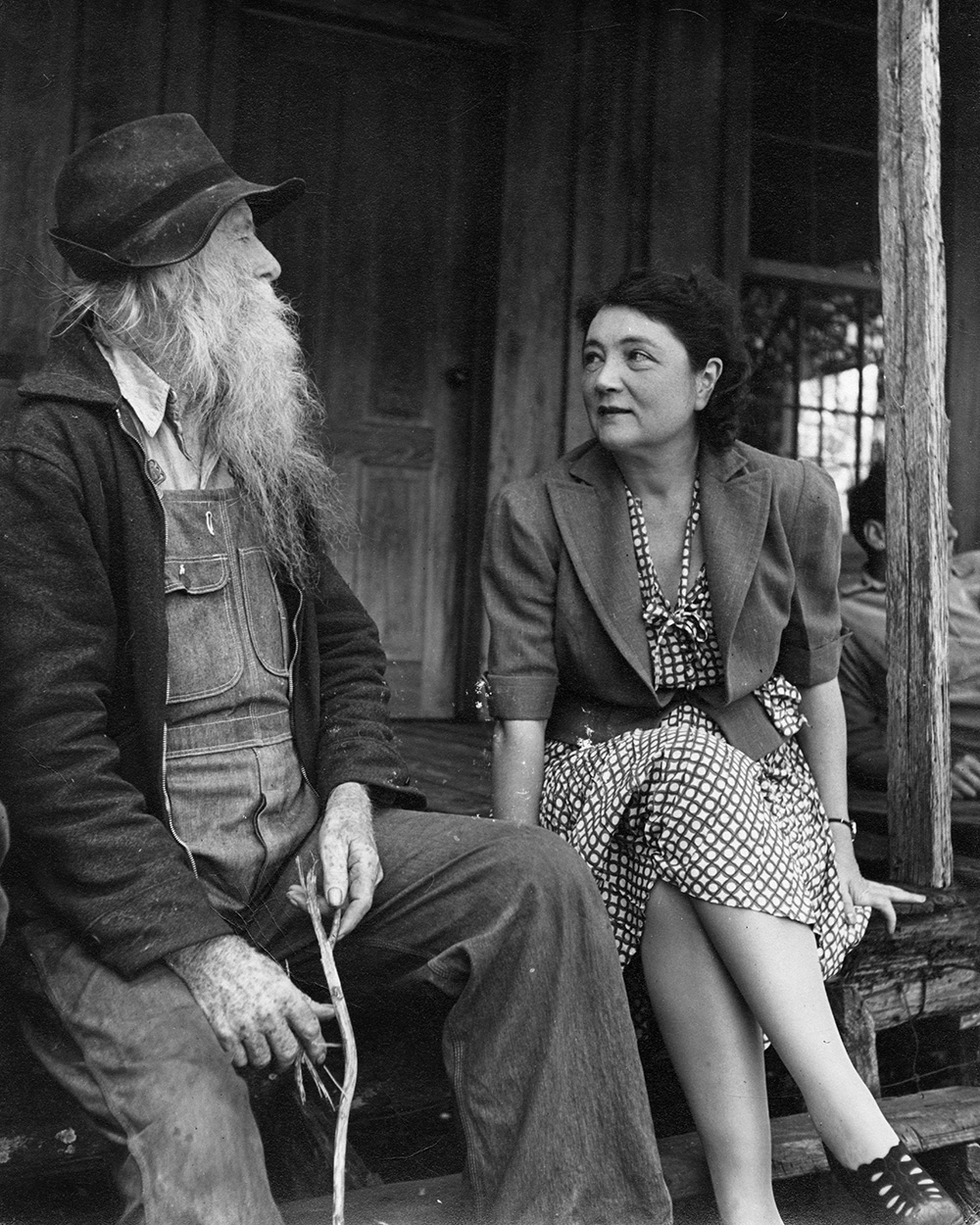
Rawlings on the set of The Yearling with neighbor and storyteller Julian Bauknight, one of the locals who inspired her writing.
At the time, this was not helpful advice. Instead of figuring out her “private gospel,” she got a more practical job writing marketing copy for a local YWCA. When Charles returned from the war, the pair married but struggled to make ends meet. They bounced from New York City to Rochester and Louisville, Kentucky, but by the late 1920s, the newlywed writers were desperate. Every time Rawlings landed a job writing for a magazine or newspaper, Charles would get jealous and make her quit. Rawlings then wrote a memoir about her mother’s unexpected death in 1923, but publishers turned her down.
On a whim, they visited Charles’s older brothers in Jacksonville, Florida, and fell in love with the landscape. They used the last of Rawlings’s small inheritance to purchase a decrepit house and orange grove in rural central Florida, in a hamlet called Cross Creek. After years of financial and marital insecurity, both Rawlings and Charles thought they’d finally found a place where each of them could settle down and flourish. To spoil the ending, though, it was only Rawlings who managed to break through, and the success of her debut novel proved too much for Charles. The pair divorced in 1933. Charles spent the rest of his life sailing around the world, writing about yacht races, and Marjorie married again in 1941, to hotelier Norton Baskin.
A Paean to Rural Roots
At more than 500 pages, The Yearling is a brick of a book, and the plot follows the daily routines of a 12-year-old boy named Jody and his “Cracker” parents in the Florida scrub. While the term cracker is sometimes used as a racial slur, in central Florida, it is used in a historical context (often with pride) to refer to the state’s earliest settlers.
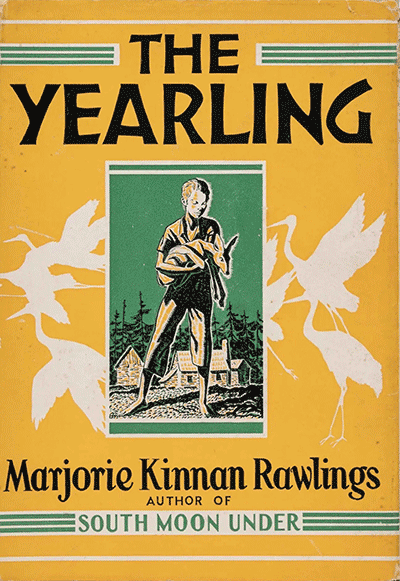
The first edition of the prize-winning novel came out in 1938.
Early in the book, Jody’s father kills a white-tailed deer, and they adopt its orphaned fawn, naming it Flag. For a year, Flag follows Jody everywhere as the family navigates economic hardship and entanglements with their neighbors. Flag matures and eats the family’s corn crop, and Jody is forced to kill his pet. He believes he will never love anything so intensely again, and the book ends with Jody dreaming of Flag.
After reading it, I finally began to understand. “That book about the deer” is a deeply emotional story about how challenging it can be to balance human tenderness with economic survival. It’s a theme that is still relevant, says Ashley Lear, a humanities professor at Embry-Riddle Aeronautical University in Daytona Beach. She’s also the executive director of the Marjorie Kinnan Rawlings Society, an active group of academics and non-academics who share an interest in Florida history, literature, culture, and environmental concerns. Every year, the society hosts a conference in Florida for Rawlings aficionados, and they run the Marjorie Kinnan Rawlings Journal of Florida Literature.
“For me, Rawlings represents an element of American culture that still looks for authenticity and individualism by traveling to frontier areas both literally and figuratively and discovering oneself outside the influences of the modern world,” says Lear. “She found within the community at Cross Creek lifelong friends who struggled together to make a life on farms that were removed from the creature comforts of the city. What they lacked in material wealth, they made up for in a reliance on their neighbors and their own hard work and perseverance. Now, more than ever, there is a longing and a nostalgia for the deep satisfaction and connection that such a lifestyle produces.”
A Changing Legacy
Lear has noticed that Rawlings’s legacy is shifting to recognize her early environmentalist leanings. “In addition to her writing on the lumber industry after being commissioned by the U.S. Forest Service to tour the industry and advocate for reforms, her works serve as a biological repository for the flora and fauna of Florida,” she says.
Similarly, Rawlings is one of the inspirations for The Marjorie, a new independent investigative journalism outlet dedicated to the intersection of social justice and the environment. “The Marjorie is inspired by the legacies of three famous Marjories, including Marjorie Kinnan Rawlings [along with Marjory Stoneman Douglas and Marjorie Harris Carr], who were fierce advocates for Florida’s environment,” says cofounder Hannah Brown. “We strive to build on the work that they did by highlighting the human connection to environmental issues in the state. Rawlings’s creativity and connection with rural communities in Florida, such as Cross Creek, resonate clearly with our mission.”
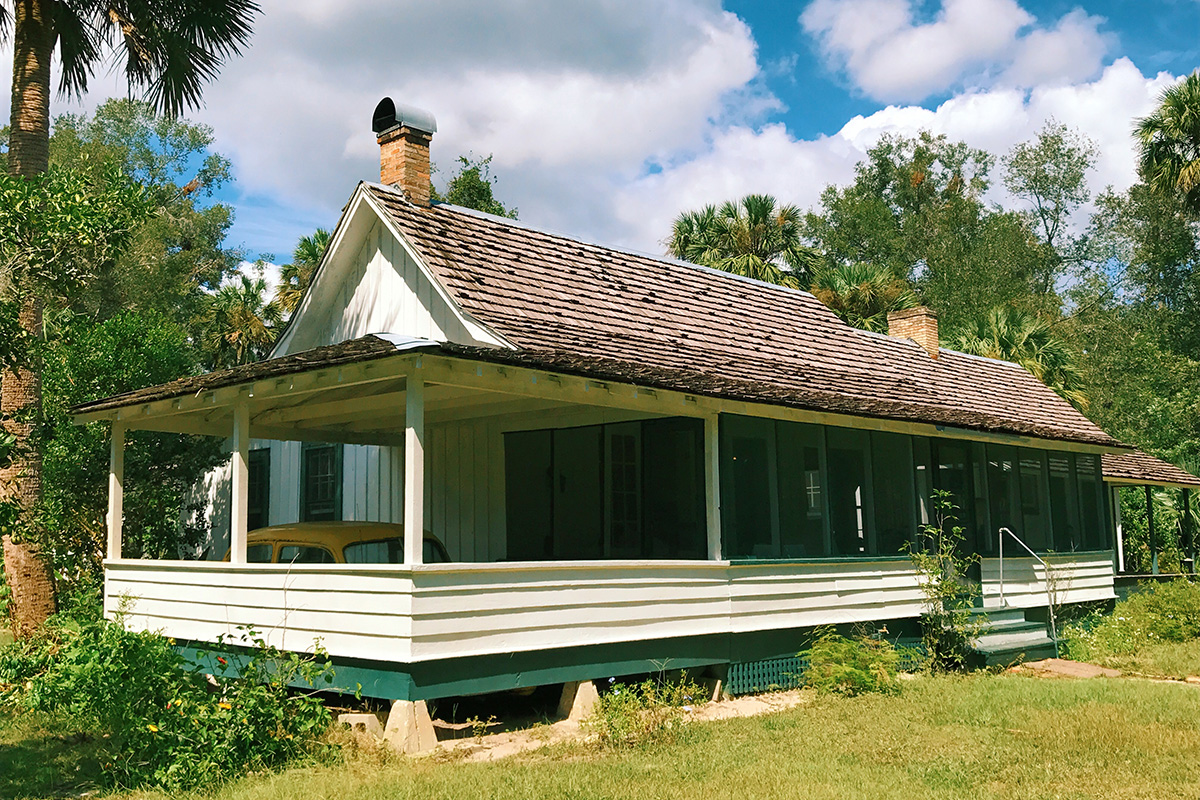
Rawlings’s Cross Creek home is now a National Historic Landmark and a Florida state park.
I went back to Rawlings’s homestead in the spring, alone this time. I skipped the formal tour and followed a trail into a mature stand of orange trees.
Why should we still care about a long-dead UW author? I asked myself as I listened to birds chirp above me and water lap at the muddy shores of nearby Orange Lake.
I care that she cared about this place, I realized. I care that she wrote lines like: “No man should have proprietary rights over land who does not use that land wisely and lovingly” in her 1942 memoir, Cross Creek. “We cannot live without the Earth or apart from it, and something is shriveled in a man’s heart when he turns away from it and concerns himself only with the affairs of men.”
Perhaps the greatest testament to Rawlings’s storytelling talent is that she still inspires her fans to appreciate — and to strive to protect — the wild, rural Florida she chose as her home.
Sandra K. Barnidge ’09, MA’13 is a Gainesville, Florida, writer who authored The Diamondbacks. Her former UW roommate has taken her kayaking through alligator-infested waters, the sort of thing that Marjorie Kinnan Rawlings used to do.
Published in the Winter 2026 issue

Comments
No comments posted yet.