How Ads Suppress Voter Turnout
A UW–Madison study quantifies the effect of microtargeting.
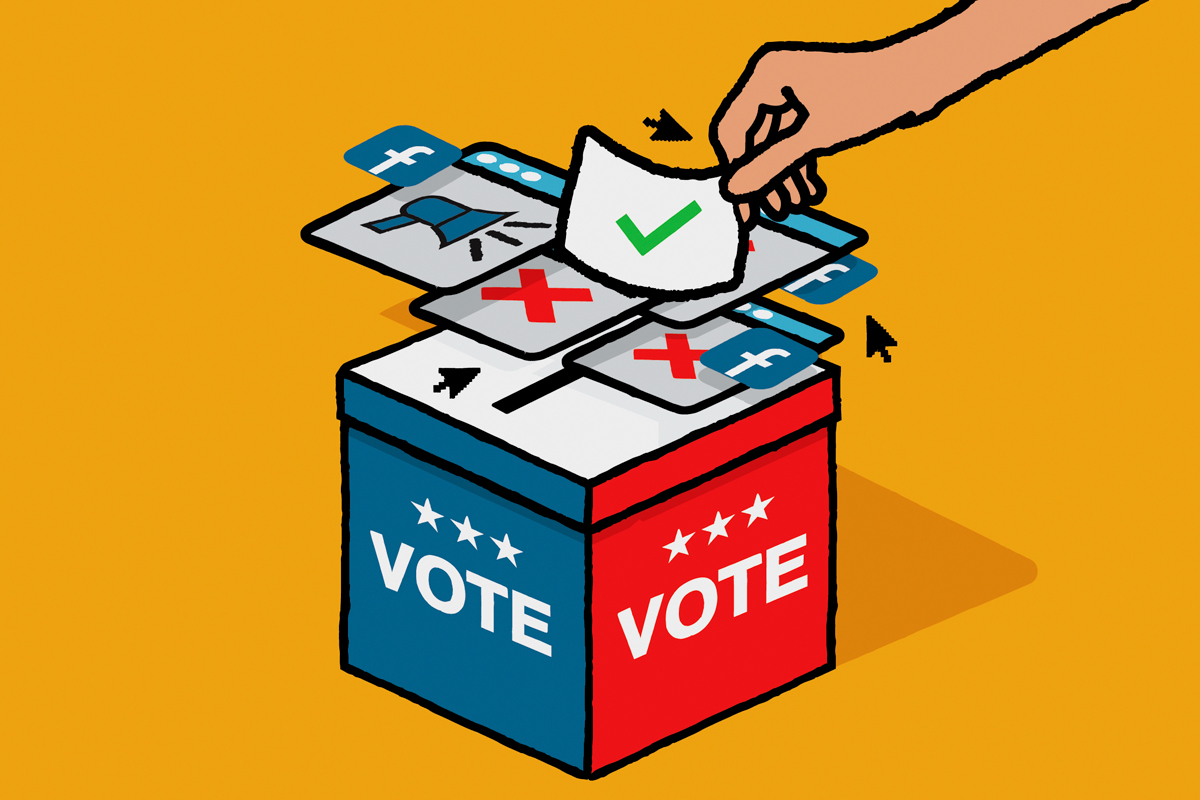
The study participants who saw the ads with vote-suppressing messages on Facebook were 1.9 percent less likely to vote in the election than people who did not see the ads. Jaime Espinoza
Messages intended to suppress votes can be precisely delivered to particularly vulnerable and consequential groups of people via social media and keep millions of them from casting ballots. A new UW study is the first to quantify the effect of such microtargeting on voter turnout.
A team led by Young Mie Kim, UW–Madison professor of journalism and mass communication, recruited more than 10,000 people across the United States — a group representative of the country’s voting population. They were asked to install an app that captured every ad they viewed for the six weeks leading up to the November election in 2016.
The study participants who saw the ads with vote-suppressing messages on Facebook were 1.9 percent less likely to vote in the election than people who did not see the ads.
The most common targeted message suggested an election boycott would send the strongest message to politicians. The ads’ creators used Facebook’s microtargeting advertising features to reach mostly nonwhite, voting-age people in hotly contested states in the presidential election. Those Facebook users received four times as many vote-suppressing ads as their white neighbors.
While a 1.9 percent shift in the behavior of some voters is small, the researchers say, so were the margins of victory in many states in 2016. Extrapolated across the country for the 2016 election, the effect of the ads may have kept about 4.7 million people from voting.
Congressional investigators showed that many of the ads the research team identified were purchased by the Internet Research Agency, a Russian digital disinformation operation. They used terms including “Martin Luther King Jr.” and “African American Civil Rights Movement” to target nonwhite voters on Facebook and discourage them from voting.
None of the vote-suppressing ads were purchased by groups that had filed reports with the Federal Election Commission. Strengthening and enforcing federal regulations on disclosing the source of political messages could provide important context for targeted social media users.
“Voters should be able to understand who is trying to influence them, especially whether it is foreign influence,” Kim says.
Published in the Summer 2026 issue


Comments
No comments posted yet.