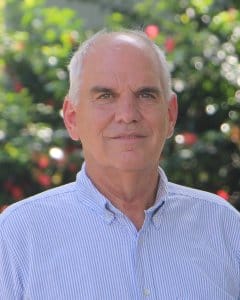
McCord is one of the nation’s most decorated chemists in the fields of explosives residue detection and trace analysis of controlled substances. Lila Aryan
Bruce McCord PhD’86 was already at work on a new method of recovering information from badly degraded DNA when terrorist planes hit the World Trade Center towers in New York City in September 2001.
McCord, who earned his UW doctorate in analytical chemistry, was then an associate professor at Ohio University. He had a federal grant and was working with former student John Butler of the National Institute of Standards and Technology on the new tests. They shared their progress with the New York City medical examiner.
“My understanding,” McCord says, “is that the procedure was used to help identify about 20 percent of the victims. We were very honored to play a part in the identification of the victims of this tragedy.”
McCord had previously spent a decade as a research chemist with the FBI, which took him to the scene of the first World Trade Center bombing in 1993. In 2004, he left Ohio for Florida International University, where he is currently a professor of chemistry.
McCord is also one of the nation’s most decorated chemists in the fields of forensic DNA analysis, explosives residue detection, and trace analysis of controlled substances. In 2008, he earned the Paul Kirk Award, which is one of the top honors awarded by the American Academy of Forensic Scientists.
It wasn’t crime that lured McCord to UW–Madison; it was a stroll on a frozen Lake Mendota.
McCord did his undergraduate studies at William & Mary in Virginia, and a professor there suggested Madison for graduate school. On his visit, McCord walked out on the lake, turned, and was dazzled by the Capitol and campus skyline.
“I was completely amazed at how beautiful it was,” he says.
McCord was also taken with analytical chemistry professor James Taylor.
“He was a wonderful adviser. He fostered a sense of community that I try to emulate with my research group.”
In McCord’s lab, where he’s mentored more than 35 doctoral students, they’ve worked on cutting-edge projects like detecting drugs used to incapacitate victims of sexual assault, who often retain little of the drug in their system. They’re also working on improving detection methods for dangerous synthetic drugs.
“Our current project,” McCord says, “is to detect fentanyl at very low levels and also detect fentanyl analogs.”
McCord has managed to balance a rewarding career with family — he and his wife, Margery Phipps MS’86, have three daughters — and a passion for Florida sports like kayaking and sailboarding.
He loves the water even when it doesn’t freeze.
Published in the Fall 2026 issue

Comments
No comments posted yet.