Bend-It-Like-Beckham Bots
Teaching robots to play soccer helps train them for useful jobs.
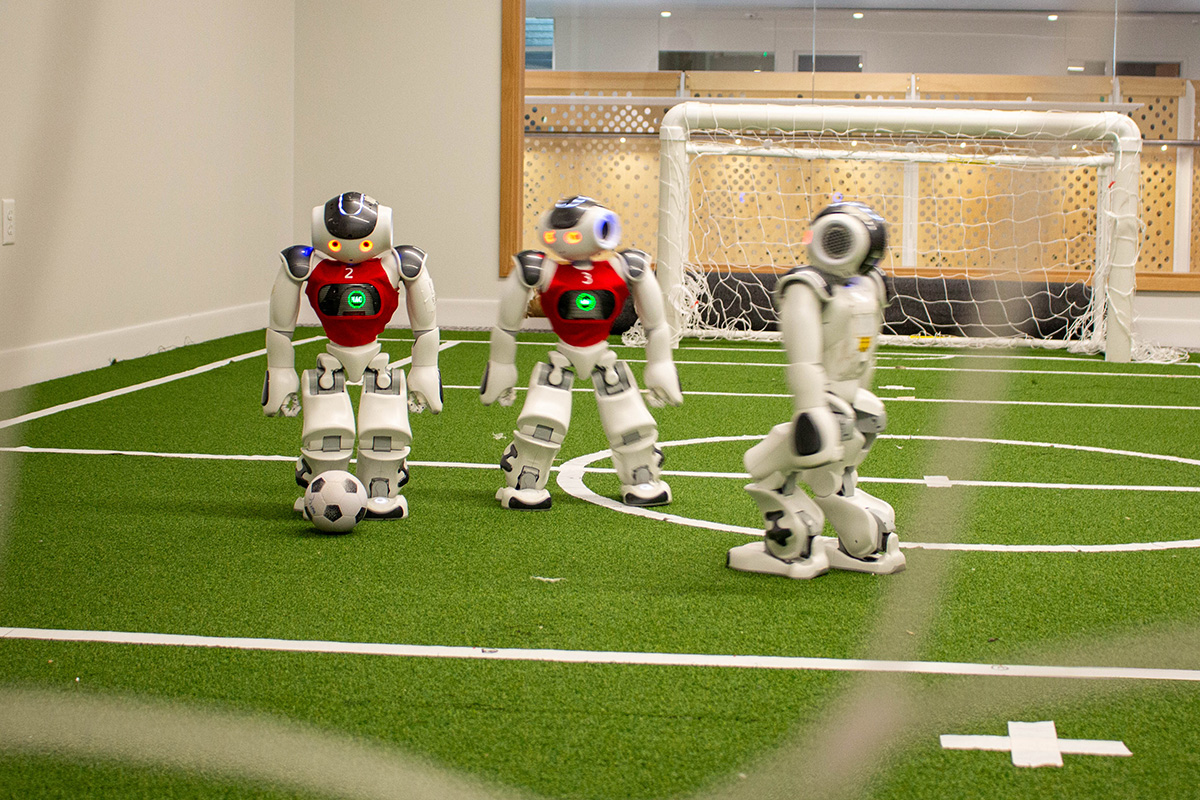
RoboCup has a formidable goal: create soccer-playing robots capable of beating the World Cup champions by 2050. Rachel Robey
To Josiah Hanna, a researcher in robotics and artificial intelligence, the world is like soccer: it’s dynamic, it’s fast paced, and there’s too much going on to process everything at once. That’s what makes the popular game the ideal forum for training his intelligent robots of the future — droids capable of reasoning, decision-making, and bending it like Beckham.
In Hanna’s lab, one of the more popular undergraduate research projects is participating in a team that competes annually at RoboCup, a robot soccer tournament that brings international researchers together to promote research. At its founding in 1997, RoboCup pledged a formidable goal: create soccer-playing robots capable of beating the World Cup champions by 2050. It’s been an effective driver for public interest in robotics.
“Games are one of the first things humans learn to do. They’re where we first develop skills that will serve us for the rest of our lives,” says Hanna, an assistant professor of computer sciences in the university’s forthcoming College of Computing and Artificial Intelligence, launching July 1. Plenty of intelligent animals learn through play, from human children to orca calves to fledgling crows. Hanna’s lab borrows this approach for training intelligent nonlife, hypothesizing that teaching robots to play soccer is a gateway to teaching them other things. “As we push the boundaries of artificial intelligence, it makes sense to use games as a test bed.”
Hanna says that robots have the potential to aid humanity by filling positions in industries where there aren’t enough people to take on all the open jobs. Researchers refer to the “Three D’s of Robotics” to encompass the kinds of work that robots are best suited for: dull, dirty, and dangerous.
First the robots beat the World Cup champions, Hanna says, and then they revolutionize disaster response and rescue operations. Or fight wildfires. Or any number of scenarios in which the “robot is faced with uncertainty about the true state of the world and must make decisions quickly.”
In the meantime, robot-soccer fantasy league, anyone?
Published in the Summer 2026 issue



Comments
Molly June 4, 2026
Wow I love robots