How to Beat Phone Addiction
Two Badgers have created the Brick to eliminate digital distractions.
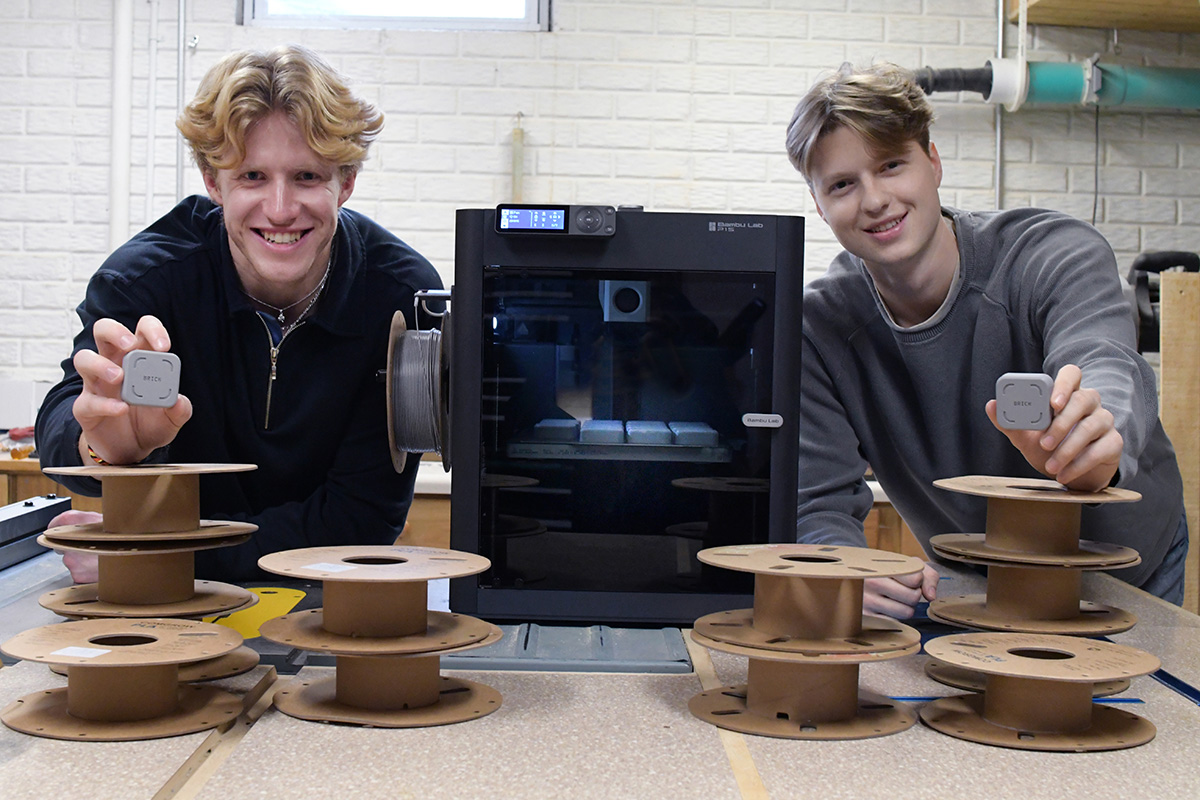
The computer sciences courses Driver and Nasgowitz took at UW–Madison taught them to figure out solutions without a road map. Lila Aryan
Longtime best friends T. J. Driver ’22 and Zach Nasgowitz ’21 experienced a problem endemic to their generation: their smartphones ruled their lives. They couldn’t escape the constant distractions — the apps, games, emails, and notifications all clamoring for their attention. Driver tried using a flip phone but found it too limiting and impractical, not allowing him to access information he needed. The built-in blockers on their iPhones were too easy to override. So the pair of engineers set out to create their own solution.
They didn’t really know what they were doing, developing a new product and starting a business, but the computer sciences courses they took at UW–Madison taught them to dive in and figure out solutions without a road map. “You learn some amount of confidence in solving problems that is very applicable to entrepreneurship,” Nasgowitz says.
The result of their efforts was the Brick, a small, square device (about half the size of a deck of cards) that you tap with your phone to block selected apps. You cannot access those apps until you tap the Brick with your phone again. The extra effort — or actually storing the Brick someplace separate from a work or study location — eliminates distractions.
The device solved their immediate problem, allowing them to focus, but they found it also delivered an ancillary benefit. Freed from distractions, they felt more present with friends and family or whatever task was before them. “It’s so liberating,” Driver says. “You don’t have to fight off the temptation every time you pick up your phone because you’ve already made that decision. The temptation doesn’t exist anymore because there’s no way to get into the distracting apps.”
Both alums are builders at heart, but Nasgowitz is more of a visionary. In the early days, he focused mostly on design and marketing while Driver, who is more detail-oriented, handled the engineering and operations.
They launched the Brick in 2023, selling it for $59 on Getbrick.app. The product has generated some media buzz, including in New York magazine, and the company is looking to add more employees to its Chicago office.
“We measure success by the number of people who benefit from the Brick,” Driver says. “The people buying this are coming back to us and saying, ‘This has improved my relationship with my phone and genuinely improved my life.’ That has been very fulfilling.”
Published in the Summer 2026 issue



Comments
No comments posted yet.