We Are the Champions
Revisit some of the most memorable national title runs in Badger sports history.
What does it feel like to win a national championship?
Just ask a Badger.
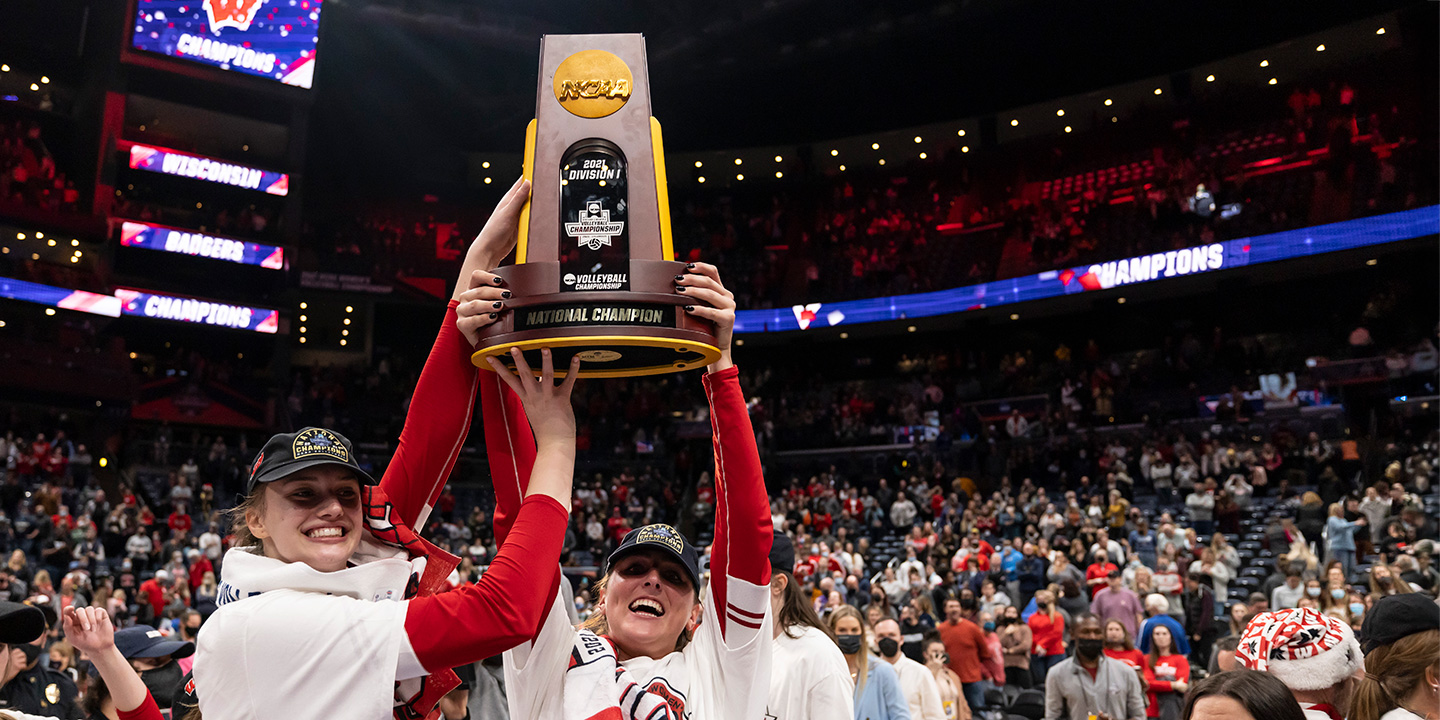
“It’s a peak moment, one of the best of my life,” says Sydney Hilley ’20, MS’22, who helped lead UW–Madison to its first volleyball title in 2021. “It was so rewarding to see how happy everyone was, looking at the faces of my teammates crying, knowing how many years of work — our whole lives — led up to that.”
When the women’s hockey team won its record ninth national championship in March, it became the 35th UW team to culminate their season with an NCAA title. These championship teams span nine varsity sports and range from underdogs to dynasties. Each is immortalized in Badger sports lore.
So let’s relive some of the exceptionally dramatic championship runs — and feel what it’s like when the buzzer hits zero.
Thirty-five UW–Madison teams have won NCAA titles. Althea Dotzour
The Storybook Ending
Volleyball — December 18, 2021
UW volleyball had long been knocking on the door of a national championship. The Badgers reached the regional finals of the NCAA tournament 11 times between 1997 and 2020. Four of those times they advanced to the national semifinal and thrice to the title match. But on each run, they fell agonizingly short of the ultimate prize.
By 2021, the UW program coached by Kelly Sheffield had already secured a place among the elite of college volleyball for its consistent success in a stacked Big Ten conference. But the pressure to deliver on the program’s championship promise had reached an all-time high. With every passing point in every passing tournament — including near-title runs in 2019 and 2020 — you could practically feel an entire fan base holding its collective breath.
And then, a special group of super seniors finally blew the championship door down.
Because the COVID-19 pandemic shortened the 2020 season, the NCAA granted an extra year of playing eligibility. For the 2021 Badgers, that meant the unlikely return of the most dynamic duo in college volleyball: Dana Rettke ’21, the towering 6’8″ middle blocker and former Big Ten Athlete of the Year (and, spoiler alert: eventual National Player of the Year), and Sydney Hilley, the ever-steady and reigning Big Ten Setter of the Year. Hilley and Rettke weren’t just inseparable on the court. They also lived together during all five years of college.
“She was my best friend — still is my best friend,” Hilley says.
Rounding out the super seniors were outside hitter Grace Loberg ’21 and defensive specialists Giorgia Civita MS’22 and Lauren Barnes ’21, MS’22.
None of them had to return to Madison for a fifth college season. There were pro offers. But they had a job to finish.
“This was our last chance to finally go and do it,” Hilley says of winning the championship, “and we knew what it was going to take because we had been close before. We had played together for so long. We loved each other so much. We had the ultimate trust and confidence in each other.”
The fourth-ranked Badgers entered the NCAA tournament on a high after winning the Big Ten championship for a third consecutive year. They swept through the first four rounds of the tournament, with heavy-hitting help from young stars Anna Smrek ’24, Jade Demps x’24, Devyn Robinson ’24, MS’25, and Julia Orzol ’24. At the semifinal in Columbus, Ohio, they outlasted top-ranked and previously undefeated Louisville in a five-set thriller.
Next up: Nebraska — and what would become the longest championship match in college volleyball history.
At first, it felt like déjà vu. The UW dropped the first set 22–25. Then Nebraska raced to a 13–7 lead in the second. Lesser teams might have crumbled, but the Badgers got back into the set with a 4–0 run. From there, it was a prolonged back-and-forth fight, with the UW fending off four set points — including at 28–29. That’s when Rettke took matters into her own hands, finishing off the set with a kill and back-to-back solo blocks against all-American Lauren Stivrins.
“Even if the other team knew that’s where the ball was going, it didn’t matter — she was that good,” Hilley says. “It gave me a lot of confidence to set the ball from anywhere and find her.”
The grueling match continued, featuring two of the best defenses in the nation. The Badgers controlled the net and set a championship record with 24 blocks, including 13 from Rettke. Barnes blanketed the back row with a match-high 31 digs.
The UW squeaked out the third set 25–23; Nebraska the fourth by the same score. And then the Badgers stormed out to a 7–0 lead in the decisive fifth set. At match point, with the UW leading 14–11, a Nebraska hitter smashed the ball out of bounds. The Badgers began to celebrate their big moment at midcourt. But Nebraska challenged the play. After a long review, the refs ruled that the ball had brushed the tip of a Badger finger on the block attempt.
The UW players couldn’t believe the call (and still don’t, Hilley confirms), but the veteran squad quickly regained its composure.
And then, because it had to be, it was Hilley to Rettke — a back set into a violent spike down the line — for the championship point. The team, including Coach Sheffield, broke into tears of relief and joy. The super seniors had finally brought the elusive title home.
“It was the perfect storybook ending,” Hilley says.
The Perfect Defense
Men’s soccer — December 10, 1995
The story of the 1995 UW men’s soccer championship starts with a budget crisis and ends with the most dominant defensive display in NCAA tournament history — five straight shutouts, even after an injury forced a backup goalie into his first real college action.
But if you think this is an underdog story, don’t tell it to the 1995 team.
“We came into the year, legitimately, with the goal of reaching the College Cup,” says Scott Lamphear ’96, the Badgers’ all-American defender and team MVP. “It almost looked like we hated each other, we were so intense in training.”
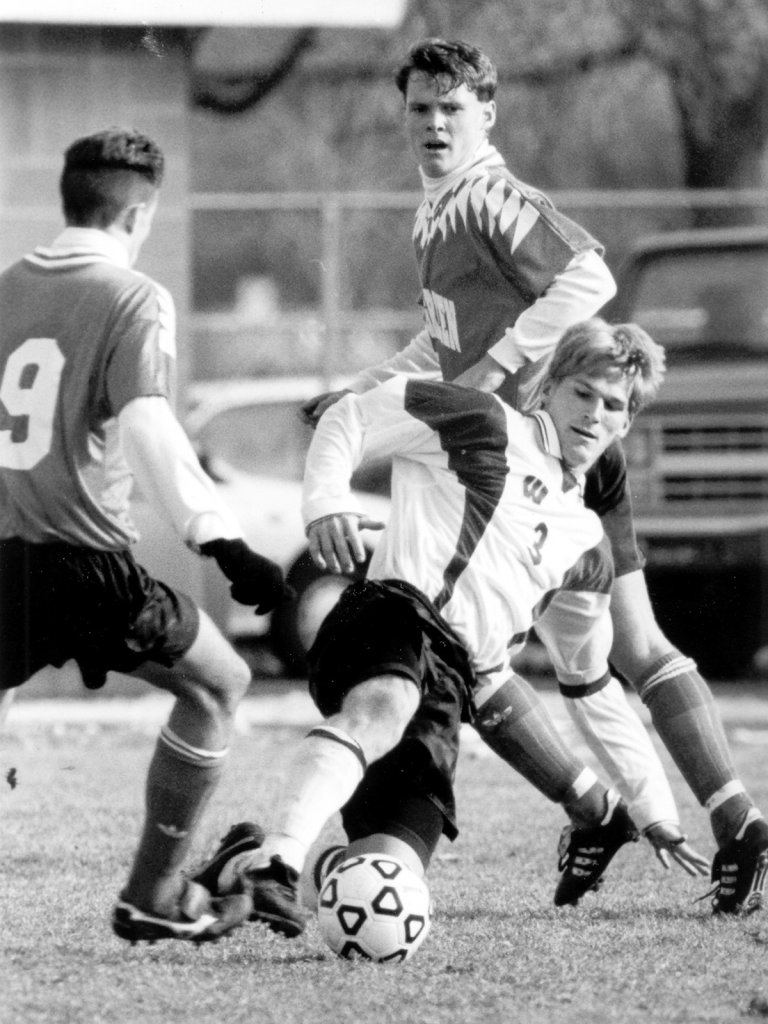
Lamphear: “When we got the ball, we kept it.” UW Athletics
In 1991, facing a $2 million budget deficit, the UW athletics department made the difficult decision to cut five sports. One of the few beneficiaries was the men’s soccer program, which had previously been allotted two scholarships. Now it could offer the maximum of 10.
Coach Jim Launder made the most of that good fortune, recruiting Lamphear, midfielder Mike Gentile ’97, and forward Travis Roy ’97 — a touted trio from Michigan (the former two being high school teammates). This class would eventually lead the Badgers to glory as seniors.
UW soccer was building on a solid foundation. It had won the regular season conference title in 1991 to qualify for its first NCAA tournament in a decade. Then the scholarship-infused program advanced to the Sweet 16 in 1993, with a memorable win over top-seeded Indiana. The next year, the Badgers qualified for the tournament again but fell short to Southern Methodist University (SMU) in the first round.
With eight returning seniors and some postseason experience, the 1995 squad was as confident as it was determined. The UW’s defense gave up just 11 goals in 25 games, including 17 shutouts. Most of those performances were with goalkeeper Todd Wilson ’98 in net. But after the Badgers blanked Bowling Green to start the NCAA tournament, Wilson dislocated his elbow against William & Mary in the second round. They only had one other goalie on the roster: Jon Belskis ’96.
The walk-on redshirt junior was a massive obstacle: 6’4″, 215 pounds. Yet in his four years at the UW, he had only seen the field twice and never even had to make a save. In fact, he had considered quitting the sport altogether.
But Belskis was brilliant when thrust into action. Leveraging his long limbs to snatch up balls, he didn’t allow a goal in the overtime win against William & Mary — or for the rest of the tournament. It helped that he played behind a nearly impenetrable defense featuring both size and speed.
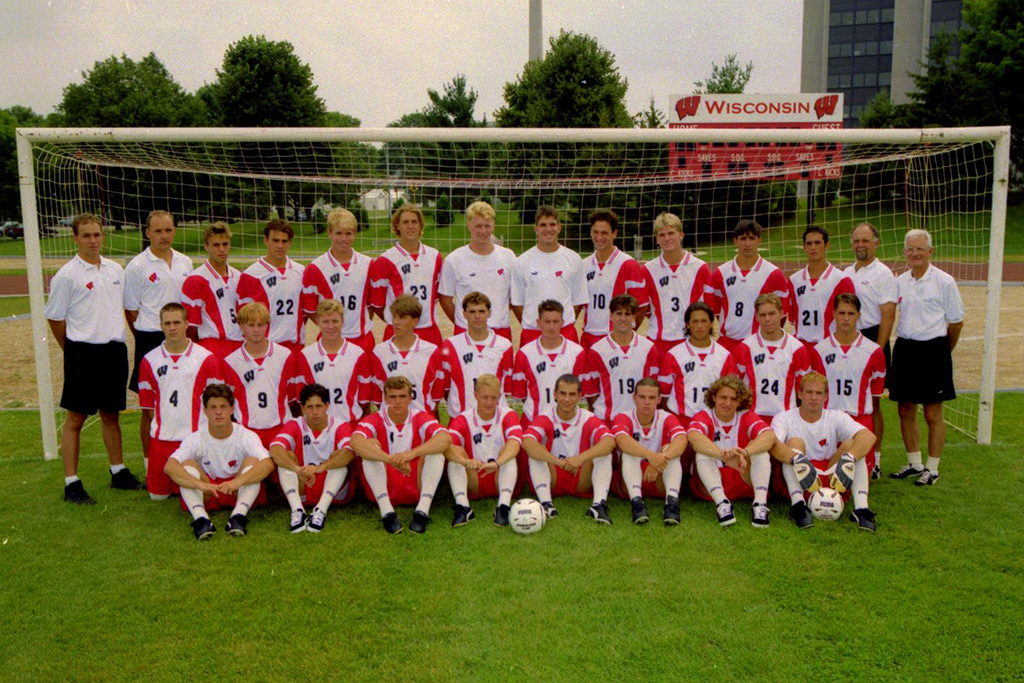
The soccer team’s feat of five consecutive shutouts in the NCAA tournament has never been repeated. UW Archives
“When we got the ball, we kept it, and when we didn’t, we were organized,” says Lamphear. “We had amazing athletes who understood the game and worked as a unit. If you got by one of us, there would always be another one there waiting.”
The Badgers got some revenge against SMU, smothering the Mustangs 2–0 to advance to the semifinals. To say they were the afterthought among the four teams heading to Richmond would be an understatement. There was local favorite Virginia, riding a 33-game winning streak and vying for its fifth consecutive title. There was Duke, featuring star freshman strikers who would soon stun Virginia. And there was Portland, with a coach who made history by leading both its men’s and women’s teams to the College Cup.
The Badgers came in with the reputation of a team that didn’t give up many goals — but also didn’t score many. Observing warmups for the semifinal against Portland, Soccer America magazine wrote: “One saw a clue to the Badgers’ low output … shots were flying everywhere but in the goal. One knocked down a walkway barrier and stunned an elderly usher.”
Still, these Badgers were no timid offense. They aggressively controlled the ball against both Portland in the semifinal and Duke in the championship, combining to outshoot them 31–9.
Against Portland, the Badgers finally converted in the 64th minute when Lars Hansen ’95 took a sliding goal-line pass from Gentile and tapped it into the net for the only goal of the game.
In the championship match, Hansen again tipped in an easy shot that had bounced off a Duke defender at the eight-minute mark. (Not a bad showing for the Norwegian forward who, according to Launder, literally walked on to the team after passing by a practice and asking if he could join.)
Matching Duke’s breakneck pace, the Badgers broke through again in the 63rd minute. Junior defender Chad Cole x’97 kicked in a rebound for his first goal of the season.
“There was no chance we were losing the game after that shot. I said right after, we were no longer going for the win. We were going for the shutout,” Lamphear says.
And that’s what they did. The UW’s feat of five consecutive shutouts in the NCAA tournament had never been done before and has never been repeated.
As Gentile told media after the game: “Don’t call us a fluke. Don’t call us a Cinderella team. This is a great team.”
The Miracle In Boston
Men’s hockey — March 17, 1973
In 1973, the UW needed a winner. The football program was mired in 10 straight losing seasons, while men’s basketball was stuck in a long stretch of mediocrity. The Badgers’ last national title dated to 1956 — and to a sport, college boxing, that no longer existed.
It was in this landscape that UW men’s hockey emerged to make believers out of everyone at the Boston Garden in one wild weekend in March.
Hockey was still in its early adolescence on campus, restarting intercollegiate competition in 1963 after decades of dormancy. “Badger Bob” Johnson took over as coach in 1966. He turned the program into an immediate winner with his trademark positivity, eye for recruiting, and eagerness to innovate on the ice. By 1969, the Badgers had earned entry into the big leagues, the Western Collegiate Hockey Association. They officially arrived on the scene by reaching the national semifinals in 1970 and 1972.
The 1972–73 Badgers featured the return of tourney-tested vets — captain Tim Dool ’73, Norm Cherrey ’73, Max Bentley ’75, and Jim Johnston ’73 — plus an infusion of freshman talent. With hard-nosed senior leadership and a well-rounded scoring attack, the team powered through the regular season with a 24–9–1 record and squeaked by Minnesota and Notre Dame in the conference tournament to qualify for the four-team NCAA postseason.
But if the team had a weakness, it was the young and inexperienced defense. For much of the Badgers’ national semifinal bout against Cornell in March 1973, it looked to be their doom. The higher-seeded Cornell scored within 40 seconds and then scored and scored and scored again, taking a commanding 4–0 lead early in the second period.
But the Badgers, channeling their coach’s buoyant spirit, never gave up. Later in the second period, Cherrey capitalized on a power play, and freshman Dennis Olmstead x’76 flipped in a backhander to halve the score, 4–2.
Cornell’s fifth goal seconds into the final period should have been the dagger. But the Badgers feverishly pressured the puck and answered with scores by Gary Winchester ’77, MBA’84 and Johnston, closing the gap to 5–4 with three minutes to go. With under a minute remaining, Johnson pulled goalie Dick Perkins ’79 in desperation. The extra attacker paid off in the form of the “Mad Stork,” Dean Talafous x’75. With five seconds left, following a scramble by the net and Cornell’s failed effort to clear the puck, Talafous gathered it on a short pass by Olmstead and flicked it toward the net. Goal!
Miraculously, this game was going to overtime. And there, after Cornell somehow failed to score on a two-man breakaway, Talafous tapped in a rebound to secure the unlikely 6–5 win.
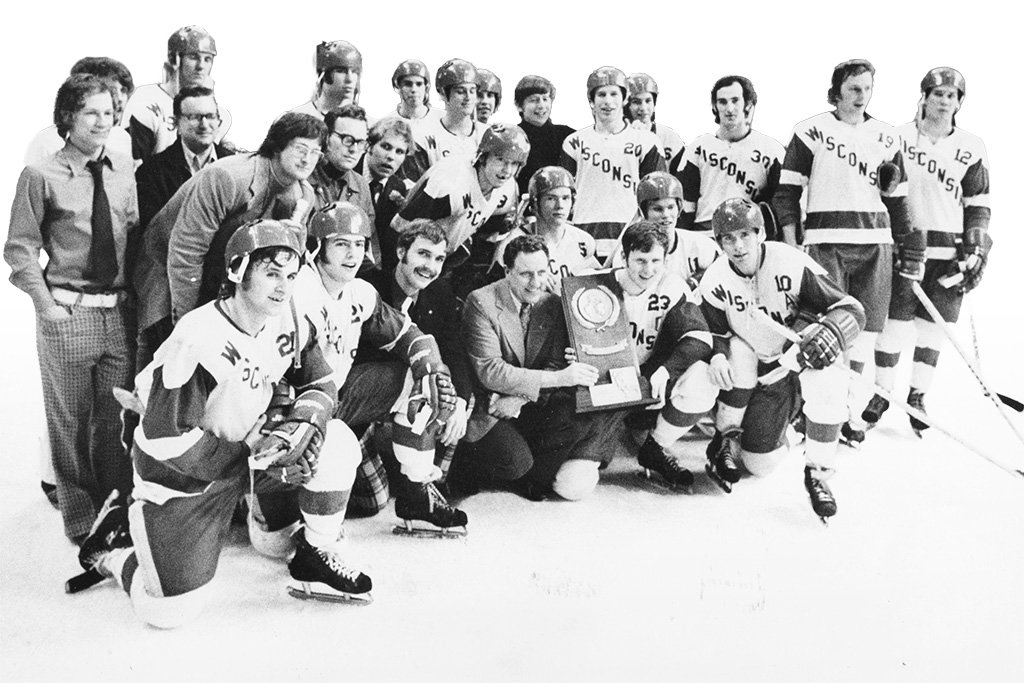
The men’s hockey team was dubbed “a squad named desire.” UW Archives
“We just kept coming,” says Steve Alley ’77, MBA’82, a freshman forward whose final shot ricocheted to Talafous for the win. “[The Garden] didn’t clean the ice before overtime, so we were playing on rough ice, and it was a perfect rebound.”
“I’ve seen comebacks,” Coach Johnson said after the game, “but try and match that. What a combination of guts and drive.”
The Boston Globe praised the scrappy upstart Badgers as “a squad named desire,” and they showed it again in the title game against five-time champs Denver. (One sign in the crowd, riffing on a Boston sports joke: “Jesus saves, but Talafous scores on the rebound.”)
The championship game couldn’t quite match the theatrics of the previous night. But the Badgers carried over the momentum into a convincing all-around performance, downing top-ranked Denver 4–2. UW goalie Jim Makey ’78 blocked 32 shots, while Talafous delivered the go-ahead goal again with a backhander by the net.
“He was in the right spot at the right time, twice,” says Alley, who would go on to lead the UW’s 1977 team, arguably the greatest in college hockey history, to a second NCAA title with a dramatic game-winner of his own.
Long-suffering Badger fans — who traveled by the thousands and never quieted, even with their team down 4–0 — celebrated long into the night in the streets of Boston.
It was, in Badger Bob’s famous phrase, a great day for hockey.
The Unquestioned Dynasty
Women’s hockey — March 23, 2025
“Who wants it?”
It’s a phrase that will go down in Badger sports history.
In 2025, the Badger women’s hockey team had found itself in a familiar place, the NCAA championship game, against a familiar foe, the Ohio State Buckeyes. Trailing nearly the entire contest, the UW was just awarded an improbable opportunity to tie the score with 18.9 seconds left. The Badgers had seemingly failed to capitalize on a desperate flurry of power-play shots, but Coach Mark Johnson ’94 called for a challenge. The review exposed an Ohio State infraction for covering the puck. The Badgers were getting a penalty shot — a clean, one-on-one attempt at the goal.
And then Johnson asked the question, captured on national TV: “Who wants it?”
For a championship-defining decision, this was a remarkable show of faith and act of delegation. But who could argue with the tactics of the winningest coach in NCAA women’s hockey history?
Johnson could have easily picked from his three Patty Kazmaier Award finalists for the penalty shot. And, yes, the best players in the country that season were all Badgers. Casey O’Brien ’24, MS’25, who claimed the award in the end, led the country in points and assists while breaking school records. Laila Edwards ’26 led the NCAA in goals and had just scored a hat trick against Minnesota in the semifinal. Caroline Harvey ’26 posted the most points of any defender in the nation and in school history.
But the players unanimously selected junior forward Kirsten Simms x’27 for the equalizer attempt. She had earned her teammates’ trust as a shootout savant in practice and a clutch scorer in games, having tallied 17 game-winning goals to that point in her college career — including the clincher in the 2023 championship.
“Everybody on the bench was like, ‘Simms, you’re taking it!’ ” she said after the game. “And I was like, ‘Fine, I’ll do it.’ But I was so nervous. I couldn’t think while I was going, just had to try to be confident with it.”
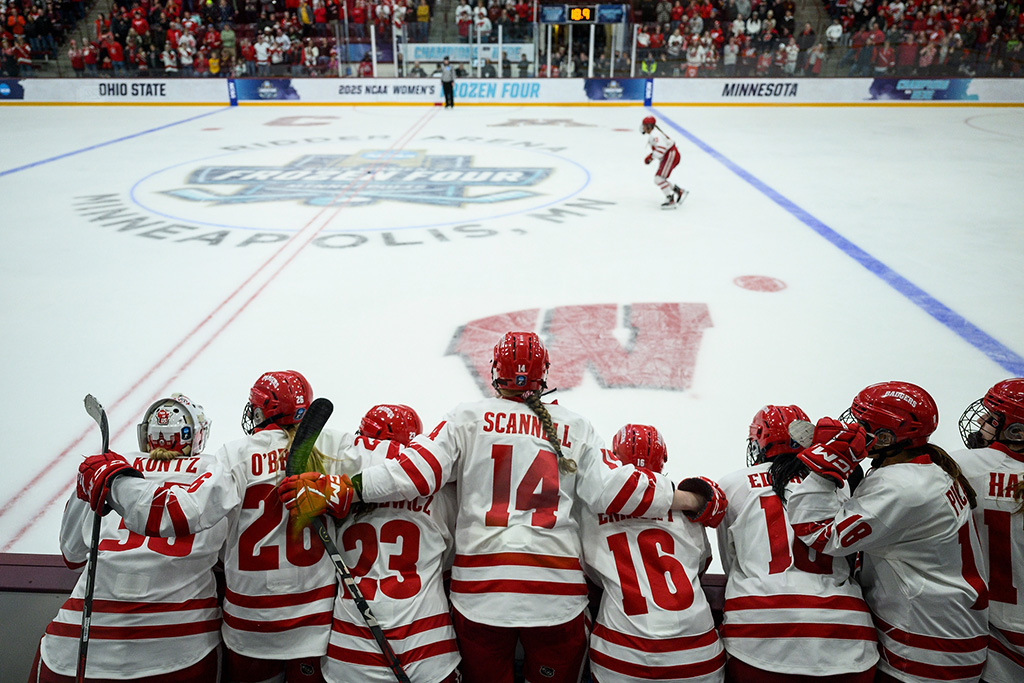
Women’s hockey teammates watch Simms take her dramatic penalty shot. Althea Dotzour
So Simms took to the ice, all eyes fixed on her. She dribbled the puck down the length of the rink and then deked the Ohio State goalie nearly out of her skates, flicking the puck into the net and tying the game 3–3.
Three minutes into overtime, Simms played the hero again. She contorted her body and stick to catch the puck on a ricochet and slap it into the net. Goal!
The Badgers had won their eighth national championship, the most of any program in the country (followed by their ninth this year). Even sweeter that it happened at Ridder Arena in Minnesota, home of the archrival Gophers.
Harvey, who scored in the second period to close the deficit to 3–2, confidently predicted the unlikely turn of events in a sideline interview before the final period.
“We’re definitely a third-period team,” she said. “We have the comeback in us.”
And so they did. The championship marked the 38th win of the season, making this special squad — with just one loss and two ties on the season — the winningest in school history. And it solidified the UW’s claim as the most dominant dynasty in women’s college hockey. No questions asked.
Preston Schmitt ’14 is a senior staff writer for On Wisconsin.
Published in the Summer 2026 issue

Comments
No comments posted yet.