UW Professor Chosen as Nobel Laureate
Francis Halzen was honored for his groundbreaking work on neutrinos.
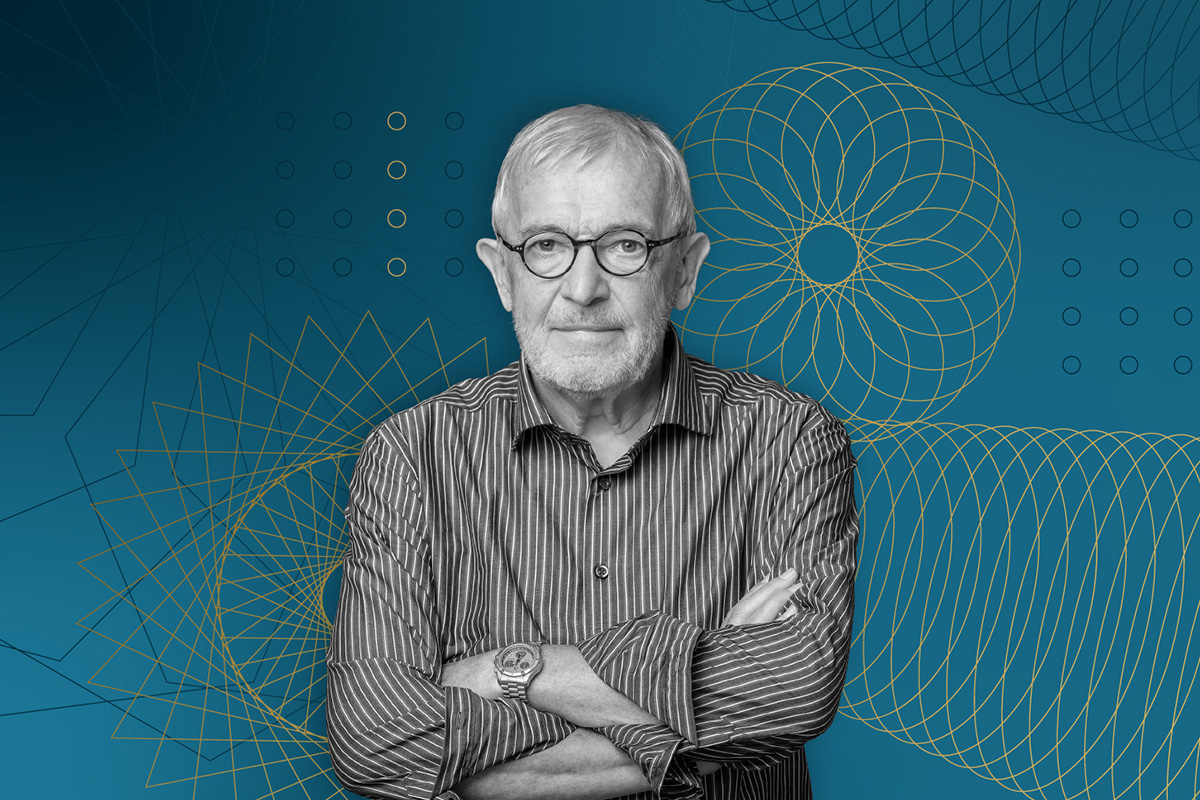
Halzen: "It is difficult to imagine that we could have pulled this off anywhere but at UW–Madison, with its unique research infrastructure." Althea Dotzour
On October 6, UW–Madison professor Francis Halzen was named the recipient of the Nobel Prize in physics at the Royal Swedish Academy of Sciences in Stockholm, Sweden. The prize was conferred for Halzen’s contributions to our understanding of the astrophysical particles known as neutrinos.
“This is a celebration of a very unusual project,” says Halzen. “It is difficult to imagine that we could have pulled this off anywhere but at UW–Madison, with its unique research infrastructure. The success of this project involved some luck, and I was fortunate to be at UW, where unconventional ideas can thrive and where I had the support of a remarkable community, from talented engineers at the Physical Sciences Laboratory to longtime colleagues on the faculty and supportive administrators.”
Halzen is the principal investigator of the NSF IceCube Neutrino Observatory, the world’s largest — and perhaps strangest — telescope. The U.S. National Science Foundation–funded observatory is operated by an international collaboration of scientists led by the Wisconsin IceCube Particle Astrophysics Center based at UW–Madison.
Embedded in a cubic kilometer of Antarctic ice, IceCube uses thousands of light sensors to survey the universe for neutrinos, nearly massless particles that rarely interact with other matter. Neutrinos provide information about the workings of black holes, galaxies, and other objects in the cosmos.
Along with observations by other telescopes, the neutrino first detected by IceCube provided the earliest evidence of a source of high-energy cosmic rays, whose origins have been notoriously difficult to pinpoint since their discovery more than 100 years ago.
In 2013, IceCube announced the first detection of high-energy neutrinos from outside the solar system. The discovery won the 2013 Physics World Breakthrough of the Year Award.
Four years later, IceCube detected a high-energy neutrino from a supermassive black hole at the center of a distant galaxy in the direction of the constellation Orion. Since then, it has provided the first evidence of high-energy neutrino emission from an active galaxy 47 million light-years away, and also from the Milky Way.
This is the 23rd Nobel Prize tied to UW–Madison, in a legacy that spans medicine, chemistry, economics, engineering, and physics.
Published in the Winter 2026 issue


Comments
No comments posted yet.