
The Two Owens
The death of a six-year-old inspired a UW researcher to investigate a rare brain cancer.
Fair warning: this is not a happy story.
If you keep reading, you’ll learn about a young boy’s death, a rare and incurable disease, tortuous bureaucracy, and political interference. This is a story about grief and frustration and anger.
But if this isn’t a happy story, neither is it a hopeless story. The boy’s mother is tenacious, her friends are resourceful, and at the UW, there are clever and determined scientists working to see that it all leads, eventually, to something meaningful.
This is a story about smart people and tragedy, about a cancer called diffuse intrinsic pontine glioma, or DIPG, and how science slowly works to help us understand things that terrify us so that we can confront them. And it’s about what America risks when its government impedes research.
This is the story of Owen Petrzelka and Owen Tamplin.
The First Owen
In March 2020, Owen Petrzelka was doing what just about all five-year-olds did that month, when COVID-19 shut down schools and workplaces: he was driving his parents to distraction. Owen was jumping up and down on the furniture in his family’s home in Oak Park, Illinois. He was obsessed with ninjas, and in Owen’s understanding, ninjas never touch the floor. He was bouncing and yelling, and then there was a crash.

Something meaningful had to come from Owen's death, his mother says, "or else the universe is just too awful."
“He was jumping from couch to couch and then hit his head on a table,” says Owen’s mother, Amanda Shaker ’04. Owen was dizzy, which was no surprise. Shaker’s husband, Adam Petrzelka, took Owen to urgent care, where a doctor looked at the bump on his head and then sent him home, saying he’d be fine.
But over the following weeks, Owen wasn’t fine. “He was acting a little bit weird,” Shaker says. “He started crawling up the stairs, and we thought he was just being silly. But then he started running into walls.”
Owen’s parents set up a virtual checkup, and his doctor suggested an MRI — not an easy thing to get in spring 2020, with hospitals concerned about the spread of COVID. He’d have to wait until August.
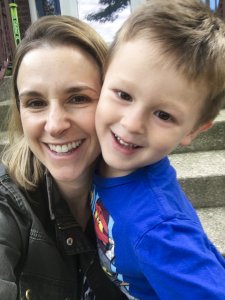
Owen’s first day of kindergarten.
On Easter Sunday, April 12, Owen got on his scooter and traveled two blocks from his parents’ house to his grandparents’. The following Tuesday, he couldn’t stand up. Shaker called Lurie Children’s Hospital and got him in for an MRI right away. The pediatric neurologist suspected Owen had the after-effects of a concussion or at worst, a blood clot from his fall.
The MRI revealed something much worse: Owen wasn’t struggling because he’d fallen in March. He’d fallen in March because he had a brain tumor.
“The neurologist told me to call my husband and have him come, which was breaking the COVID rules,” Shaker says. “And then he told me it was DIPG, which is just about the worst diagnosis you can get.”
Every word abbreviated in DIPG is scary. Glioma means a cancer of the brain or central nervous system. Pontine means that the cancer is centered in the pons, the brainstem. Intrinsic indicates the cancer originated within the brainstem, where surgery would be extremely dangerous, and diffuse means that it doesn’t have a well-defined tumor that could be removed even if you decided to risk surgery.
“DIPG is a very aggressive brain cancer,” says Raheel Ahmed, a pediatric neurosurgeon at American Family Children’s Hospital. “And unfortunately, it’s uniformly fatal. The outcome for treatment is dismal.”
Uniformly fatal: the only treatment for DIPG is radiation, and it merely delays the inevitable. Almost all DIPG patients are dead within nine to 15 months of diagnosis. Dismal: the median age of DIPG patients is between six and seven years old.
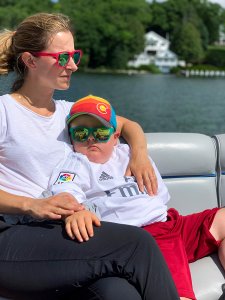
Doctors prescribed steroids for Owen, which caused his weight to double. Shaker and her husband, Adam, did their best to make memories during Owen’s final months.
Owen’s case was atypical in that his disease arrived earlier and proceeded more rapidly. Nothing seemed to help. He went through 30 rounds of radiation, and then doctors tried six rounds of chemo, but his symptoms persisted. “Every time he had an MRI,” says Shaker, “we could see that his tumors were shrinking. It was all medically working, but DIPG is diffuse, meaning it spreads throughout the brain, and it intermixes with healthy tissue. The cancer was still affecting him.”
Doctors prescribed steroids, but Owen didn’t improve. Still, the steroids had an effect — they made him so hungry that his weight doubled from 48 to 96 pounds.
“He was just ravenous,” says Shaker. “He would wake up in the middle of the night screaming for food. It was really, really terrible.”
Owen’s doctors told Shaker that all she could do was to try to make memories. But COVID had shut everything down. “Museums are closed, parks are closed,” says Shaker. “Where am I supposed to make memories?”
Owen’s family rented beach houses in Michigan and in Wisconsin where he could look at the water. Friends and cousins came to visit and play Nintendo. And in October 2020, five and a half months after his diagnosis, Owen Petrzelka died.
But that was not the end of Owen’s story. Shaker refused to let it end there. “Something meaningful has to come out of this,” she says, “or else the universe is just too awful.”
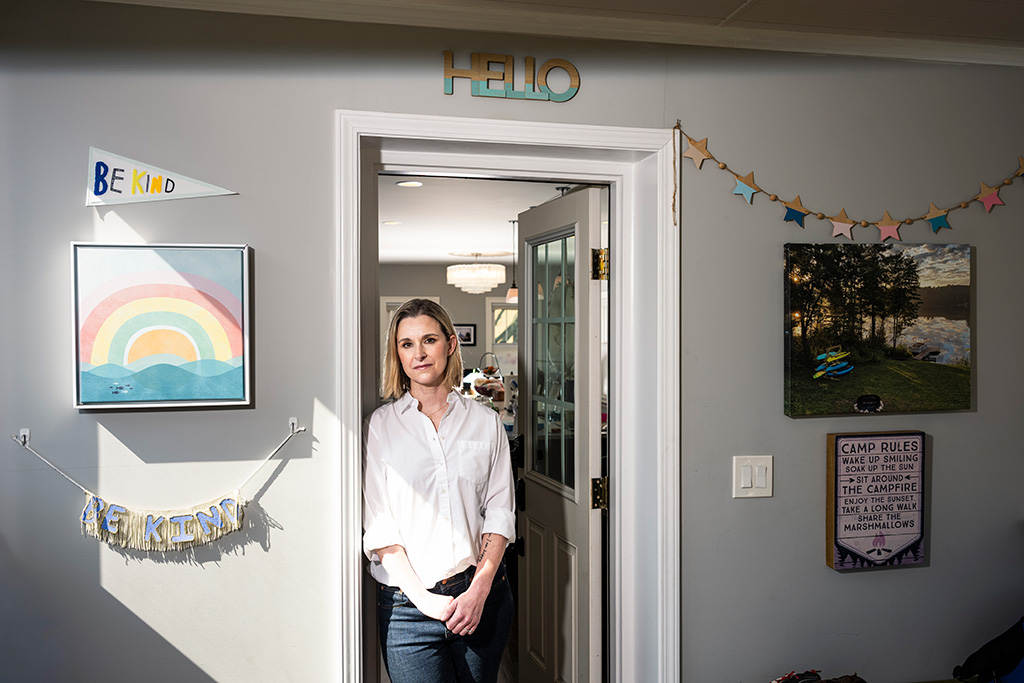
After Owen’s death, Shaker began working to raise awareness of DIPG and support for research.
The Second Owen
Shaker had studied journalism at UW–Madison, and she works in public relations. She knows how to get attention, how to network, and how to mobilize. So she went to work.
She connected with the ChadTough Defeat DIPG Foundation, a Michigan-based organization. She organized an annual five-kilometer race, the Run Tough for Team Owen, to raise money in her neighborhood. All this caught the attention of Owen Tamplin, a former Oak Park resident who had just moved to Madison to take a position on the UW faculty.
When Tamplin lived in Illinois, his daughter was a preschool classmate of Owen’s. He knew Shaker a little, and he felt inspired by her determination. He believed he could make something meaningful come from Owen’s death.
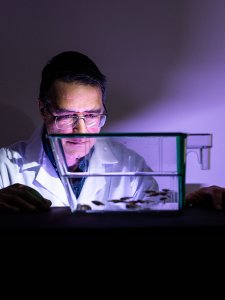
Tamplin’s lab is working to make zebra fish a model for DIPG studies.
Tamplin has a research lab at UW–Madison, which means that he not only manages a lab, but he also manages grant applications, and he manages frustration.
Tamplin is not a physician — he studies cell and regenerative biology. Prior to March 2020, he’d been working at the University of Illinois–Chicago, but an opportunity to conduct research at one of the world’s leading stem-cell institutions drew him north.
“I hadn’t worked in cancers before,” Tamplin says. “I’m not a doctor. I’m not a neurobiologist. I’d never heard of DIPG before.”
Tamplin’s research to this point had studied blood stem cells using zebra fish as a model organism. But in former positions, he knew people who’d used zebra fish as a model organism to study melanoma, and he thought maybe he could do the same thing for DIPG. So when he began assembling a lab at UW–Madison, he did so with DIPG in mind.
“His lab is just amazing,” says Shaker. “It’s really incredible, the work his team is doing. It’s very cool.”
To be clear: the Tamplin lab is not curing DIPG, or even investigating a treatment. But its work could be instrumental to those who will eventually investigate treatments and cures.
DIPG is not only uniformly fatal, it’s also rare. Between 150 and 300 cases are discovered in the United States in a year, according to the DIPG Resource Network, meaning that it occurs in less than one in a million people. Scientists who want to investigate DIPG have very few patients to look at. That most of those patients are young children, and most are dead in less than a year, only makes it harder for anyone to conduct studies.
“The first thing that everyone talked about was, especially in the States, people have had grants frozen. It creates uncertainty.”
Tamplin’s cool idea is to use zebra fish as living models for DIPG researchers to work with. Using human oncogene DNA, he and his team induce brain tumors in embryonic zebra fish. They can then observe the development of tumors because a fertilized zebra fish egg is transparent, and the animal will remain transparent through its juvenile stage.
“In order to better understand DIPG,” says Ahmed, “we need access to tissue. The genetic changes that [Tamplin] can produce in the zebra fish are similar to some of the genetic and molecular changes that we see in human patients who have DIPG.”
A model like this might show how the cancer develops, opening the possibility of a test to discover it early. It might help researchers discover why DIPG develops in some people and not in others — do the disease’s victims, for instance, have tumor-suppressing genes that fail to activate?
So Tamplin collected all the pieces he needed to study zebra fish as a DIPG model. He had a facility in the UW’s Wisconsin Institutes for Medical Research. He added Ahmed as a consultant to give expertise on neurosurgery and oncology, and he hired undergraduate and graduate assistants to help with the work. He connected with leading researchers at other universities to join forces as co-principal investigators, including Bruce Appel at Children’s Hospital Colorado Anschutz Medical Campus, Carl Koschmann at University of Michigan Health, Claudia Kleinman at McGill University in Montreal, and Richard White at Britain’s University of Oxford. He began seeking grants to fund the effort.
And, in 2025, his frustrations began to grow.
Grants
The new administration under President Donald Trump began to raise concerns about funding that U.S. researchers shared with foreign faculty. A policy announced on May 1, 2025, stated that the National Institutes of Health (NIH) “will not issue awards to domestic or foreign entities (new, renewal or non-competing continuation), that include a subaward to a foreign entity. Additionally, NIH will no longer accept prior approval requests to add a new foreign component or subaward to an ongoing project.”
White at Oxford and Kleinman at McGill might be among the best researchers in the world, but from a federal grant standpoint, they were now problematic.
“The program officer from NIH contacted us and said, no more,” says Tamplin. “The NIH is not going to give any more foreign subawards. No more NIH money will leave the U.S. If you don’t remove the foreign subawards, the group in Canada, they’re going to pull the whole thing.”
The NIH policy was modified in July and again in September, keeping Tamplin in a state of confusion about how or whether his research would be funded. His experience is hardly unusual. Last year, he went to a meeting of the American Society of Hematology in Orlando, Florida — a gathering of 30,000 researchers, clinicians, and pharmaceutical companies — and the chief topic of conversation was the set of new barriers that the NIH had created for grant applications.
“The first thing that everyone talked about was, especially in the States, people have had grants frozen. It creates uncertainty, and that’s one of the biggest challenges we face. It makes it very difficult to plan, to recruit people. When we start an animal study, we have to think about being able to maintain the animals for years.”
Maintain: there are about a dozen researchers on campus who work with zebra fish, and the university has nearly 10,000 adult fish. To supply specimens to those several labs, the UW has to make sure that its more than 500 fish tanks are cleaned, its fish fed, the dead animals removed.
Tamplin’s team is chiefly interested in spawning zebra fish embryos in which to inject human oncogenes. The work requires speed: within 45 minutes of fertilization, those egg cells will begin to divide, and because Tamplin’s team is doing genetic work, they need to intercept the eggs before division. Within 10 minutes of fertilization, they begin injecting each egg with bits of human DNA that will, they believe, create the sort of glial cells that develop DIPG.
Zebra fish are not only transparent in their early stages; they also develop rapidly for vertebrate animals. What would take a few days in mice, or a few weeks in a human embryo, happens in hours for zebra fish. Tamplin’s lab might inject 500 eggs in a morning, and by the next day, those fish have developed into a juvenile stage, “with a little head and spinal cord and a nervous system that’s already patterned,” according to Tamplin.
In addition to paying for its share of the UW’s fish-breeding tanks, Tamplin’s lab requires a considerable amount of equipment: computers, refrigerators, microscopes, petri dishes, needles, cleaning equipment, and more. All of this is expensive, and to ensure that his lab can pay its way, Tamplin has sought not just federal grants but also private dollars. A foundation called Alex’s Lemonade Stand, which supports childhood cancer research, has helped with funding.
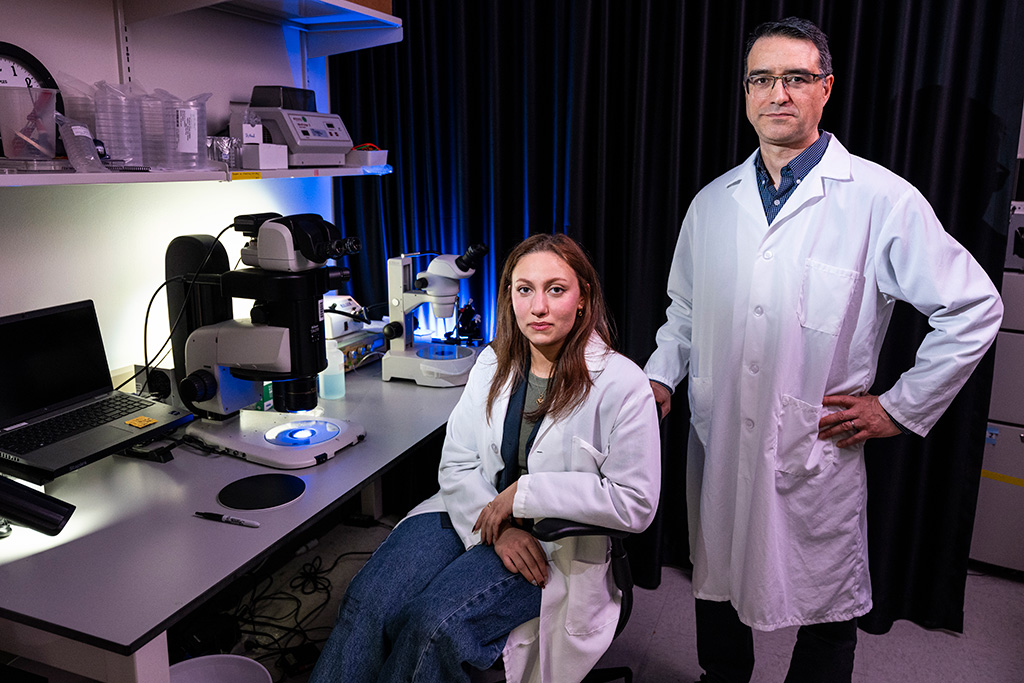
Owen Petrzelka’s death inspired Owen Tamplin to focus his lab’s work on DIPG. Alice Alhaj Kadour is one of his students.
But no private organization can match the amount of money that the federal government has provided, nor do private entities give the sort of nonfinancial support that NIH traditionally has offered. Because NIH employs thousands of top scientists, its staff can help researchers understand what kind of work is being done in their field of study. They can help researchers refine their goals so that they’ll have a better chance of earning a grant and a better chance of conducting valuable research.
“What we’re told to do is, if you see an announcement for a grant or funding opportunity, contact the program officer,” says Tamplin. “Contact the person who works in the NIH who administers those grants and get them on the phone, talk to them, email them, try to understand if your grant application fits into their priority. You want to make sure you have a high chance of being funded. Being new to the field, I reached out to this program officer, and she was fantastic. I sent her some preliminary documents, and she was very enthusiastic. Sent me tons of feedback. She was excellent.”
But changes in the last year have not only reduced the amount of money federal science agencies have. They have also eroded expertise. Prior to 2025, the NIH grant system was hardly simple, but it was relatively clear. Decisions about funding were made by panels of scientists, both bench and clinical. But a presidential order announced in August 2025 expanded the NIH’s grant panels to include a senior political appointee. The appointee’s decision can override the scientists “to ensure [the grants] are consistent with agency priorities and the national interest.”
Political interference, as well as conflict between the Trump administration and the NIH, has led many NIH staffers to leave. In 2025, the heads of 13 of NIH’s 27 centers and institutes left, resulting in a loss of almost half its senior leadership. More than 1,100 other employees have left or been laid off, about triple the number from the previous year. In March 2025, Tamplin’s program officer announced she was retiring early, citing challenges with the Trump administration’s directives.
Still, Tamplin persists in his efforts. He’s adjusted his applications to keep most of his grants alive. And he’s been willing to talk about the obstacles he’s faced and their effects on his research, believing that people will see its importance.
“I’m a biologist and not a clinician,” he says, “but basic biology and clinical, translational research can converge. And most people can probably get behind pediatric cancer research.”
Alice
While Tamplin scrambles to maintain funding for his lab so that he can add a little more to our understanding of DIPG, the cancer continues killing several hundred children in America every year, as well as hundreds more around the globe. That would be frustrating enough. But the current federal funding restrictions go beyond a single lab and a single line of research. They have an effect, for example, on people like Alice Alhaj Kadour ’23, PhDx’27.
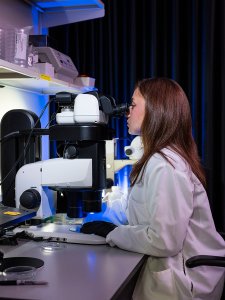
Alhaj Kadour sits at the microscope station, where members of the lab examine fish embryos.
Alhaj Kadour is one of four graduate students who work in Tamplin’s lab, along with five undergraduates and a research intern. On mornings when she’s at the lab, Alhaj Kadour can be found crouched over a bench, eyes on a microscope, glass capillary needle in hand, lining up hundreds of fish embryos, injecting them with fatal illness. It is not, she admits, the most exciting task, but she loves it.
Injecting may be tedious, but being part of Tamplin’s studies could be a boost to Alhaj Kadour’s career. She has already presented at conferences, including an International Zebrafish Society gathering that took place on campus. At the UW’s Stem Cell and Regenerative Medicine Center conference, she took third place for best poster. She’s also presented in Boston, and her name will show up on the papers that the lab submits for publication.
For someone at the outset of an academic career, Alhaj Kadour is building a good résumé. But her work’s purpose is also important to her. She came to the UW to study medicine so that she could treat cancer patients — her grandfather died of cancer. She left medicine for the lab because the more she studied, the more she felt she could have a bigger impact if she focused on research instead of clinical care.
“I was working as a [certified nursing assistant] from high school to try and get some experience in the medical field,” she says. “I really liked being there and taking care of people, but I wanted to do more. There were so many times when all we could do was just make people comfortable, and I wanted to be behind the scenes trying to find ways to help these people, even if it’s a few generations later.”
“The U.S. can be a very charged environment. Even though there’s a lot of money for research here, a lot of times your personal life gets affected and you’re put under a lot of stress, and I’ve seen what stress can do to people. I just don’t want that for my life.”
Alhaj Kadour is like many of the bright minds that the UW tries to attract. She grew up in Wisconsin and initially wanted to study close to home, at UW–Oshkosh, but moved to Madison because it offered greater academic opportunity and challenge. UW–Madison gave her research opportunities when she was an undergrad, and now she’s part of an international network of scientists trying to explore previously unimagined ideas to address a previously unsolvable problem.
So far, she hasn’t been much involved in Tamplin’s back-and-forth with the NIH. “I hear about it, and the research can get affected by it, but mostly that’s just Owen’s thing,” she says. “We’ve been very lucky so far. Owen’s good at getting funding in these difficult times. He says, ‘You guys don’t need to worry about this. I’ll worry about this.’ But it’s been affecting him a lot.”
Although Alhaj Kadour hasn’t yet had to deal directly with the NIH’s new funding challenges, she will eventually, as she advances toward her PhD. And even now they’re affecting her. She may be several years away from completing her degree, but she’s already thinking about where her career will take her. And her initial hope is that it will take her out of the United States.
“I would like to do a postdoc in Canada or Europe,” she says. “As we’ve seen recently, the U.S. can be a very charged environment. Even though there’s a lot of money for research here, a lot of times your personal life gets affected and you’re put under a lot of stress, and I’ve seen what stress can do to people. I just don’t want that for my life.”
Stress: the funding issues Tamplin faces reflect an American political environment that is increasingly isolationist. Alhaj Kadour was born in Syria. Tamplin was born in Canada. Ahmed came to the UW from Pakistan. Like many universities, UW–Madison takes pride in its ability to attract the world’s best brains and get them to work together. The American research enterprise leads the world not only due to its superior funding but also because so many top scientists come here.
“NIH is the biggest cancer-funding body in the world,” says Tamplin. “Or it was. And I come from Canada, and there’s great research in Canada, but everyone comes to the States because of this critical mass [of science talent].”
People like Alhaj Kadour are the future of that enterprise. Now she’s thinking of leaving for better conditions elsewhere. If enough young scientists like her decide that America isn’t a welcoming place, it would erode the U.S. dominance in science, and it would diminish America’s ability to solve problems like DIPG.
“The salaries are usually better in the U.S. overall than in Europe and Canada,” says Tamplin, “[but] I think people look at the States and wonder if the great opportunities here will continue. Researchers from other countries still talk about how opportunities in their home countries are limited. That said, I think we are going to lose talent from the U.S. because of the political environment.”
The story of the two Owens isn’t a happy one, but it needn’t be a hopeless one. Hope is a choice — the one Tamplin, Alhaj Kadour, Ahmed, and their colleagues make as they try to bring something meaningful from Owen Petrzelka’s death. Because turning away from that work means accepting that the universe is just too awful.
John Allen is associate publisher of On Wisconsin
Published in the Summer 2026 issue
Comments
Heather Gentile Collins June 2, 2026
Hello. I am the artist who created the art on this cover for a client which was given to Owen’s family. A friend recognized my work and sent this article to me. It means a great deal to me that the memorial art has meant something to you. Beautifully brave story. You are all in my prayers.
Anthony R Shaker June 2, 2026
Owen 1 is my grandson. Your artistry perfectly sets the stage for not only this perfectly explained article on the deadliness of this terrible disease but also outlines the suffocating political obstacles created by the political powers around us. One would think humans can put aside their political differences to save the holy innocents. We can only hope and pray Owen 2 and his lab partners procure the help they need to save the lives of these braves loving children.
Krystal Palmer June 2, 2026
Thank you for sharing this story and thank you to all the relentless researchers working tirelessly to find a treatment for DIPG. We can only hope the NIH continues to fund this important work.
Bucky4019 June 10, 2026
The is a tragedy. Exactly how much($) funding was blocked from going overseas? How much funding were they able to raise through private sources. I would think the facts would be important here.
Let’s see all sides if the equation rather than just the platitudes
Kman June 30, 2026
To Owen’s family: very sorry to hear of the loss and heartbreak it caused, especially how it happened during COVID.
To John Allen: Is this a political opinion article or DIPG awareness article? It appears it is the former, since, according to my vertical scroll bar less than half is describing Owen’s story and what DIPG is, with the remaining more than half being orange man bad.
Julie July 5, 2026
https://onedaymd.substack.com/p/ivermectin-and-fenbendazole-for-brain-cancer
The combination of ivermectin and fenbendazole is doing amazing things for sufferers of brain cancer.
Maybe it’s time to take the politics out of medicine, and initiate the use of scorned upon medicines. I’m as left as can be, and RFKjr is a nut job. But don’t discount the power of repurposed medicines, especially these, for cancers.