Studying Kids in the Wild
The Child Development Lab offers a rare chance to observe young students in a real-life setting.
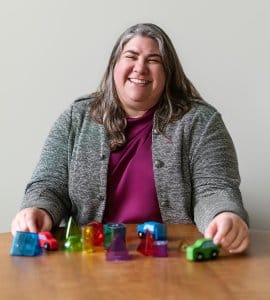
Faculty Director Heather Kirkorian helps advance the field of child development. Althea Dotzour
UW–Madison founded the Child Development Lab to teach parenting skills to young mothers. Over the past century, it’s become an innovative center for researching early childhood — with real-life children on hand for observation. In one capacity, the lab serves as a childcare center with high-quality programming for dozens of kids through age five. In another, it’s a place where students and faculty can involve children in creative studies that advance the field of child development.
The School of Human Ecology will celebrate the Child Development Lab’s centennial with a research symposium, community events, and an exhibition. Faculty Director Heather Kirkorian, the Laura M. Secord Chair in Early Childhood Development, has conducted influential studies at the lab with the adorable cohort she calls “the kiddos.”
What’s the value of the Child Development Lab?
The first five years of childhood are foundational for all of us. So understanding kids — how to be responsive to them, how to support their learning and emotional well-being — benefits all of us. Being able to do that in real time, with direct observation of kiddos, is especially important.
How does the Child Development Lab benefit UW students?
Seeing a wide range of children in the wild and building relationships with them is just transformative for our students. That kind of deep, hands-on training is hugely impactful for those who will be working with children one day, such as pediatricians, childcare providers, and educators. It’s something we wouldn’t be able to do without having a resource like the Child Development Lab on campus.
What are some examples of the lab’s research?
The questions we’re asking have evolved to address changing times. Right now, for example, I study how videos, apps, and other kinds of technology impact child development. One of our grad students did his dissertation on kids with an autism spectrum disorder to test the impact of room design and lighting on how children do different kinds of tasks.
What’s the space like?
We have a state-of-the-art facility in Nancy Nicholas Hall, with embedded audiovisual systems so we can record the classrooms. There’s also an attached research lab so kiddos can be pulled out by research groups. Most of our classrooms have observation booths with one-way mirrors and headsets so UW students can observe infants during naptime, toddlers during playtime, or structured reading time.
How do parents feel about such an environment?
Parents know this is a place where students are coming in the classroom and working directly with kids. We do this in ways that are respectful to everyone involved. A lot of the families are invested in the university’s mission of research, teaching, and outreach, and they see it as a plus.
How do the kids benefit?
In my department, Human Development and Family Studies, we think a lot about the relationships children have at home and in the childcare center. And we collaborate with teachers to train our learning community in good science and practice around early relationships. “Early relational health” is one of the terms we use for having safe, stable, healthy relationships, which is important in predicting all types of long-term outcomes.
What kind of impact does your research have?
Our studies have been cited by the American Academy of Pediatrics in their screen-time guidance. I also consult with media creators on how to design media in ways that support kids, maximize benefits, and minimize harms. I’ve been an adviser to groups like Sesame Workshop and PBS Kids around the design of media for young kids and resources for families. And I’ve been a consultant to Common Sense Media, a nonprofit organization that writes tipsheets and reviews for parents so they can figure out what kids should and shouldn’t watch.
Published in the Fall 2026 issue

Comments
Nancy Harter-Alwin October 19, 2026
Good Morning! I enjoyed reading your article on Studying Kids in the Wild. I am currently working on a Civil Grand Jury team in San Diego, CA doing research on unhoused children and their challenges in education. I’m curious if a topic such as this has been considered in the Child Development Lab?