Playing with Fire — for a Purpose
UW researchers test the safety of hybrid vehicle batteries.
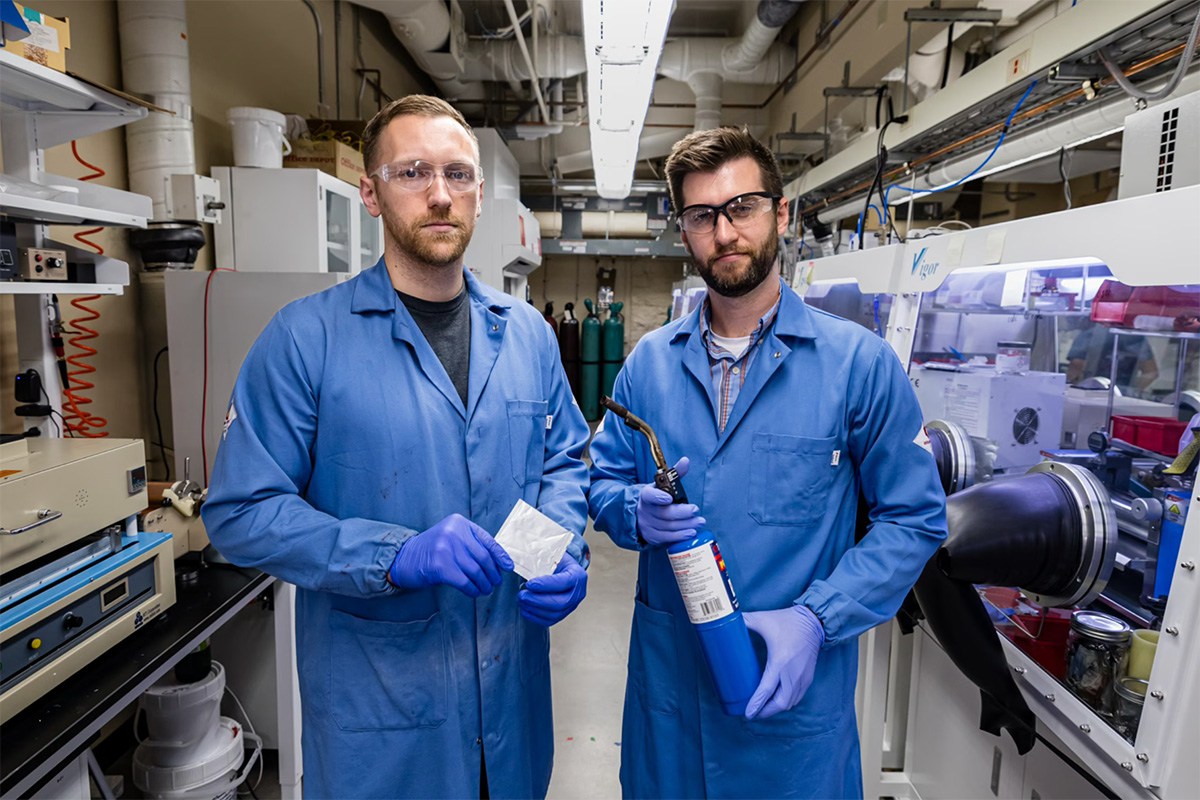
Kazyak (left) with Fakkema: “We showed that this type of solid-state battery will still burn, but it’s less likely to quickly result in a catastrophic event because of the slower flame propagation.” Joel Hallberg
Many hybrid vehicles use lithium-ion batteries, which can be flammable if a car gets in an accident. Some manufacturers are switching to solid-state batteries, so Eric Kazyak, a UW assistant professor of mechanical engineering, decided to test whether these next-generation power sources would be safer and less likely to catch on fire.
Solid-state batteries have a high energy density that could give electric vehicles much longer driving ranges. These batteries use a nonflammable, solid electrolyte instead of a flammable, volatile liquid electrolyte. The electrolyte is the material in a battery that allows ions to move between the positive and the negative ends to release power.
Jonathan Fakkema PhDx’28 manufactured a range of solid-state batteries made of different materials. Researchers then placed each battery directly inside a propane flame to see how long each one burned and how much heat it generated.
They found that batteries with a ceramic solid electrolyte burned significantly more slowly and generated heat at a lower rate than lithium-ion batteries under the same conditions.
“We showed that this type of solid-state battery will still burn, but it’s less likely to quickly result in a catastrophic event because of the slower flame propagation,” Kazyak says.
“That’s beneficial for safety because it allows for more time for people to get out of a vehicle in a worst-case scenario.”
Published in the Winter 2026 issue



Comments
No comments posted yet.