“Just Talk to Each Other”
At a time of intense polarization, a unique public policy course at UW–Madison encourages conversation and compromise.
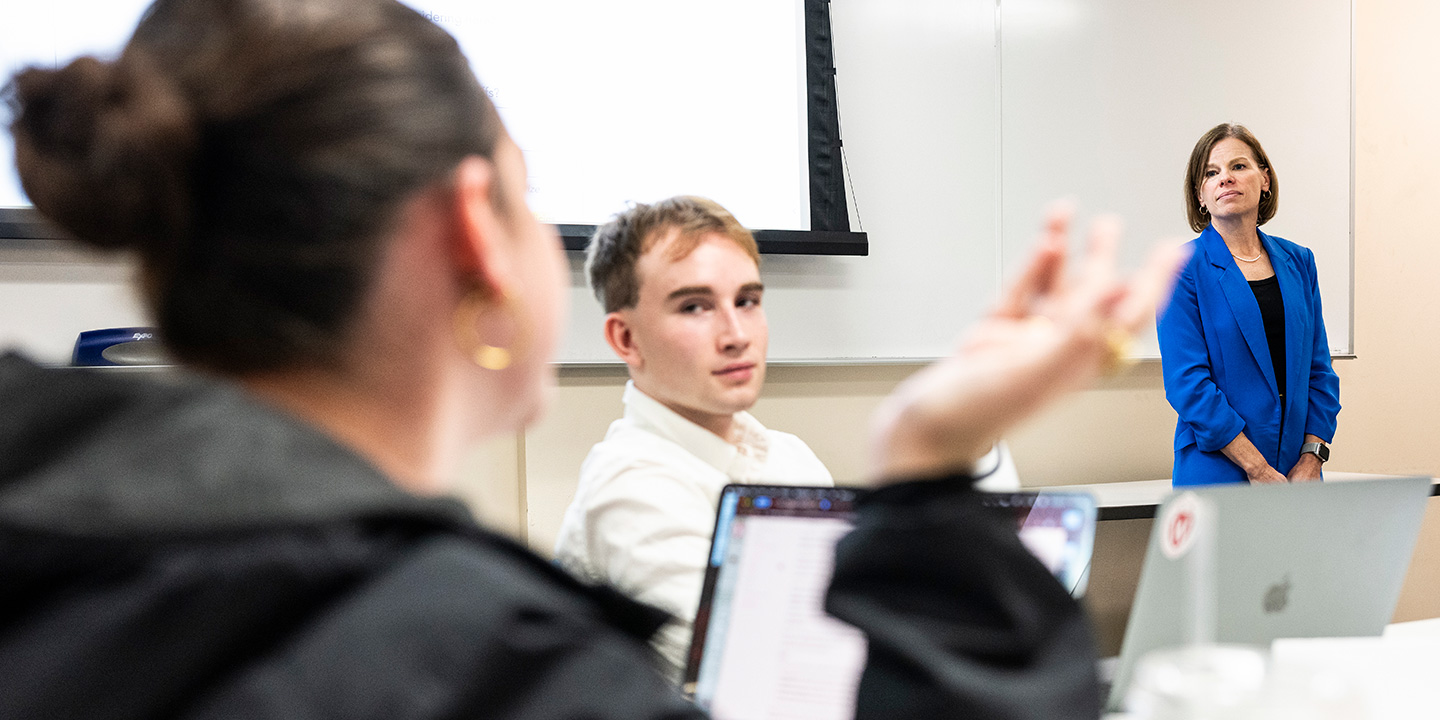
It’s immediately clear that this is an important day for the 30 students in public affairs professor Amber Wichowsky MA’06, PhD’10’s class. Most students sit in a ring of desks with a small group of their peers seated in the middle, ready to face off. To a newcomer, the students at the center of this makeshift arena look like they’re primed for a heated argument, with laptops open and notes at the ready.
But then, Wichowsky’s voice cuts through the tension. “Remember,” she says, “this is not a debate.”
Addressing polarization and the breakdown of civil discourse in America has been a focus for the UW’s La Follette School of Public Affairs. Advancing Public Policy in a Divided America is one of the only public policy classes in the country to directly address the political divide and is a foundational course for the school’s new undergraduate major. It’s also a key example of the work the university seeks to expand as part of the Wisconsin Exchange, an initiative to advance pluralism on campus.
“We have to understand where people are coming from,” Wichowsky says. “We’re not going to know that if we don’t try to get to know one another.”
That’s a big reason the course was designed around discussion rather than lectures. It’s also why students’ seats change every class, so they are regularly talking to different classmates and hearing different opinions.
“Students really embrace having good discussion in the classroom,” Wichowsky says. “It’s practicing the civic skills that we know our students will take throughout their time here at UW–Madison and then into their careers.”
“Facts from Both Sides”
Back in the classroom, the students aren’t preparing to prove their points or outwit their classmates. Instead, they launch into a respectful, structured conversation from different sides of a hot-button issue: the effect of artificial intelligence on the job market. After each side presents, the listeners reiterate what they heard from their peers.
“Okay, now that you’ve heard facts from both sides, you can drop your assigned point of view,” Wichowsky instructs the class. “Just talk to each other. What do you really think should be done?”
The exercise compels students to think through who and what is left out when a solution only considers one perspective. It’s a good way to start answering the question: How can America advance public policy when the country is so polarized?
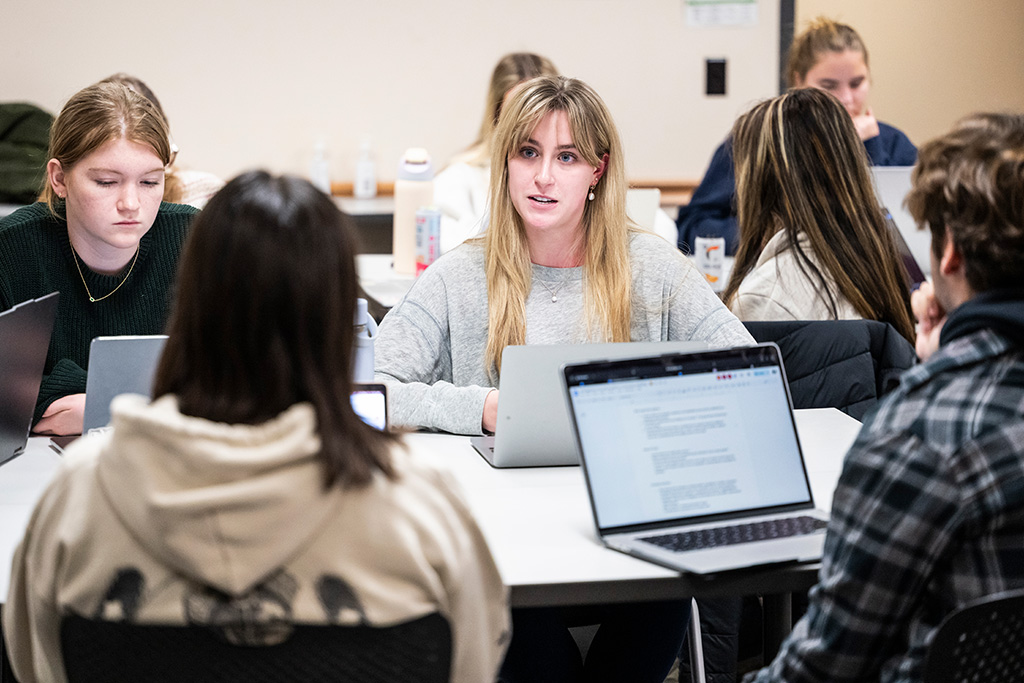
Students launch into a respectful, structured conversation from different sides of a hot-button issue.
As the semester begins, Wichowsky sets the scene of how polarization became so pervasive in American politics and society. Students then learn about the science and psychology of how we form opinions. Wichowsky explains that understanding how personal experiences inform opinions opens the door to understanding how those opinions may be able to change.
This idea prompted Bella Sciara ’26, a biochemistry major, to incorporate new skills into her own advocacy work beyond the classroom. As a childhood cancer survivor, Sciara has a personal interest in advocating for legislators to continue investing in cancer research. Rather than focusing on her own points in conversations, she hopes to invite others to reflect on their experiences, creating common ground they can build from together.
“It’s interesting to see how different people’s backgrounds and what they’ve experienced have influenced how they see the world,” Sciara says.
Students then learn to do nonpartisan research that acknowledges biases, makes evidence-supported arguments, engages counterarguments, and starts to acknowledge tradeoffs. That’s where the structured discussions come in.
“There are conservatives in class, liberals, centrists, and because it’s so discussion based, everyone’s bringing up their own point,” says Drew Stacey x’28, who’s majoring in history and educational policy. “You might propose an idea, and a classmate says, ‘That sounds great, but what about this?’ It might seem like gridlock, but I think that’s one of the great parts of democracy. We’re in a room talking to figure it out, and we have to compromise.”
“No One’s Judging Anyone”
Ishaan Srivastava x’28, a political science major, is used to having political conversations about controversial topics. In his home state of Illinois, Srivastava hosts a political news show where he interviews candidates from up and down the ballot in the hopes of spurring younger Americans to engage more with politics.
Still, walking into a room full of 29 strangers to discuss controversial topics was nerve-racking at first.
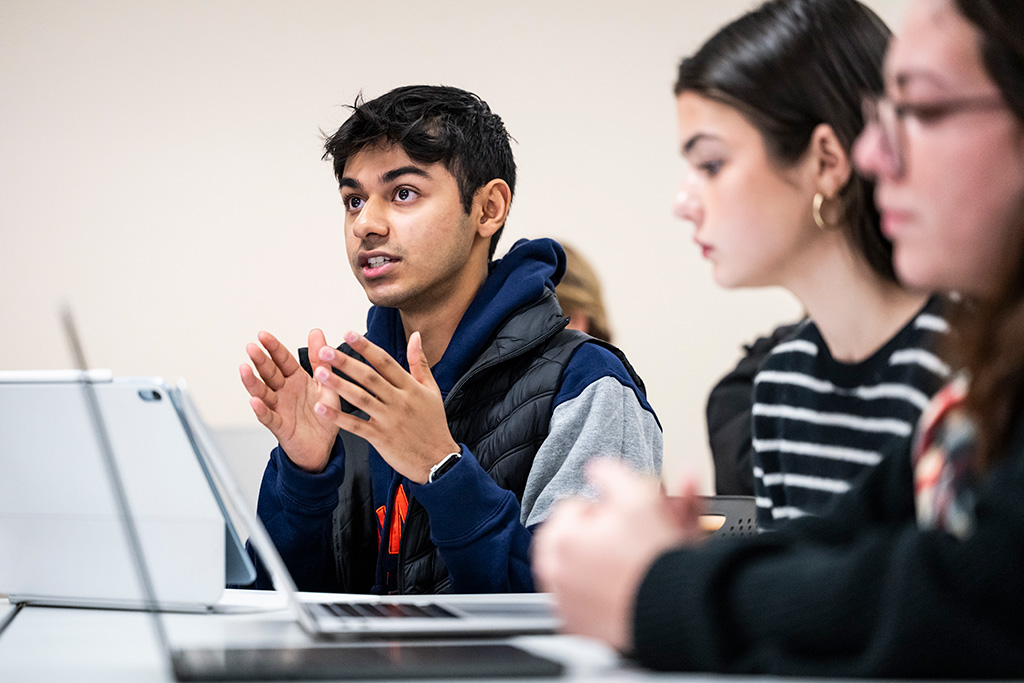
Seats change every class, so students are regularly talking to different people and hearing different opinions.
“From day one, Professor Wichowsky made sure that it’s a very safe, open environment,” Srivastava says. “We have lively discussions, but no one’s judging anyone for the opinions they have. Everyone is there to listen to each other and have those discussions and grow.”
Wichowsky has been pleasantly surprised by how eager students are to learn from one another.
“We are all coming from our individual perspectives and experiences,” she says. “But if we can share a little bit about that with one another, you find areas of common ground. We humanize each other.”
Elise Mahon is a communicator in UW–Madison’s Department of Biology.
Published in the Summer 2026 issue

Comments
No comments posted yet.