Elevating Women’s Science Fiction
Lisa Yaszek MA’92, PhD’99 shines a light on nontraditional writers in a male-dominated genre.
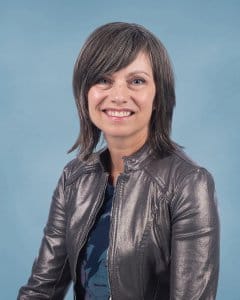
Yaszek says that women writers introduced new character types to science fiction, including the domestic engineer, the alien queen, the lady scientist, and the housewife heroines. Georgia Tech
Lisa Yaszek MA’92, PhD’99 can thank Lt. Uhura for her career. At age three, this future professor of science fiction studies at Georgia Tech saw Star Trek’s communications officer on TV. “That’s my first memory. She looked so cool,” Yaszek remembers. “She was the only smart one. She never volunteered to go down to a planet and get killed.”
Today Yaszek teaches classes like Women in Science Fiction, Fantasy, and Horror and Futurism, Fashion, and Science Fiction to engineering and design majors at the Atlanta university. “They understand that science fiction can operate as a reflecting mirror to science and society as well as a fun-house mirror that lets us rethink the most wicked but also exciting scientific and social problems of our day,” she says.
Recovering women’s science fiction has long been the central focus of Yaszek’s research. Contrary to popular belief, women have always been part of the sci-fi community. From the late 19th century on, women made up about 15 percent of science fiction authors, editors, and writers who often worked under pen names such as Andre Norton. More than 200 women published sci-fi stories between 1920 and 1970, Yaszek says.
“They wrote on many of the same topics as men but also introduced new character types — the domestic engineer, the alien queen, the lady scientist, the housewife heroines — and expanded the field’s imaginative scope. They reminded us that most people encounter the future not in laboratories and launchpads but in laundry rooms and libraries, and they explored how science and technology might reshape our understanding of gender.”
She adds that the central figure in many of their stories was the housewife heroine. “She wasn’t merely a supporting character but a technologically literate citizen who brought scientific thinking into the home while showing how domestic knowledge and emotional intelligence could shape better futures.”
Yaszek has done much to recover other lost voices. She’s a leader in Black science-fiction studies, especially Afrofuturism, which explores alternate realities through a Black lens. She and her students will soon publish a book about the first Black-authored space opera, which was written in 1930. (Space opera refers to fiction rather than a musical production.)
Her office is awash with video game imagery, neon, and a poster of the movie Blade Runner. Yaszek grew up in Detroit, which she says was “very much a Robocop experience in some ways,” referring to the sci-fi movie set in a dystopian future Detroit. Yaszek also enjoyed reading cyberpunk novels by one of her favorite authors, William Gibson. She and her husband are such admirers of his novel Neuromancer that they named their son Case after its highly skilled hacker protagonist.
“It’s hard not to be enthusiastic about science fiction in a moment where it’s very easy to be pessimistic and scared of the world,” she says. “It’s exciting that this genre gives us ways we can reach out and connect with each other.”
Published in the Fall 2026 issue



Comments
No comments posted yet.