Dreams of Robotic Fish
The UW’s unique device can aid watercraft design and ecological monitoring.
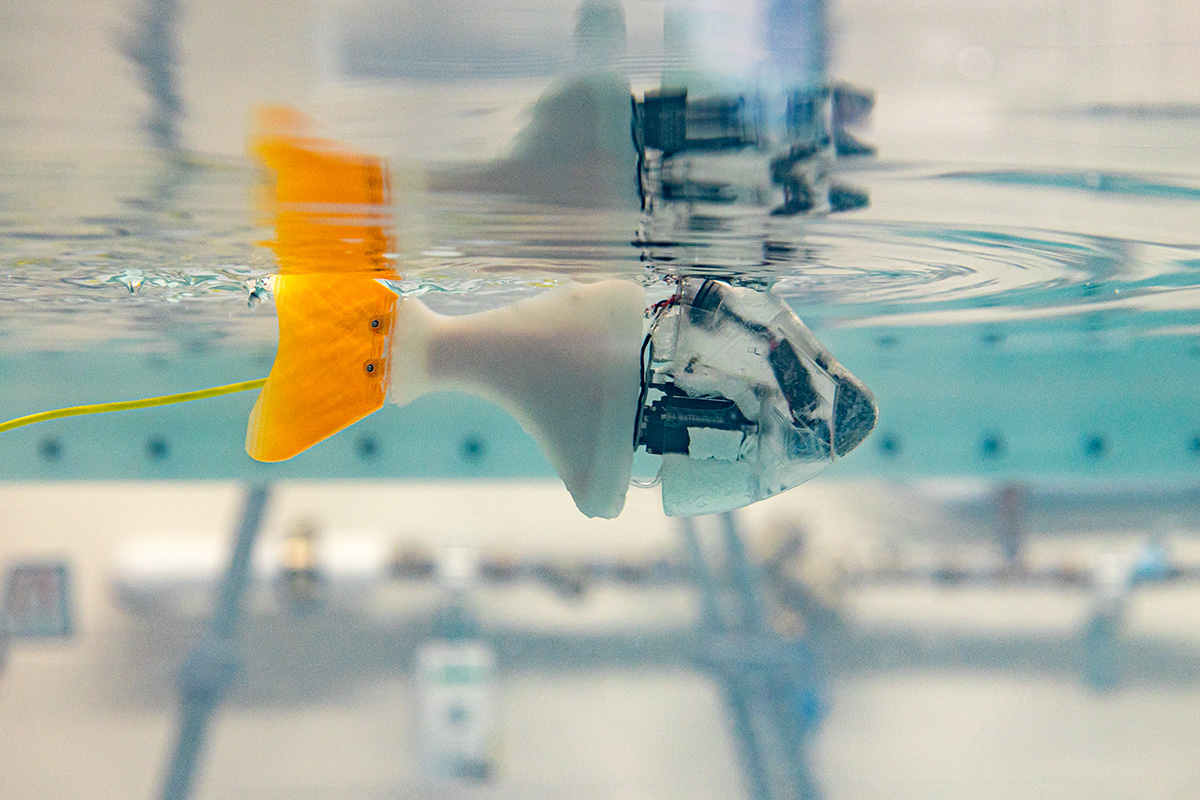
The device's body stiffness can be adjusted, allowing it to better mimic the swimming mechanics of real fish. Tom Ziemer
Jack Stonecipher PhDx’28 grew up on the shore of Minnesota’s Light Foot Lake, hooking bluegill and smallmouth bass. These days, he’s building robotic fish as a UW–Madison mechanical engineering student. Stonecipher and Wei Wang, a UW mechanical engineering assistant professor, have devised a unique mechanical version whose body stiffness can be adjusted, allowing it to better mimic the swimming mechanics of real fish.
“There are a lot of different stiffnesses in different kinds of fish, and it can be a big indicator of how they move. But it’s very difficult to actually measure,” says Stonecipher. “Using robotic systems, we can get a better gauge of how much they’re stiffening and why they would want to do this.”
In nature, fish activate muscles, increasing the stiffness in their bodies and allowing them to accelerate. Conversely, they can also maintain efficiency in their locomotion while moving at slower speeds when their muscles are slack. Those biological machinations could hold important lessons for designing watercraft.
“Most of our current boats or underwater vehicles can only maintain a high efficiency within a very narrow speed profile,” says Wang, whose lab develops physical prototypes of aquatic robots as well as the control and sensing systems necessary to operate them. “But fish can maintain a very high efficiency over a very wide speed profile.”
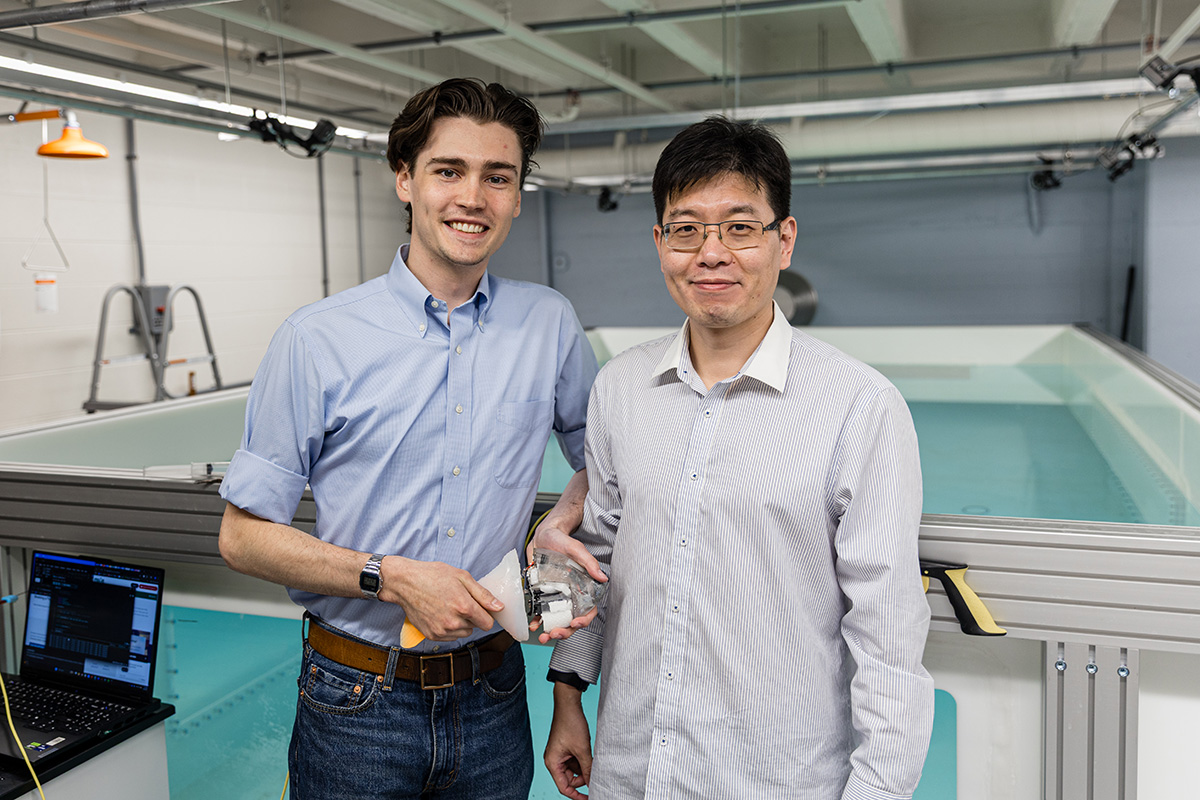
Stonecipher and Wang reveal new insights about aquatic animal movement. Tom Ziemer
Stonecipher, Wang, and former undergraduate researcher Allen Gao ’26 built their bluegill-inspired robot with a lentil-filled polymer body that can stiffen on command without significantly changing its shape or size, thanks to a vacuum pump. The fish can freely swim, allowing the researchers to test the effects of altering the body stiffness in a realistic environment.
Beyond informing watercraft design, Wang and Stonecipher see bioinspired aquatic robots as tools for ecological monitoring, where they’re able to blend in among animals and better capture photos and other data without disrupting the natural environment. They could also reveal new insights about aquatic animal movement, since it’s not possible to force a fish to selectively tense its muscles and then study the effects.
“I like this idea that robotics is spurred on by biological research, and then robotics can be used to inform biological research,” says Stonecipher.
Published in the Winter 2026 issue



Comments
No comments posted yet.