
Can the Badgers Bounce Back?
With a new strategy and significant investment, the football program has high hopes for the 2026 season.
If you need a reason to still believe in Badger football, you could start with the dedication of players like Mason Posa x’29. Despite last season’s disappointments and the promises of the transfer portal, the star linebacker returned to the program for his sophomore season with hardly a second thought.
“I’m willing to die and sacrifice anything for this program to be winning again,” Posa told a scrum of reporters in the spring. Hyperbole, perhaps, but you could only read sincerity and conviction on his face.
He later told me: “People who leave when times are tough, I feel like it’s soft. I’m a loyal guy. I gave my word to the coaches. I want to rebuild this team.”
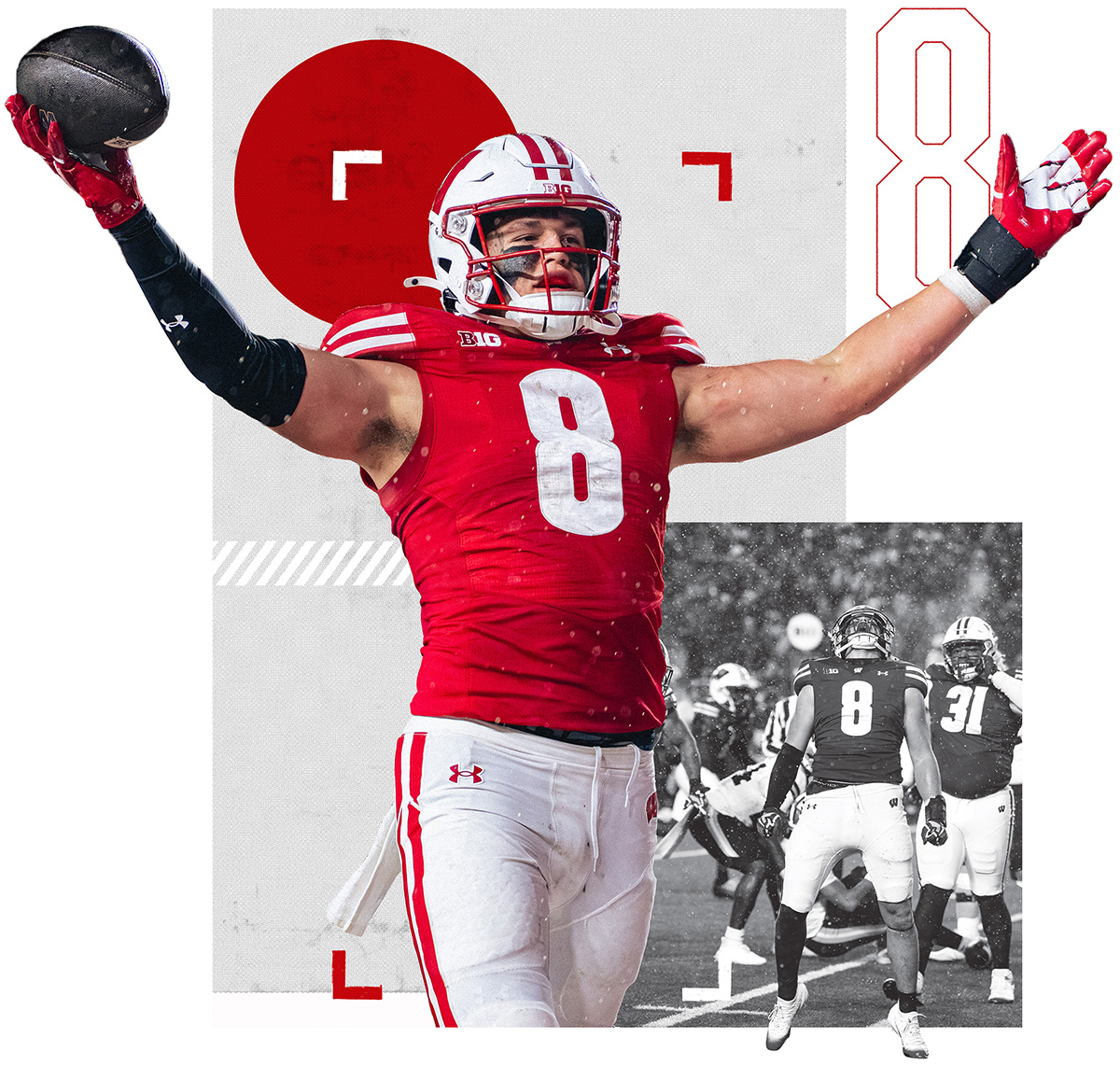
Mason Posa is willing to “sacrifice anything for this program to be winning again.” UW Athletics
Such fierce loyalty may be a surprise on a team coming off a 4–8 season. There is no sugarcoating the struggles of Badger football of late. The program suffered back-to-back losing campaigns for the first time since 1992 — before legendary coach Barry Alvarez set the expectations for Badger football excellence, with three Rose Bowl wins to round out the decade.
The low point of the 2025 season arrived in October, when the Badgers lost to Iowa and top-ranked Ohio State by a combined 71 points while being held scoreless. Afterward, then–Athletic Director Chris McIntosh ’04, MS’19 released a statement to fans acknowledging that the season had “fallen well short of our standards,” and that he and head coach Luke Fickell shared in the frustration.
McIntosh noted that the athletics department was “committed to elevating the investment into our football program to position us to compete at the highest level,” mentioning infrastructure, staffing, and, chiefly, player recruiting and retention. Translation: It was time to up the ante in the financial arms race of the new era of college athletics, in which players can receive direct revenue-sharing payments and third-party NIL (name, image, and likeness) deals, with the ability to transfer unlimited times.
For a team many outside observers left for dead, the immediate returns offered a ray of hope: wins against ranked opponents Washington and Illinois, with UW students storming the field in celebration.
But everyone knows that this season will be the defining one for the future of Badger football. That urgency was on full display in the offseason, as the program stocked the war chest and retooled the roster.
“There is a lot of pressure on this team,” Posa says, “and especially on Coach Fick, because this is the year that he’s got to bring it back up. But we’re all ready for it.”
From the financial strategy to the new roster, here’s how Badger football plans to turn things around.
“Get This Place Bumping”
Two days after the transfer portal opened on January 2, the UW’s top target, quarterback Colton Joseph x’27, announced his commitment to the program. Beyond the excitement of landing an athletic dual-threat quarterback with multiple years of eligibility, it was also an early sign of increased investment in the program.
“When I went into the portal, it was a big unknown,” says Joseph, who led Old Dominion University’s explosive offense the last two seasons. “I wanted to find the best people and the best place to help continue my career success — and that was to come here and be a Badger.”
More than 30 transfer players followed Joseph to Madison, marking a record haul for the program. They include a slew of projected starters to shore up the offensive line, defensive backfield, and skill positions, including running back Abu Sama III x’27, receiver Shamar Rigby x’28, center Austin Kawecki MSx’28, and safety Marvin Burks Jr. x’27.
A small consolation for missing last year’s postseason was the program’s ability to hyperfocus on the new January portal, which consolidated multiple transfer windows into one massive scramble. In the weeks leading up to it, personnel staff and coaches worked overtime to identify potential targets in the portal and players to retain, using an evaluation system that weighs projected fit and production relative to the existing roster to calculate individual value.
Focusing on realistic targets is essential, considering there are some 15,000 football players at the Division I level alone. To run such an operation requires both manpower and strategic thinking, which is why the UW has invested in additional football staff. The directory now reads like that of an NFL front office: a general manager, a director of scouting and player personnel, and a full team of recruiting and scouting staff.
The strategy resulted in 23 commitments within a week of the transfer portal opening. On3’s Team Transfer Portal Index, which measures a team’s production in the portal relative to its lost talent, ranked the UW’s class 15th in the nation, sandwiched between Ole Miss and Miami.
“I think we did our best job of pinpointing some of the guys we wanted to have and then stayed on top of it to get it done quickly,” Fickell says. “That window goes fast. You have to do this the right way in order to execute, or else you miss out on options one through six and settle for option seven or eight.”
The large number of transfers reflects a concerted effort to get more experience on the field in an increasingly competitive Big Ten Conference, from which the last three national champions have emerged. Fickell believes the team is uniquely prepared to handle the roster turnover because of its returning locker room leadership — particularly among the defense’s front seven, a young but productive group that has embraced adversity.
“There’s just a different leadership among the team right now,” he says. “You can feel it. There’s a core nucleus of leadership that has grown over the last two, three years through a lot of hard times.”
It includes linebackers Posa and Cooper Catalano x’29, who as true freshmen and midseason breakouts combined for more than 100 tackles, six sacks, and two forced fumbles to lead a defense that kept the team competitive down the stretch.
“This is a different team, a lot more athletic, and we’re going to get this place bumping,” Posa says.
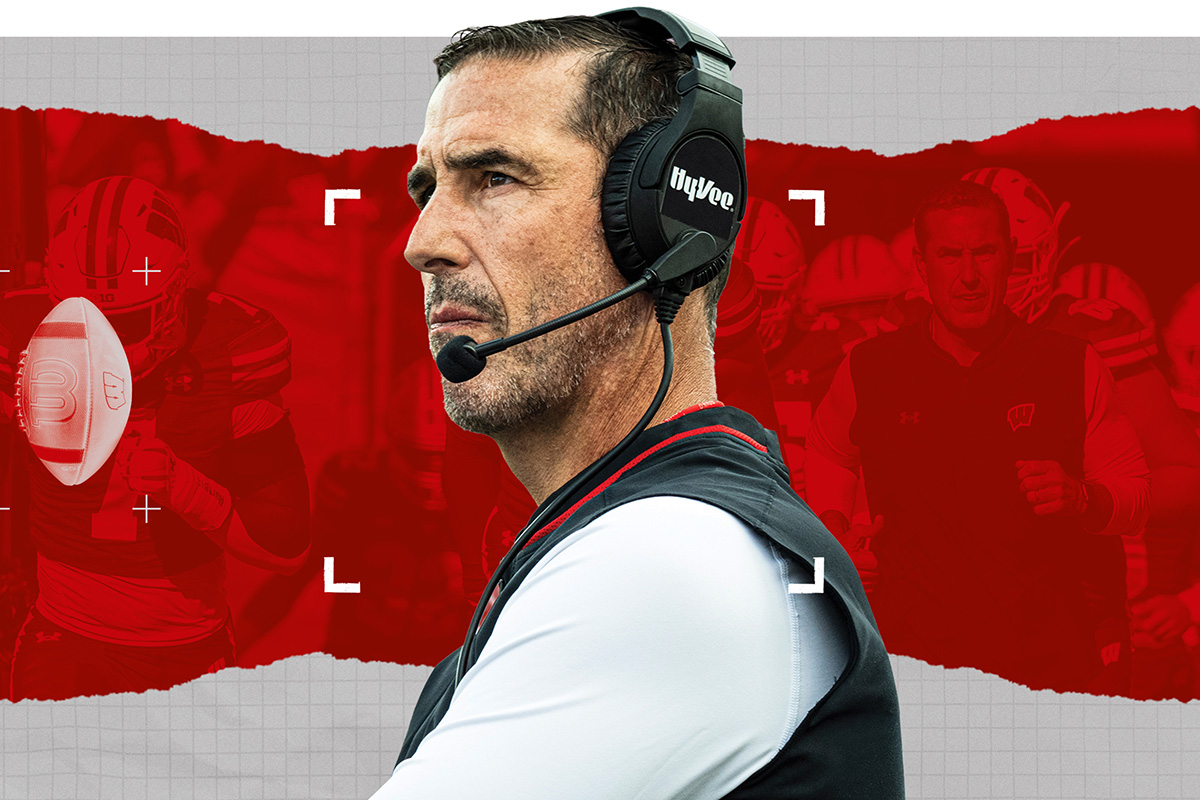
“There’s just a different leadership among the team right now,” Luke Fickell says. “You can feel it.”
There’s also been a recalibration in high school recruiting, with the program returning to its local roots and betting that players with closer ties to the state will show more patience with playing time and development. By July, the Badgers were off to a hot start with the 2027 class, securing verbal commitments from 10 of the top in-state recruits, including at positions of traditional strength at the UW — offensive line and running back.
For competitive reasons, student-athlete compensation is not public information, so the athletics department hasn’t reported how much more money it’s investing in the roster, nor does it know the precise spending figures of peer schools.
Still, you can read between the hash marks. Landing coveted transfers like Joseph and retaining rising stars like Posa and Catalano — especially during a down period for the program — suggest spending that’s closer to the upper echelon of the Big Ten.
“Put it this way, we couldn’t do what we did in January if there wasn’t a different level of investment,” Fickell says. “Money doesn’t solve all problems, but when you’re looking for starters and you have to compete in this league, there’s just a need.”
“We’re Being Aggressive”
Following McIntosh’s statement in October, it did not take long for the athletics department to make good on its promises of elevated investment.
In late November, the UW announced a 10-year contract extension with Under Armour, which outfits all the varsity programs with uniforms and accessories. As part of the new agreement, which has a total estimated value of more than $100 million, Under Armour committed to allocate funds to NIL contracts with UW student-athletes for brand endorsements and appearances.
The next month, the UW launched an initiative with Learfield called Badger Athlete Partners, which is designed to expand NIL opportunities. Learfield, a longtime sports marketing partner, committed to adding five positions dedicated to NIL-related deal facilitation and content creation for Badger student-athletes. That team works closely with the UW’s in-house NIL staff, which has also grown in recent years. And together, they see a chance to infuse NIL opportunities into traditional corporate sponsorship agreements. These range from global brand Pepsi to local furniture store Steinhafels, which recently featured UW linemen in a “Recline with the Line” video series.
“The revenue-sharing component of the financial packages for athletes across sports, including football, is not sufficient for what is needed to field successful teams,” says Brian Mason, the UW’s director of NIL strategy. “That requires the ability to position third-party NIL deals to supplement it. We need to take advantage of every opportunity that exists with our full roster of corporate partners.”
When the football program approaches a recruiting target or seeks to retain a current star, it must be prepared to discuss both on-field opportunities and a financial package, which often includes revenue-sharing payments directly from the athletics department as well as third-party NIL deals that Mason’s team works to facilitate.
Upon the landmark House v. NCAA settlement in June 2025, the UW had already committed to pay up to the maximum cap for direct revenue-sharing payments to student-athletes across sports — $21.3 million this year. But the real arms race has been in third-party NIL deals, for which there is no limit. According to ESPN reporting, some football rosters alone are approaching a total figure of $50 million.
Prior to the House settlement, there was a proliferation of donor-funded pay-for-play masquerading as NIL arrangements. Now there is a clearinghouse that reviews NIL deals for legitimate business purpose. Wisconsin Athletics believes it’s positioned to thrive on this commercial-focused playing field.
The department has posted three consecutive years of record revenue in fundraising, sponsorships, and ticket sales. Newer revenue streams include alcohol sales in stadium, the return of major concerts to Camp Randall (hello, AC/DC), and brand-promotion deals, such as Culver’s and UW Health jersey patches for men’s teams and women’s teams, respectively.
“We’re being smart, but we’re being aggressive in order to make sure that we’re keeping up with our peers,” says Mitchell Pinta ’08, the UW’s deputy athletic director and chief revenue officer. “We’re also making sure we have the right partners that fit our brand and our priorities.”
Over the spring, the success of Wisconsin Athletics emerged as a rare bipartisan political issue, with the state legislature and governor working out a bill to provide millions of dollars to UW–Madison for athletic facility debt service. The intent is to free up additional resources to expand revenue opportunities, preserve all 23 varsity sports teams, and help the Badgers stay competitive on the field.
“It is no secret that football drives 80 percent of our total athletics revenue,” says Pinta, who previously worked for the NFL as director of business development. “A healthy football program helps fuel the opportunity for all 22 other sports. The blunt fact of the matter is that we need to do everything we can to put football in a position to be successful on the field.”
Later in the spring, McIntosh departed the university to become the Big Ten’s first deputy commissioner for strategy. The listing for the UW’s new athletic director reinforced the need for financial acumen and expertise in the future business model of college athletics. In July, the university hired Shawn Eichorst for the role. The veteran administrator rose through the leadership ranks at Wisconsin Athletics before serving as athletic director at the University of Nebraska and University of Miami. Most recently, he was the deputy athletic director and chief operating officer at the University of Texas, which reemerged as a national semifinalist in football during his tenure.
When it comes to investment, sometimes seeing is believing. That’s especially true when you’re trying to sell the program to current players and future recruits. The Kellner Family Athletic Center — the largest capital project in Wisconsin Athletics history at $285 million, with more than $100 million in private funding — is towering proof. The new facility adjacent to Camp Randall will include a regulation-sized indoor football field; state-of-the-art strength and conditioning, sports medicine, and dining centers; and a 305-meter track.
“While the McClain Center served us well for many years, it just didn’t have the modern amenities that a Big Ten football program requires in this day and age,” Pinta says. “And this facility is not going to just benefit our football program — it’s going to benefit the entire athletics department.”
The first phase of the project was completed over the summer, so if you notice better punting this season, you’ll know why. Unlike the former practice facility, the Kellner Family Athletic Center has that full-sized field and a high-enough roof to accommodate indoor punting practice.
But if punts don’t get you energized for the upcoming season, perhaps the new quarterback room will.
“Make Plays When Stuff Goes Wrong”
For all the talk of money and strategy, the success or failure of Badger football this season may come down to one simple factor: a healthy starting quarterback.
That has been a matter of terrible luck for the UW. In Fickell’s three seasons, the starting quarterback to enter the year has only finished 11 of 37 games — and just two of the last 24. Billy Edwards Jr. MSx’27 sprained his knee in the first half of last season’s opener, leading to a carousel of four quarterbacks taking snaps. The disjointed offense sputtered near the bottom of college football in both yardage and scoring.
The Badgers are hoping that Colton Joseph can run free from the injury curse — and opposing defenders. He did plenty of the latter at Old Dominion, where he was one of only two quarterbacks in the country to eclipse 2,000 passing yards and 1,000 rushing yards last season as a redshirt sophomore. (By comparison, Russell Wilson MSx’13 holds the record for most rushing yards in a season by a Badger quarterback — with 338.) Against eventual national champion Indiana, Joseph ran wild for 179 yards and two touchdowns.
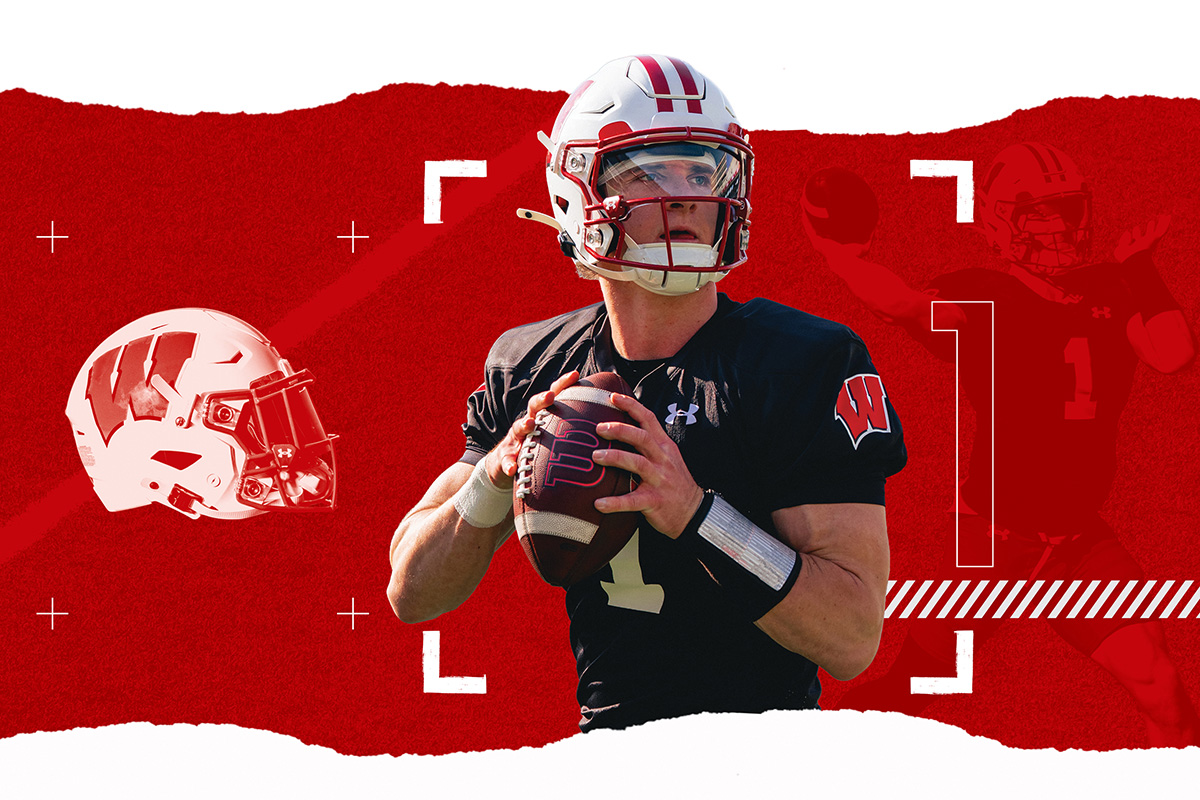
Colton Joseph wanted to find the best place to help continue his career success. “And that was to come here and be a Badger.” UW Athletics
He’s proven he can stretch the field vertically with an elite deep ball. And the belief is that he can unlock offensive coordinator Jeff Grimes’s balanced, physical pro-style system, which at BYU produced a top-two NFL draft pick at quarterback.
“I can make plays when stuff goes wrong and put more pressure on defenses,” Joseph says. “I’m going to do everything in my power to have a winning season.”
Learning from recent history, the Badgers have stacked the quarterback room with Louisville transfer Deuce Adams x’28 and freshman Ryan Hopkins x’30, both of whom turned heads in spring practice and can plug into a similar offensive style.
Compounding the quarterback injuries last season was the hardest schedule in all of college football, according to ESPN’s College Football Power Index, with seven of 12 games against ranked teams.
“The hardest thing for me to judge right now is where our ability stacks up in the league, because the Big Ten has gotten exponentially better over the last three years,” Fickell says. “But putting ourselves in a position to be in the mix for the playoffs in the last quarter of the season is what we have to be able to do.”
That’s a high bar for a team coming off a four-win season, but Fickell is aware of the expectations — and the frustration. Last year, he told reporters: “I know how everybody feels. I live it every single day, every minute.”
In his office over the summer, I asked him what that actually looks like — especially for a coach who is not accustomed to failure, having won national championships as an assistant at Ohio State and then transformed Cincinnati into a playoff team.
“It’s hard. It’s why hopefully you have a good, solid family at home, because that’s the one crew that doesn’t rise and fall on the way you perform on Saturdays,” he says. “If you don’t have some rock, some faith, I don’t know how you’d survive.”
He adds: “The challenge is to be consistent, no matter what you feel on the inside. Your players and coaches are going to look at you every single day, what your body language is, how you respond.”
How will the 2026 Badgers respond, with a coach feeling the pressure, a revamped roster, a new athletic director, a far friendlier schedule, and maybe, just maybe, healthy quarterback play? It won’t take long to find out. The Badgers open the season at Lambeau Field against ranked Notre Dame on September 6.
The lights don’t get any brighter than that.
Preston Schmitt ’14 is a senior staff writer for On Wisconsin.
Published in the Fall 2026 issue



Comments
No comments posted yet.