
Badger True-Crime Sleuths
With groundbreaking documentaries, podcasts, and a new class, UW–Madison alumni and students are shaping the coverage of real-life murder mysteries.
Mari Zoerb Hansen ’99, MA’01 has a master’s degree in linguistics from UW–Madison and a passion for true-crime storytelling.
In summer 2023, while watching a two-part documentary called The Dakota Entrapment Tapes, she became intrigued by the regional accents on the program.
It led her to Dakota Spotlight, a true-crime podcast focused on cases across the upper Midwest, hosted by James Wolner.
Hansen eventually connected with Wolner, and the possibility of a collaboration came up. Was there, Wolner wondered, a Madison case that would make a good podcast?
They settled on the unsolved campus murder of UW freshman Christine Rothschild x’72 in 1968. Six episodes of You Killed Chris: A Friend’s Fight for Justice made up the 10th season of Dakota Spotlight in 2024.
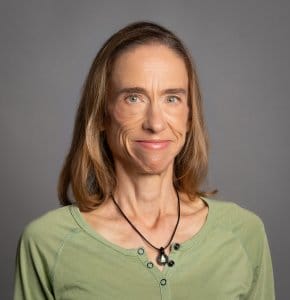
Mari Zoerb Hansen worked on a podcast about the murder of UW student Christine Rothschild. Focal Flame Photography
The series focused on both the murder and the decades-long effort of Rothschild’s college friend, Linda Schulko ’71, MA’72, to keep the case active. You Killed Chris included archival audio as well as original interviews — three hours with Schulko alone — with Hansen serving as research assistant. She’s a fourth-generation Badger, and her dad, David Zoerb ’68, was a UW student at the time of Rothschild’s murder.
The Capital Times wrote favorably about the podcast when it dropped, and then, in June 2026, the ultimate positive review arrived.
“I am writing in regard to the 1968 homicide of Christine Rothschild,” began an email to Wolner from Truli Nielsen, special agent with the Wisconsin Department of Justice Division of Criminal Investigation.
“We have formed a team of folks, investigators, special agents, crime analysts, and prosecutors who are actively working on [this] case,” Nielsen continued. “We have listened to your Dakota Spotlight series and appreciate the attention you have brought to this case. I am wondering if you might be able to share my contact information with some of those whom you interviewed.”
Hansen calls it “a reminder that true crime can help solve crimes.”
One of the earliest — and still best — reminders of that is the 1988 documentary film The Thin Blue Line, directed by Errol Morris ’69, which is credited with helping overturn the murder conviction of a Texas death-row inmate.
Morris, an Academy Award–winner for 2003’s The Fog of War, is the best-known UW–Madison graduate working in the true-crime genre. But others have followed, including the documentarians Erin Lee Carr ’10 and Rachel Bozich ’14. With their productions — plus a new UW class — alumni and students are shaping the coverage of real-life murder mysteries.
Truth and Crime
The success of a 2014 12-part podcast titled Serial about a 1999 murder in Baltimore launched a flurry of true-crime podcasts. Some were serious-minded, and some incorporated humor, introducing the genre to the digital generation.
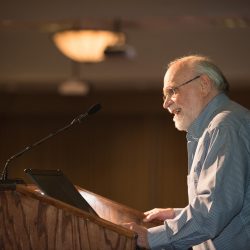
UW–Madison Professor Ralph Grunewald LLM’05, who has a joint appointment in the English department and the Center for Law, Society, and Justice, teaches classes on criminal justice and law and literature. He found students increasingly bringing in legal questions prompted by listening to true-crime podcasts.

Ralph Grunewald created his class Truth and Crime when students began posing legal questions inspired by true-crime podcasts. Taylor Wolfram
Eventually, those questions inspired Grunewald to debut a course in fall 2023 titled Truth and Crime, which explores the true-crime genre and the intersection of law, narrative, and truth. The class is offered through Constellations, an interdisciplinary program in the College of Letters & Science.
In 2025, Grunewald gave students the chance to create a 10- to 15-minute true-crime podcast in lieu of writing a final paper. Some 80 students in teams of three or four worked on 23 projects. Just as Hansen was drawn to a local Madison case, some of the teams chose to examine crimes such as the 2008 murder of UW–Madison student Brittany Zimmermann ’08 and the 1970 bombing of Sterling Hall.
The exercise captivated the students.
“They loved it,” says Ali Mansouri PhDx’27, the teaching assistant who worked with the students on their projects. “They needed to write a report about how they approached the podcast, how they created the narrative, and who was doing what. It was very collaborative.”
In his class, Grunewald makes it clear that all true crime is not created equal.
There are, for instance, wildly popular true-crime podcasts that involve comedic takes (My Favorite Murder) and makeup tips (Murder, Mystery, and Makeup).
True-crime podcasts have greatly increased the genre’s ubiquity. An article on forbes.com in December 2025 noted that they are “extremely popular, considered a dominant genre in podcasting, with over 19 million regular listeners in the U.S. in 2024.”
Grunewald’s favorite podcast is Criminal. New York magazine called it “one of the most expansive, compassionate portraits of the lives of real people caught up in crime.”
“It’s what some call highbrow true crime,” Grunewald says. “It’s great journalism; it’s background stories; it’s human interest. It’s not sensationalized; it’s not dramatized. It’s never one-sided or judgmental. There is always another level they explore.”
He contrasts that with the My Favorite Murder podcast. An episode he refers to in class involved a case in which someone convicted of a heinous crime ended up on death row. In a textbook example of bad taste, the host says, “But unfortunately, he died of cancer before he could get fried.”
Grunewald’s students read excerpts from In Cold Blood, Truman Capote’s famous 1966 “nonfiction novel” about a Kansas farm family’s murder. The book was a critical and popular success, though Capote was later criticized for inventing scenes and dialogue. The class also watches Morris’s Thin Blue Line, which, while drawing numerous raves, was criticized by some for employing expressionistic reenactments of events.
In Defense of Reenactments
The Blue Line case involved a man convicted of shooting and killing a Dallas police officer in 1976. Morris’s investigation revealed his innocence, as well as the real murderer. It didn’t come easily.
“An actual investigation involves a kind of obsessive personality,” Morris says. “A real need to find out the truth, to the extent that it’s possible to find out the truth.”
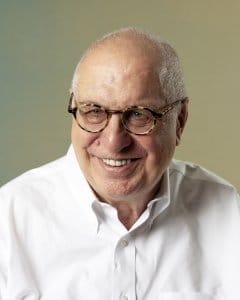
Errol Morris directed the trailblazing documentary The Thin Blue Line, which helped overturn the conviction of a Texas death-row inmate. Jay L. Clendenin/Los Angeles Times via Contour RA by Getty Images
Describing his work on The Thin Blue Line, Morris says: “I stumbled on a story that required me to see it through to the end. And as I investigated it obsessively over close to three years, I learned enough to tell me that the man who had been sentenced to death — he was within three days of being electrocuted in Texas — was completely innocent. Am I proud of the fact that I was able to investigate a case to its conclusion? I am immensely proud of it.”
The man originally charged and convicted in the Dallas officer’s death, Randall Dale Adams, was exonerated and released from prison after serving 12 years.
In 2008, Morris published a two-part series in the New York Times defending the use of reenactment in documentaries, zeroing in on a famous scene in The Thin Blue Line in which the location of a milkshake tossed from a police car is critical to impeaching the veracity of a witness.
“I reenact this detail in my film,” Morris wrote. “The milkshake toss for me is emblematic of the discrepancies between [the witness’s] account and what really happened. As such, the spilled milkshake is a clue and stands at the beginning of a chain of inferences. … How do you represent this in a movie? How do you evaluate the nature of competing and conflicting evidence? It is through reconstructing the past with reenactments.”
Grunewald, who wrote a book about the role of narrative in wrongful convictions (Narratives of Guilt and Innocence: The Power of Storytelling in Wrongful Conviction Cases, NYU Press 2023), says, “Lawyers tell stories. Just like Morris, I stress that narratives create a certain legal reality which might not be the truth.” He has his students analyze the reenactments in The Thin Blue Line and notes that in some instances, they offer competing versions of what may have taken place.
“With those reenactments,” Grunewald says, “he shows the ambiguity of the case.”
Morris is currently working on a series called Betrayal.
“It’s about Ukraine,” he says. “You might even call it a series of interlocking mystery stories, true-crime stories — what I consider to be an enormous crime perpetrated by Vladimir Putin against the Ukrainian people.”
The lively film scene on the Madison campus in the late 1960s inspired Morris. “My whole interest in movies comes out of the University of Wisconsin,” he told this magazine in 2009.
How Not to Exploit Subjects
Erin Lee Carr admires Morris’s films and says, “I am, in a way, an Errol Morris protégé, even though he doesn’t know me.”
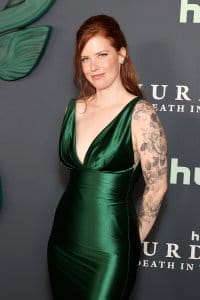
Erin Lee Carr: “I make films about perpetrators who are human beings before and after they do such a thing.” Dominik Bindl/Getty Images
Morris may not, but the prolific Carr has already made a significant mark in the true-crime genre, and she says she has a two-part series coming out on Netflix about “one of the biggest criminal cases in American history,” although she isn’t free to divulge the subject at this time.
Carr strives to be empathetic and nonjudgmental, even in telling stories involving terrible events, such as 2019’s critically acclaimed I Love You, Now Die, which centered on a woman convicted of involuntary manslaughter for sending text messages encouraging her boyfriend to commit suicide.
“I make films about perpetrators who are still human beings before and after they do such a thing,” Carr says, “and almost more importantly to me, [films about] the survivors who have to deal with this trauma and what’s going on in their lives.”
She calls true crime “one of the most populist genres of documentary,” but she’s leery of work that “puts more violence in the world for violence’s sake.”
Carr has a checklist she uses to decide whether a potential project is right for her.
“I do think there’s a right way to do it,” she says. “People are still looking for that human, empathetic approach.”
Carr has collaborated with fellow UW grad and filmmaker Rachel Bozich, whose interest in the genre dates to reading crime stories in magazines when she was a teenager.
“I was the kid who used to get People magazine to read about the murders in there,” she says. “My parents were definitely highly concerned about that. But I wanted to understand the human complexity of how someone could get to the level where they hurt someone.”
Bozich double-majored in journalism and communication arts at UW–Madison, and it was taking a film editing class that helped her find her career path.
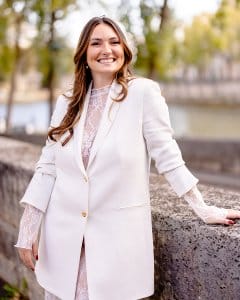
Rachel Bozich found her passion when she took a UW film editing class. Veronica Spann
“That was probably the best decision I ever made,” Bozich says. “I think there’s something to the way a film makes you feel — the pacing, the tempo. There’s nothing quite like it. It shaped the way I look at stories and aim to put them together.”
After graduating, Bozich served as first assistant editor on 2017’s The Death and Life of Marsha P. Johnson.
“It was very much a social activism film,” she says — Johnson was a Black gay rights activist — “but it’s framed within the murder of Marsha P. Johnson.”
Bozich quickly realized that she wanted to be part of a production before the editing process. Drawn to finding a compelling story, meeting the people involved, and gaining their trust and interviewing them, she moved into producing, writing, and directing.
She was an associate producer on 2020’s Kingdom of Silence, about the murdered Washington Post journalist Jamal Khashoggi.
“It was very much a heavy political film,” Bozich says, “but layered with the true-crime element.”
Bozich was also writer and producer on the two seasons of Murdaugh Murders: A Southern Scandal.
When the first season debuted on Netflix in February 2023, the New York Times noted: “The sordid, slowly unspooling saga of the Murdaugh family, moving back and forth across tragic accidents, mysterious deaths, brutal murders, and comically brazen fraud, is an unbeatable crime story.”
How does she balance the desire to tell a gripping tale with being fair and not overly intrusive to the real people involved?
“True crime has become an industry,” Bozich says. “But you need to remember that behind every story is a family or people seeking answers or seeking something. It’s part of the filmmaker’s job, or the journalist’s job, to figure out what that is, and if they’re helping them, or if it’s exploitive.
“It can be a really fine line,” Bozich continues. “But I love helping people. The ability to tell someone’s story or get answers for someone — there’s really nothing quite like it.”
Bozich is working on a 2027 show for Netflix. The family involved had never spoken publicly, but they shared hours of Super 8 film she was able to digitize for them. They grew close.
It’s a dynamic at odds with a perception of the genre as often manipulative. Could the high demand for true crime be an incentive to cut corners?
“It almost feels like a documentary is being churned out every other day,” Bozich says. “I say this very respectfully, because these are also the people who I get jobs from. Yet something comes out and there’s this immediate, ‘Is it going to go viral, is it going to go on TikTok?’ It’s affected the industry heavily.”
One effect of the proliferation of true crime is that it’s making potential story subjects leery.
“Anytime you go to tell a story now,” Bozich says, “you are definitely met with the fear of being exploited. I think that’s why every story I work on takes years. It’s not something where you’re coming in for months and then leaving the family after you get what you want.”
In Search of the Definitive Truth
You Killed Chris, the podcast devoted to the murder of Christine Rothschild, is not sensationalized. The facts of the case are gruesome. The banner front-page headline in the May 27, 1968, Capital Times read: “Co-ed Stabbed 14 Times.”
Podcast host and narrator Wolner, along with research assistant Hansen, left few stones unturned in their investigation.
The UW Police Department is still investigating the Christine Rothschild case. If you have any information to share, please call 608-264-2677.
Schulko, Rothschild’s campus friend, is convinced the murderer was a UW medical resident on law enforcement’s radar at the time. A September 17, 1968, Capital Times headline read: “Ex-UW Surgeon Sought for Quiz in Co-ed Slaying.” The man is now deceased.
The podcasters located a doctor who knew the suspect in medical school in Madison, and in episode four of the podcast he tells them: “The night she was murdered, he was on call and didn’t answer that call. The next morning, he came with a bandage on his hand.”
By reaching out to Wolner, the Wisconsin Department of Justice would seem to validate the podcasters’ efforts in You Killed Chris. Yet Wolner, near the end of the last episode, still hopes for more: the definitive truth about the crime.
“When Christine Rothschild walked out of Ann Emery Hall on May 26, 1968,” he notes, “she embarked on a morning walk that was never finished. In some ways it feels like the final chapter of Chris’s life and death is also unfinished and incomplete, and that, despite Linda Schulko’s decades-long quest to get answers, there are still things we would like to know.”
Doug Moe ’79 is a Madison-based journalist and author.
Published in the Winter 2026 issue


Comments
No comments posted yet.