A UW Boost for National Security
The university seeks closer research ties with federal defense agencies.
Althea Dotzour
Military careers carry an outsize risk for traumatic brain injuries, and that’s why the U.S. Department of Defense has invested millions of dollars into university-based research aimed at preventing, detecting, and treating them. Much of that work is performed by a group of engineers and scientists involved in PANTHER (Physics-bAsed Neutralization of Threats to Human tissuEs and oRgans). The multi-institutional collaboration, led out of the UW College of Engineering, is developing better methods for diagnosing brain injuries, as well as advanced materials that promise to improve military helmets. These materials are also improving helmets used by others, from law enforcement officers to athletes.
UW–Madison leaders are hoping to attract more of this “dual use” research, which benefits both the Department of Defense and civilians. The push is part of a broader strategic effort led by the Office of the Vice Chancellor for Research to increase Department of Defense research funding and expand the university’s national security–oriented research and education opportunities.
The defense department’s research interests are broad, from cybersecurity and quantum computing to food security and disease detection. Vice Chancellor for Research Dorota Brzezińska is confident that the UW’s similarly broad research portfolio is well positioned to attract new investment from the agency.
Defense-oriented research has long been an important source of federal funding at the UW. What’s new is a campuswide effort to build on existing relationships and develop closer ties between UW researchers and decision-makers at the Department of Defense and other national security partners.
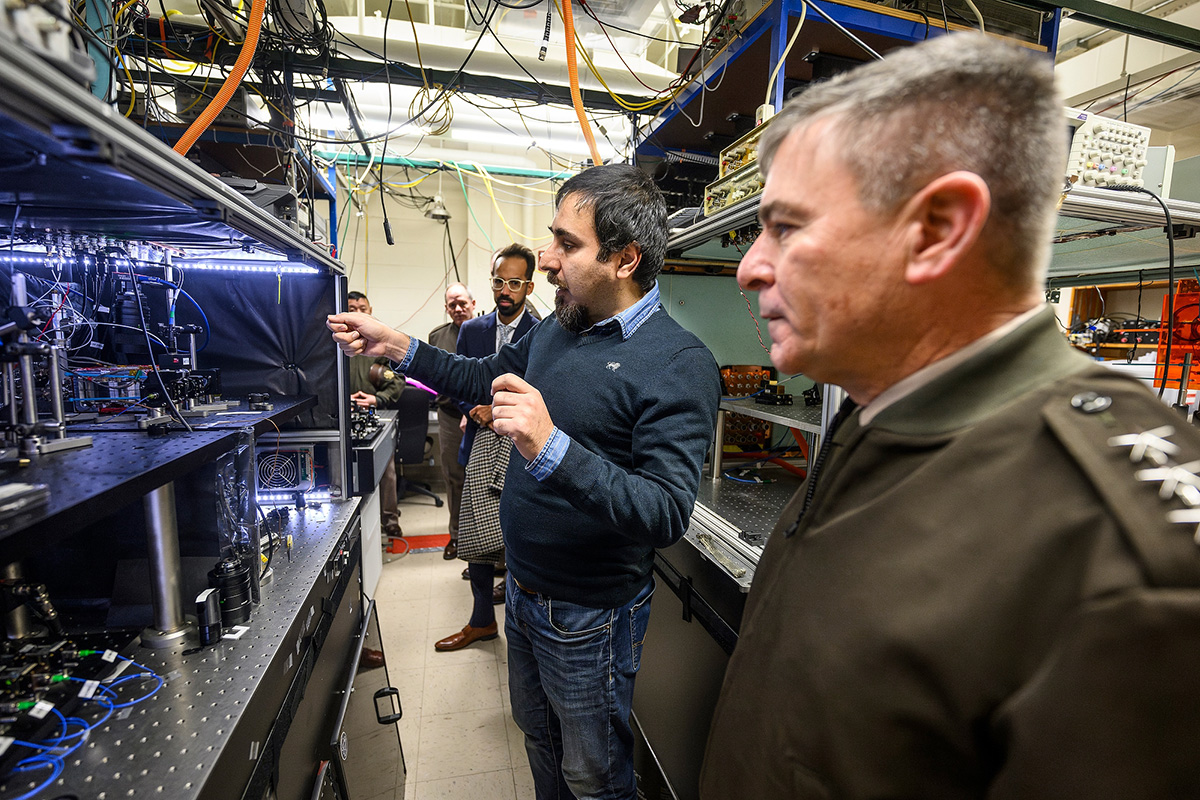
A recent example was the 2024 visit by a delegation from U.S. Cyber Command (above). The delegation toured labs and met with researchers in the Department of Physics, College of Engineering, and School of Computer, Data & Information Sciences. They heard directly from faculty and students about work in important cybersecurity areas like quantum computing and cryptography, and the visit resulted in an expansion of university partnerships on cybersecurity.
“The strategic growth of UW–Madison’s Department of Defense portfolio will strengthen our standing as a world-class university that trains tomorrow’s leaders and solves today’s problems,” says Vice Chancellor for University Relations Craig Thompson ’91.
Published in the Spring 2026 issue



Comments
No comments posted yet.