Motorcycle Mogul
With Harley-Davidson, William Harley 1907 turned a motorized bicycle into a national icon.
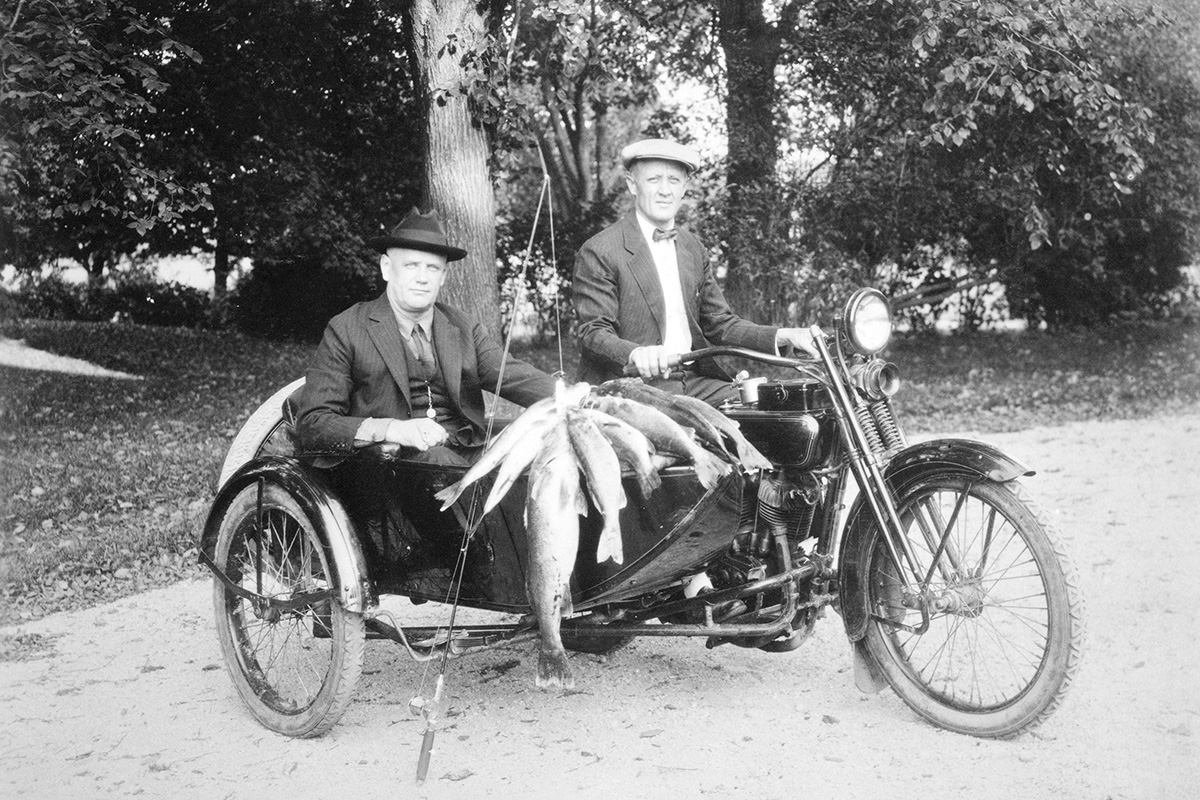
William Harley (right) takes a partner for a spin. The man in the sidecar is Bill Davidson, who joined the firm Harley started with Bill’s brothers, Arthur and Walter. The Harley-Davidson Motor Company incorporated in 1907. The fish received no compensation. Getty Images
When three Milwaukee friends first put together a motorized bicycle, it needed a name. Since the motorbike was originally his idea, William Harley 1907 got top billing. They called it a Harley-Davidson.
Before they cofounded what would be the world’s largest motorcycle manufacturer, Harley and Arthur Davidson were next-door neighbors on 38th Street in Milwaukee, where they spent many childhood hours tinkering with bicycles and engines in the Davidson family basement.
Taking his interests to work at age 15, Harley began as a cycle-fitter and draftsman for a high-end bicycle maker, Meiselbach Manufacturing Company. Soon, he joined Davidson to work at metal-fabricator Barth Manufacturing Company.
Along with Davidson’s brother Walter, a mechanic, the three combined their industrial knowledge to sell their first motorcycle in 1903.
That same year, seeking more engineering know-how, Harley enrolled at the University of Wisconsin. He focused on internal combustion engines, even though the School of Engineering labs had few, if any, gas engines to study. The lone course in gas engineering was a three-fifths-credit elective.
To pay for college, Harley waited tables, worked as a draftsman for a Madison architect, and created lab equipment for the Department of Psychology. As a senior, he was part of a group selected to test a new steam turbine for Chicago’s Commonwealth Edison Company. He earned his mechanical engineering degree with honors, and then he returned to Milwaukee, ready to build on a design he had created as a student. This would become his patented two-cylinder, V-twin engine, capable of speeds of up to 60 miles per hour.
Just three months after his graduation, the Harley-Davidson Motor Company was incorporated. Harley was chief engineer and treasurer.
An accomplished and enthusiastic motorcyclist, Harley was the company’s ideas man for more than 30 years. One of his 90 patents was the 1916 “step-starter,” which eliminated pedals and moved motorcycles into a new category. On the business side, he led Harley-Davidson’s sales of almost 75,000 cycles to the U.S. War Department during World Wars I and II. He remained the company’s chief engineer until his death in 1943.
Published in the Winter 2026 issue



Comments
No comments posted yet.