An Upgrade for IceCube
With some improvements beneath the ice, this Antarctic neutrino observatory should keep UW–Madison at the forefront of astronomy.
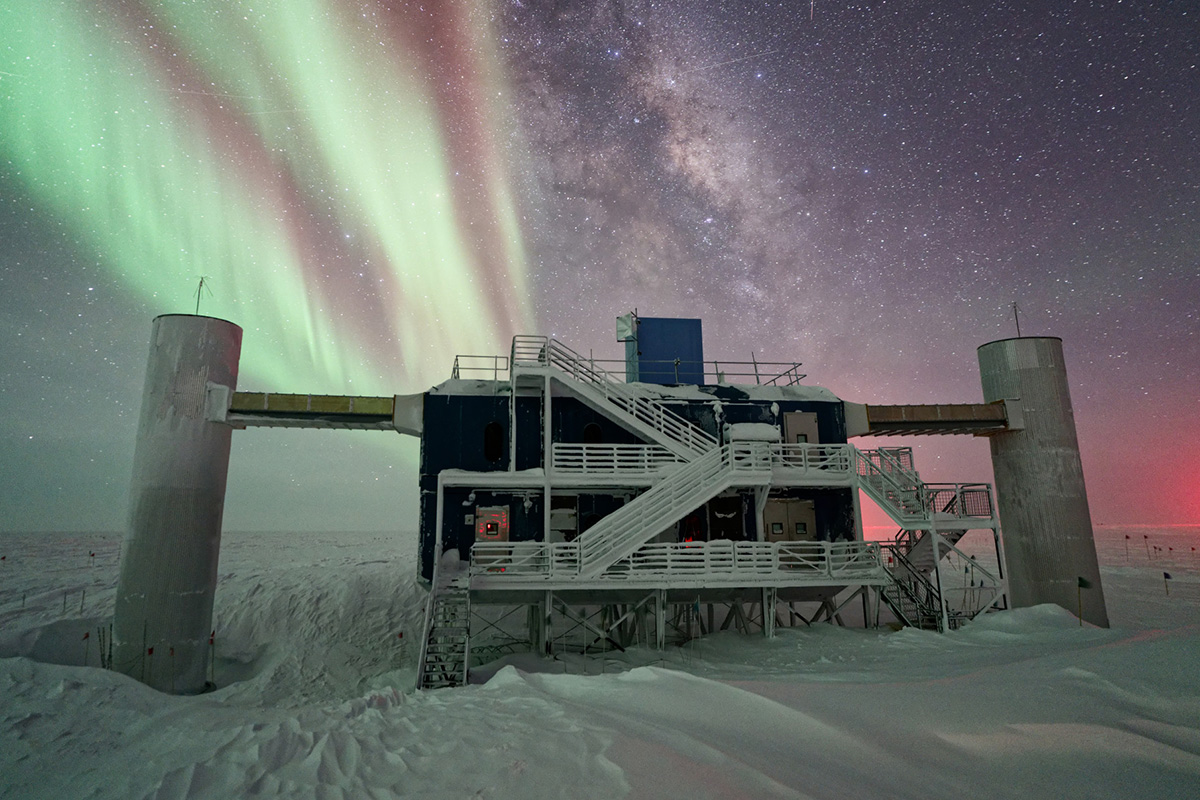
IceCube uses one cubic kilometer of Antarctic ice to detect ghostly particles called neutrinos that travel through outer space. Ilya Bodo, IceCube/NSF
The IceCube Neutrino Observatory has received its first major upgrade since it came online 15 years ago, significantly boosting the observatory’s scientific capabilities.
Located at the U.S. National Science Foundation’s (NSF) Amundsen-Scott South Pole Station, IceCube uses one cubic kilometer of Antarctic ice to detect ghostly particles called neutrinos that travel through outer space. The international scientific endeavor is led by scientists at the University of Wisconsin–Madison, with NSF providing its main source of support.
Because neutrinos rarely interact with matter, the nearly massless particles can provide a lens into otherwise obscure extreme cosmic environments. The upgrade will allow more precise measurements of neutrino properties, making IceCube the world’s premier neutrino experiment.
“The successful deployment of the IceCube Upgrade project is a feat of U.S. engineering that demonstrates significant logistical capabilities in Antarctica,” says Marion Dierickx, NSF program director for IceCube. “This upgrade will secure the nation’s continued leadership in neutrino physics for years to come, paving the way for new cosmic discoveries.”
IceCube uses more than 5,000 sensors to capture the faint light produced by neutrino interactions in the ice. The pristine quality of the Antarctic ice makes it an ideal medium for detecting this light. The IceCube Collaboration, with more than 450 scientists from around the world, then uses these light patterns to reconstruct the energy and direction of each detected neutrino to determine its origin.
Thanks to the upgrade, scientists will be able to better characterize the surrounding ice, leading to improved reconstruction of neutrinos and a reanalysis of 15 years of archived data. The upgrade will also improve scientists’ ability to determine cosmic ray composition and measure neutrinos from galactic supernovae.
“The successful completion of the IceCube Upgrade relied on the critical support of the South Pole station and Antarctic service contractors,” says Vivian O’Dell, the upgrade’s project director. “Their essential contributions allowed us to complete the entire installation in one drilling season despite extreme weather conditions and logistical constraints, for which I am deeply grateful.”
Published in the Summer 2026 issue


Comments
No comments posted yet.