Till Death Do Us Part
Ann Packer’s Some Bright Nowhere asks just how much we’re willing to do for those we love.
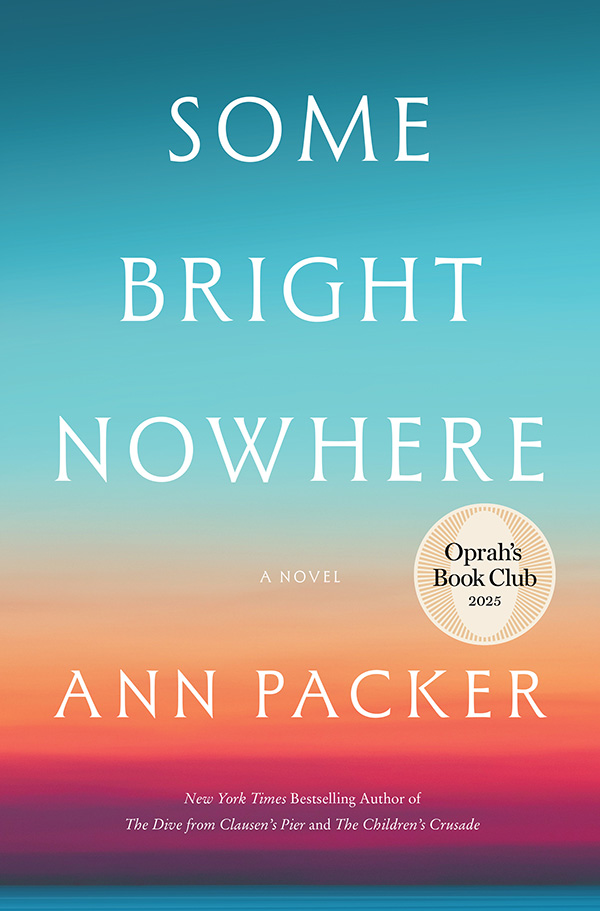
Packer explores questions of love, devotion, and death through a couple whose long-shared path diverges as they approach the end.
As a devoted husband and caretaker, Eliot can’t imagine leaving Claire’s side during her final days with terminal cancer. But when those final days are upon them, Eliot’s absence is Claire’s only request. In Some Bright Nowhere, Ann Packer explores questions of love, devotion, and death through a couple whose long-shared path diverges as they approach the end.
In a conversation with the New York Times, Packer revealed that, after years of struggling with unfinished projects, she wrote the first draft of Some Bright Nowhere in just four months. She was inspired by an anecdote she’d heard nearly two decades earlier about a woman whose friends provided her end-of-life care when her husband wasn’t up to the task. The book’s title comes from a line in Christian Wiman’s poem “Night’s Thousand Shadows,” which also makes an appearance in Packer’s story.
“Some Bright Nowhere is an exquisite gem of a novel, shot through with luminous prose and profound insight into the human heart,” writes author Tania James. “Trust me: you’ve never read a novel about marriage — about sacrifice and selfishness and soul-mending hope — quite like this one.”
Packer was a 1988–89 Jay C. and Ruth Halls Fiction Fellow in the third cohort of the Wisconsin Institute for Creative Writing. Her 2002 debut novel, The Dive from Clausen’s Pier, takes place, in part, in Madison, and was adapted into a made-for-TV movie in 2005.
Some Bright Nowhere is Packer’s first novel in a decade and was chosen by Oprah’s Book Club in November 2025 as the program’s 120th read.
“This novel will mean something to everyone,” writes the Chicago Review of Books. “Packer beautifully weaves the things we have all gone through in some capacity, the generational patterns that make us who we are.”
Published in the Spring 2026 issue


Comments
No comments posted yet.