
Writer on the Rise
An extraordinary story collection has made UW–Madison professor Dantiel Moniz MFA’18 an up-and-coming literary star.
On a fall day last semester, 12 UW–Madison undergraduates in an advanced creative writing course provided feedback to one of their classmates on a short story. When the topic turned to the story’s ending, they debated whether it was clear to the reader what had happened.
After the students weighed in, Assistant Professor Dantiel Moniz MFA’18 gave her take.
“A short story is a slice of something that represents the invisible whole around you,” she told them. “You are suggesting an entire world, an entire life, that goes beyond this last page. I love a story where the ending is more like a window than a door. It allows me, as the reader, to never really leave the story.”
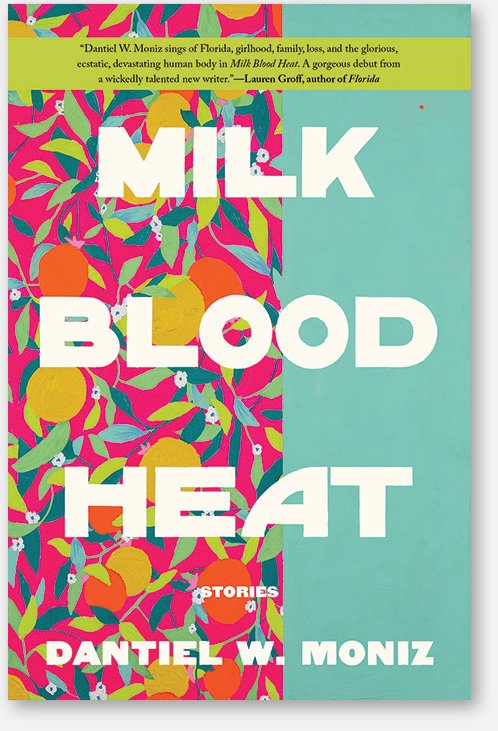
The students nodded, aware that they were learning from a top practitioner of the craft. In 2021, Moniz’s debut short story collection, Milk Blood Heat, was published to great acclaim, earning a raft of industry awards and anointing Moniz an up-and-coming literary star. Her highly anticipated first novel is scheduled to be published next year.
The 11 stories in Milk Blood Heat are set in Moniz’s home state of Florida and give rich voice to the interior lives of Black women and girls.
“From meticulously executed twist endings to striking imagery, Moniz has an impressive handle on all aspects of the short story,” wrote the Berkeley Fiction Review. The Washington Post said reading one of Moniz’s stories “is like holding your breath underwater while letting the salt sting your fresh wounds. It’s exhilarating and shocking and even healing.” The Chicago Review of Books found it difficult to imagine the book as a debut “given that the stories read with the ease of an author well into an established career.”

Moniz’s creative writing students appreciate learning from a top practitioner of the craft.
Moniz was named a “Writer to Watch” by Publishers Weekly and Apple Books, and Milk Blood Heat was chosen as a “must-read” by TIME, Entertainment Weekly, Elle, O, BuzzFeed, and others. The book was a finalist for the PEN/Jean Stein Book Award, the PEN/Robert W. Bingham Prize, and the New York Public Library Young Lions Fiction Award, and it was longlisted for the Dylan Thomas Prize and The Story Prize.
“It’s rare for a first book to make the kind of splash Milk Blood Heat did with both critics and readers,” says Amy Quan Barry, the Lorraine Hansberry Professor of English at UW–Madison and herself an acclaimed novelist, poet, and playwright. The fact that Moniz’s book is a short-story collection only amplifies the achievement, Quan Barry says. Publishers tend to favor novels, viewing them as easier to market to the public.
“When a book like Milk Blood Heat has so much success, it demonstrates that readers are hungering for engrossing and carefully crafted work regardless of length,” Quan Barry says, adding that she’s excited to have Moniz, her former student, as a faculty colleague now.
How Moniz came to be a Badger is a tale that surprises even Moniz, though it speaks to something she’s trying to do more of — trust her gut.
“A Little Voice Inside of Me”
Moniz had never visited Wisconsin and knew no one in the state when she moved to Madison alone in 2016 at age 26. She was looking to pursue a master of fine arts degree in creative writing and had been accepted to several programs, including the esteemed Iowa Writers’ Workshop at the University of Iowa. For many aspiring writers, the reputation of the Iowa program would have shut down any further considerations. But Moniz couldn’t shake the feeling that UW–Madison was a better fit for her.
She liked the deliberately small size of the UW’s MFA program. It typically admits just six students each year, alternating between fiction one year and poetry the next. “I was drawn to the intense level of personal mentoring here,” Moniz says.
She appreciated the UW’s generous financial aid offer and felt an immediate connection with Professor Judith Claire Mitchell, who helped found the UW’s graduate program in creative writing in 2003.
“The acceptance letter she wrote me made me feel so seen,” Moniz says. “She wasn’t even trying to sell me on the program. She just let me know that she was already proud of me as a writer.”
And then there was the intangible. “I have a little voice inside of me that is very clear,” Moniz says. “It’s not coming from my head. It’s coming from the center of me. Whenever I’ve listened to that gut feeling, it’s never led me wrong.”
“A Great First Paragraph”
That voice told her she was supposed to be at the UW. She’s never looked back. The UW enveloped her in a robust writing community, something she’d been craving since her youth in Jacksonville, Florida, where she attended an arts magnet school and fell in with a creative writing crowd. Schoolmate Sabrina Enders befriended Moniz as a freshman — she calls her Dee. Enders remembers the two furiously sharing journal entries, engaging in sometimes “brutal” critiques of each other’s work, and creating a faux fashion magazine together.
“We were playing at being writers, always imagining what our lives could be like if we pursued it as a career,” says Enders, a social worker who remains Moniz’s close friend. “Dee stuck with it, and I’m not surprised. She’s very intentional. She sees what she wants and focuses on it.”
The magnet school chose students through a competitive portfolio process. “It was the first time I had to audition for something I really, really wanted,” Moniz says. “When I was accepted, people couldn’t believe I would be attending a high school that didn’t even have a sports program. Writing was our extracurricular activity.”
Still, it would be a few years before Moniz landed on the idea of trying to earn a living by writing. And there were detours along the way. She tried Eckerd College in Saint Petersburg, then a community college before briefly moving to Washington state and working at an Abercrombie & Fitch store. Broke, she returned to Jacksonville and tended bar and waitressed. Of this period, she says, “The life experiences were happening.” The struggles provided grist for some of her early fiction.
Moniz returned to college, earning a bachelor’s degree in English from Florida State University in 2012. By this time, she had amassed tens of thousands of words of unpublished fiction and felt in need of further mentoring. She used an eight-page short story titled “Outside the Raft” to apply to the UW. The story follows two young girls during a pivotal day on a beach that illuminates their differing paths. It would later end up in Milk Blood Heat.
It’s rare for a first book to make the kind of splash that Milk Blood Heat did.
There were more than 600 applicants for six fiction spots at the UW the year Moniz applied. She learned years later that she was far from a shoo-in. The initial screener who read her short story submission placed her application in the “no” pile. Moniz says it’s important for other writers, especially young ones, to hear such stories, as fiction is a subjective art form requiring great perseverance.
Mitchell, who was director of the MFA program at the time, rescued Moniz’s application.
“Sometimes people miss things, they’re tired, they’re reading for their own taste,” says Mitchell, who retired in 2018. “I made it my business to go through the submission folders at the end of the screening process just to look at everyone’s first paragraphs.”
She pulled out Moniz’s short story, and “to my shock, holy moly, this is a great first paragraph,” Mitchell remembers thinking. “And by the end, I thought, ‘This is the best thing I’ve read in years.’ It was my prerogative as director to put it forward, and I did.”
“I Had This Deep Sense of Fear”
Moniz describes her two years as a UW graduate student as nearly ideal — once she got over an initial period of imposter syndrome.
“I felt super-supported here,” she says. “I got a lot of work done — numerous short stories, the first draft of a novel — and I learned how to teach creative writing.” (MFA students teach courses in creative writing and English composition and are provided a semester of teacher-training and support.)
While a student at the UW, Moniz acquired an agent and began attracting national attention for her short stories, earning publication in Ploughshares, Tin House, Pleiades, and Apogee Journal, among others. Back in Jacksonville after graduation, she entered into conversations with multiple publishers for Milk Blood Heat, choosing New York-based Grove Atlantic. It was another trust-your-gut moment. Though larger publishers were showing interest, she liked Grove Atlantic’s reputation for cultivating and sticking with young talent.
The night before Milk Blood Heat came out, Moniz barely slept.
“Writing is a solitary practice until it isn’t,” she says. “I had this deep sense of fear — oh, no, everyone is going to read it and I’ll be exposed. This thing I created will have its own life and I will no longer be able to control it.”
She had little to fear.
“To get the kind of recognition her book received — well, it’s the jackpot. She hit it big,” says Mitchell, who remains close to Moniz. “And to have it happen to such a nice person made it even sweeter.”
A writer for the Los Angeles Review of Books praised Moniz’s command of language, saying, “Her sentences are something I want to hold up to the light and study in detail to understand just how they do what they do.” Elle magazine said Moniz addresses “charged subjects of racial identity, family obligation, romantic entanglement, and wholehearted friendship, always lingering on fragile moments that are quotidian in scale but existential in meaning.”
Moniz says the response from critics and readers has been gratifying, though “there comes a point where you have to detach yourself from it. The book is just out there having its own life now, and I can’t be attached to that life because I still have things to do.”
“The Most Fun Thing on Earth”
Those things include teaching and keeping her own writing going. After earning her MFA, Moniz taught for a semester at Florida Atlantic University in Boca Raton as a visiting assistant professor, then began a two-year lectureship at the UW in the spring of 2021. The lectureship turned into her tenure-track professorship in English.
“Because I had such a positive experience here, I want that for my students, too,” she says. “Seeing them come into their own or understand something about their own process — that is the most fun thing on earth.”
Senior Jamie Restieri x’26, a double major in film and creative writing from Greenwich, Connecticut, took Moniz’s advanced creative writing course last fall. Prior to the course, he read the first story in Milk Blood Heat and was so impressed he immediately bought a copy of the book for his mom.
“When I found out I could take a class with her, I had to do it,” Restieri says of Moniz. “She’s already a master of what she does. It’s insane that we have a chance to get to learn from someone like that.”
“It’s Part of Being Human”
Moniz devotes Mondays through Thursdays to students and university work, then tries to carve out writing time for herself on long weekends. “Has that gone perfectly? No,” she says, laughing. “But I am writing.”
She is not an early riser or a write-every-day kind of writer, but once she focuses, she can write for hours, especially at a coffee shop.
Moniz is most interested in writing about the things people don’t say, especially those things that have shame or guilt or “badness” attached to them.
“I want to lift up the rock and see all the little albino creatures crawling underneath there, even if it’s a little gross or makes people uncomfortable. I want to know that stuff because it’s part of being human. We would do a lot less harm to ourselves and to others if we understood that the very temporary feelings we all have that might be thought of as wrong or bad are really just natural and human. It doesn’t make you a bad person.”
For Moniz, fiction suggests an entire life that goes beyond the last page.
Moniz had a realization about her writing after the death of her mother in 2022 from complications of COVID-19.
“You learn a lot about yourself when you lose someone who means so much to you,” she says. “I really didn’t know that motherhood and daughterhood were major themes for me. But now I realize that even the stories that aren’t about that are about that.”
Her mother’s voice continues to speak to Moniz. It helps her process all the things that have happened to her since moving to Wisconsin. And it helps her to keep trusting her instincts.
“At one point, I told my mom, ‘I’m waiting for the other shoe to drop. It’s happening too easily. What’s the catch?’ And my mom said, ‘Maybe there is no catch. Maybe there doesn’t have to be one when you’re on the right path.’ ”
What a Writer Reads
 The full power of literature hit Dantiel Moniz at age 14 when she stumbled upon White Oleander in her high school library. The novel, by Janet Fitch, explores a complex mother-daughter dynamic and wrestles with challenging issues around identity and self-discovery.
“I remember pulling it from the shelf and being just floored,” Moniz says. “I didn’t know you were allowed to write about things like that, to say those things out loud.”
White Oleander broadened Moniz’s already expansive taste in literature. As a child, she read across genres and age categories, encouraged by a mother who was a devoted and adventurous reader.
“She didn’t limit what I could read, and I’m so appreciative of that,” Moniz says. “She’d say, ‘You can’t watch that TV show,’ but then she’d hand me Flowers in the Attic.”
Some of the books Moniz read as a child may not have been considered age appropriate, she says. “But it helped form me in some way, just to be able to read whatever I wanted. That’s why I’ve been so interested in relationships and the secrets they can create.”
While doing publicity for Milk Blood Heat, Moniz mentioned White Oleander as a formative book. Fitch saw the interview and acknowledged the compliment on social media.
“That felt like a full-circle moment,” Moniz says.
—D.E.
Doug Erickson is a Madison-based freelance writer.
Published in the Spring 2026 issue



Comments
No comments posted yet.