
The UW’s AI Moment
The new College of Computing & Artificial Intelligence offers thoughtful leadership amid technological upheaval.
“It felt like a piece of technology had been dropped on us from the future.”
That’s how Remzi Arpaci-Dusseau, the founding dean of UW–Madison’s new College of Computing & Artificial Intelligence, describes the moment in 2022 when OpenAI publicly released ChatGPT, the generative AI chatbot that foreshadowed a technological — and societal — revolution.
In this domain, it’s hard to surprise a preeminent computer scientist who literally wrote the book (or at least the most downloaded textbook) on operating systems alongside his wife and longtime academic partner, Andrea. After all, their work had helped set the foundation for generative AI. But suddenly, with enough computing power and training data, techniques that had been around for decades — and that a lot of people even in artificial intelligence said would never work — finally broke through.
At the time, Arpaci-Dusseau was getting ready to step down as chair of the UW computer sciences department and return to a professor’s life in the classroom and lab, where he’s won many teaching awards and co-advised 37 doctoral students.
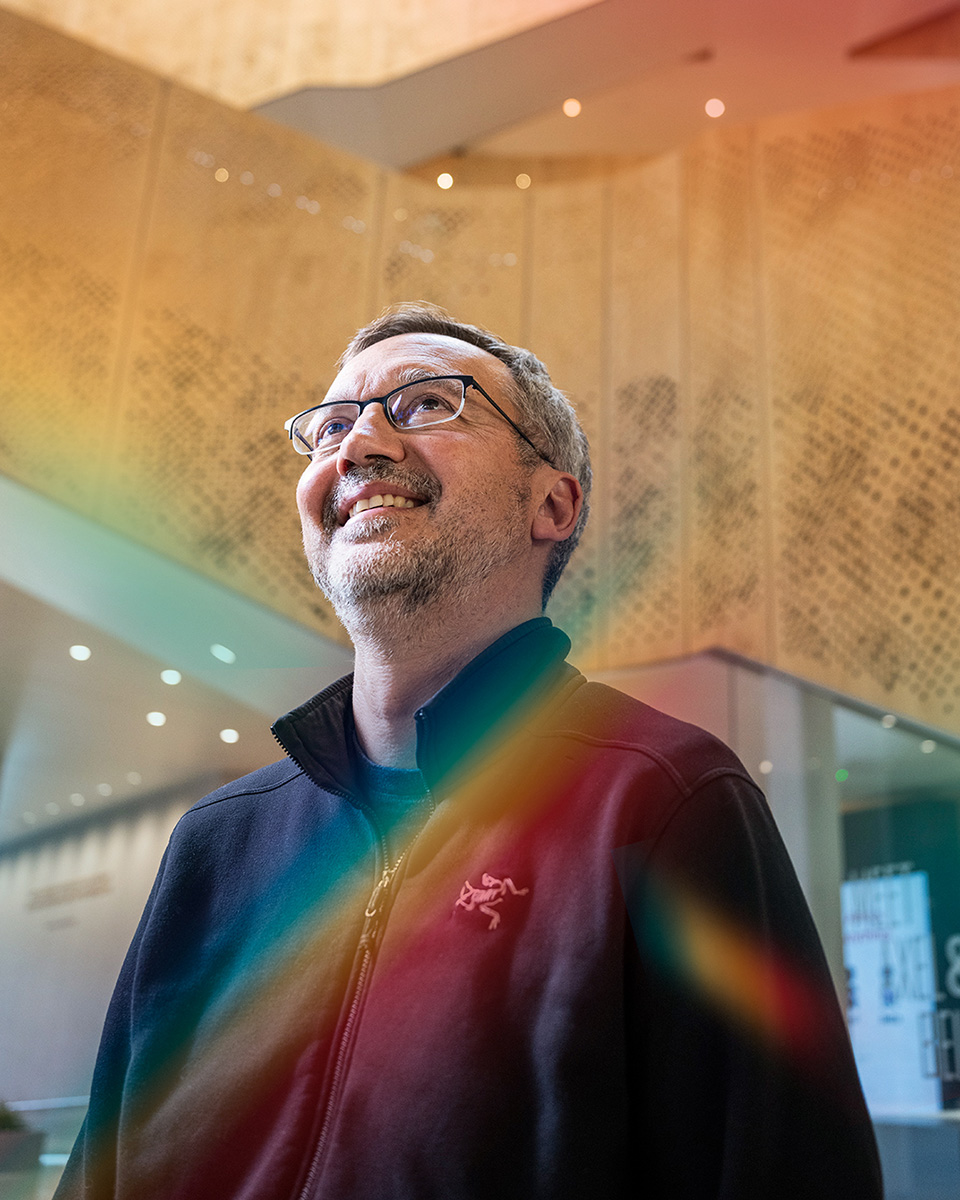
Remzi Arpaci-Dusseau is stepping up with a bold vision to lead UW–Madison into the AI era. Photo: Jeff Miller; Photo illustration: Danielle Lamberson Philipp
“But there was this drumbeat of AI that I could just hear in my head,” he says. “My wife said to me — with some reluctance, because she likes having me around more rather than less — ‘Maybe you should think about how you can help the campus move forward in this space.’ ”
Fast forward to July 1, 2026, when the College of Computing & Artificial Intelligence (CAI) officially launched to become UW–Madison’s first new standalone college or academic division since 1983. With Arpaci-Dusseau as its first leader, the college is both a rapid, visionary response to this AI moment and the culmination of a deliberate, decade-long effort to consolidate and elevate campus investment in computing. It’s also an acknowledgment that institutions must rethink education and how to prepare students for an uncertain future.
“Universities that take leaps and restructure based on significant things happening in society are ones that become leaders in the space,” Arpaci-Dusseau says.
The mission of CAI matches the moment: to position UW–Madison as a nimble leader and a reasoned voice at a time of great change.
A Moment of Crisis
Perhaps more than most universities, UW–Madison was prepared for the AI moment because it had been planning for it — or at least something like it — since 2014.
Leadership within the College of Letters & Science had observed growing student interest and career demand in computer sciences and approached the department with an ultimatum: you can restrict the size of enrollment and admit only the highest-achieving students, or you can open it up and expand your offerings.
Computer sciences faculty, part of a department that for decades had been ranked among the top 15 in the country, voted on the inclusive path forward.
“We said, ‘We should serve the public mission. If our area is important, why should we be gatekeepers?’ I remember that vote because it was unanimous, and we don’t often vote unanimously,” Arpaci-Dusseau says.
“Universities that take leaps and restructure based on significant things happening in society are ones that become leaders in the space.”
From 2013 to 2017, enrollment in computer sciences nearly tripled, from 574 to 1,674 students, making it the largest major on campus — a distinction it’s held ever since.
In 2018, then-Chancellor Rebecca Blank asked a working group of faculty, alumni, and industry leaders to assess the future of computing on campus and explore opportunities to increase the number of students exposed to computational thinking, big data, and artificial intelligence (this before the term was omnipresent).
Among the working group’s recommendations was to bring together three related units — the computer sciences and statistics departments and the Information School (formerly the School of Library and Information Studies) — under one umbrella. The School of Computer, Data & Information Sciences (CDIS), operating within the College of Letters & Science, was born in 2019. (This original structure, Arpaci-Dusseau says, gave the new unit time to find its footing and made it possible to evolve into an independent entity in the AI era.)
The working group also advocated for a top-level leader to facilitate cross-campus collaboration at a time when nearly all research fields relied on computing ability to make sense of massive data sets.
“Put simply,” the report stated, “there must be someone who wakes up thinking about computing and goes to bed thinking about computing.”
Arpaci-Dusseau, who served on the working group, did not know then that he would eventually become that person. He took over as the head of CDIS in 2024, when the school was humming. Since its establishment in 2019, enrollment across its programs had nearly doubled to 6,200, and a new data science major introduced in 2020 was an immediate hit.
By fall 2025, the momentum had taken physical shape in the form of Morgridge Hall, which opened as a seven-story, state-of-the-art hub for the School of Computer, Data & Information Sciences and several other units sharing a data mission. Named for lead donors John ’55 and Tashia ’55 Morgridge, it’s the largest privately funded building investment in UW–Madison history at $267 million.
Still, with the emergence of generative AI, the future of computing on campus was facing yet another inflection point.
“AI is going to change how we do research, how we do education, and how we do work in the world,” Arpaci-Dusseau says. “Having a unit front and center to help steward that change and lead it toward outcomes that are good for people — for society — was something we needed to do as a university.”
Andy Konwinski ’07, who knows a thing or two about artificial intelligence as the cofounder of Databricks, Perplexity AI, and the Laude Institute, frames this moment for the university even more urgently. He and a group of other prominent UW–Madison alumni formed the Catalyst Collective, which contributed $100 million alongside the university’s $50 million annual investment to support the launch of the College of Computing & Artificial Intelligence — one of the first college-level academic units dedicated to AI at any university in the United States. The three units that composed the former School of Computer, Data & Information Sciences shape the core of the new college, which will now have operational autonomy, the ability to create its own degree programs, and a seat at academic leadership tables. Several other universities have tried to create such a college and failed, stymied by bureaucracy and internal politics.
“The resources required, the types of research areas, the collaborations with industry — those all have to be reimagined if universities are going to continue to do AI research, which is the frontier of technology for our species right now,” Konwinski says.
“We want to advance AI that meets the needs of the moment, preserves our values, and reduces risk to vulnerable communities.”
He argues that academia faces a moment of crisis and, without bold action, risks losing access to the front lines of AI innovation, where actors with a profit motive and less of a focus on the public good can move faster, monopolize talent, and make progress proprietary rather than open and collaborative.
“We have top AI researchers at Wisconsin,” Konwinski says. “If we don’t innovate, they will leave in the next five or 10 years. Those are the stakes.”
Laboratory for Experimentation
If you get the impression that UW–Madison is naively racing ahead with artificial intelligence, fear not. CAI’s inaugural associate dean for research is no stranger to the risks of innovation.
Patrick McDaniel is an expert in cybersecurity and adversarial machine learning — that is, when bad actors trick or attack artificial intelligence systems by altering data. He’s also the director of the federally funded Center for Trustworthy Machine Learning.
“My understanding of cybersecurity goes back almost 30 years, and I’ve gotten the ability to understand how things might fail and what the economic and human consequences could be,” he says. “One of the beautiful things about this new college is that we have people working from the one end on the very hardcore underlying mathematics of AI, all the way to the impact of AI on tribal communities and society at large, and everything in between.”
McDaniel doesn’t view innovation and responsibility as opposing forces.
“Understanding risk is simply part of using anything,” he says. “If you use a car, there’s risk, right? So we build cars that reduce that risk to us and others. Innovation provides us ways to mitigate the risk, but you have to be thoughtful about it. We can’t just say we want to advance AI. We want to advance AI that meets the needs of the moment, preserves our values, and reduces risk to vulnerable communities.”
He adds: “Society over hundreds of years at times like this has turned to universities to help understand the moment.”
To that end, some of the largest research questions regarding artificial intelligence revolve around how to lessen the energy consumption and reduce the environmental impact. These downsides have led to a public backlash to the construction of large data centers.
CAI’s faculty, already 100 members strong with 50 new hires expected over the next few years, will explore these and other problems.
“There’s a sense of wonder at the possibilities here,” McDaniel says. “Literally every day, I have 10 interactions on things that I would like to spend the next 10 years working on. It’s a unique time.”
The College of Computing & Artificial Intelligence has already been approached by seemingly every area of campus to explore ways to supercharge their work. When I talked to Arpaci-Dusseau over the summer, he had just met with the School of Pharmacy about drug discovery and pharmacist training, brainstormed with the School of Business on supporting student and faculty entrepreneurship, and lunched with the Law School over the future of legal education. As our interview wrapped up, Badger football coaches arrived at his Morgridge Hall doorstep to discuss how AI technology could lead to a competitive edge on the field.
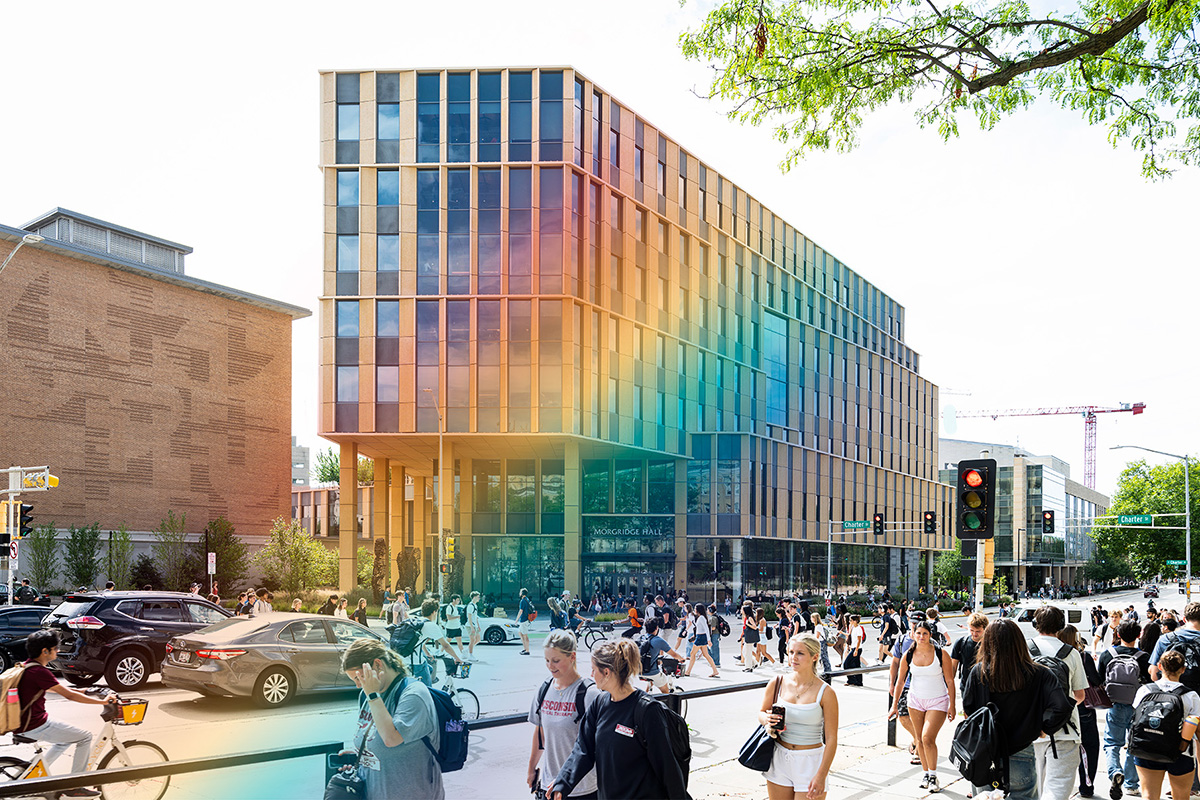
Morgridge Hall is the largest privately funded building investment in UW–Madison history at $267 million. Photo: Jeff Miller; Photo illustration: Danielle Lamberson Philipp
“If our hypothesis is true that there’s a significant technological shift happening right now that is going to fundamentally affect research and education,” Arpaci-Dusseau says, “then what better laboratory for experimentation than a university that literally studies almost every field?”
Among the early promising developments is a partnership between CAI and the School of Medicine and Public Health on a new initiative at the intersection of health and artificial intelligence. It will be sponsored by Epic Systems, a leading medical software company based in Verona, Wisconsin, and founded by Judith Faulkner MS’67.
“It will advance how we do computer science research and how people study cures for cancer and do new drug discovery,” Arpaci-Dusseau says.
The college is also leading a collaboration with Microsoft and TitletownTech, which are providing early access to AI platforms and connecting university researchers to companies in high-impact fields such as manufacturing and the life sciences. Industry partnerships that address real-world problems in real time will be a significant part of CAI’s research portfolio.
There’s also an educational component to the research, helping students gain the skills, experience, and connections they need to enter the professional workforce — one that is rapidly changing due to artificial intelligence.
Top Priority: Flexibility
Will AI take our jobs?
That question is top of mind for today’s college students. Enrollment in computer sciences, at UW–Madison and elsewhere, is projected to dip as a result. Given AI’s capabilities in coding, it’s easy to imagine how a software company would only need a team of two developers where it once needed five. Still, Arpaci-Dusseau believes we’re about to enter a “golden age of software creation.”
“I just saw an AI-enabled group of programs that is going to build the type of health care software that would have sounded like science fiction 10 years ago,” he says. “But it’s going to need people behind it that care about software.”
The College of Letters & Science will continue to administer the degree programs within CAI’s departments until the 2027–28 academic year. In the meantime, CAI is exploring how to structure its curriculum to best prepare students for a workforce that is evolving by the day. The top priority is flexibility.
“It’s hard to say what’s going to be important in four years,” says Michael Swift, CAI’s associate dean for academic affairs. “We need to have a nimble program where students have a lot of choices and ability to change paths, and we can use advising to direct them according to their interests and how things are changing.”
The heart of the curriculum will be what the college’s leaders call AI resilience and enablement — resilience being the fundamental knowledge, skills, and critical human thinking that can ride out any technological trend; enablement being proficiency with the technical tools that will make for a desirable job candidate.
“Some of the largest research questions regarding artificial intelligence revolve around how to lessen the energy consumption and reduce the environmental impact.”
“AI is a tool that can accelerate a lot of things,” Swift says, “but you still need to know how to drive it. What used to be entry-level work is what can be done by an AI, and so employers are telling us they’re looking for students who have a bit more skill than they used to.”
The College of Computing & Artificial Intelligence hopes to create a teaching support center to help instructors — both inside and outside of the college — revamp their courses in the age of AI. As a former associate department chair, Swift has already seen faculty members innovate along these lines. One instructor of an introductory computer sciences course, knowing that students would use AI if they took assignments home, turned the classroom into something like a chemistry lab so all the work would be done on site.
Spinning off from a large liberal arts college, CAI plans to stay true to its roots by continuing to offer a deep education with exposure to diverse viewpoints.
“We’ll be working with departments like philosophy, where they have ethics, and psychology, where they understand the depths of the mind, and I could list many others,” Arpaci-Dusseau says. “We want our students to enter the world with a much broader and richer viewpoint than a person who’s just been technically trained. We’re trying to make the full connection between developing technology and seeing where it lands in society so we can help shape it toward a positive end.”
A Sense of Wonder
The first time Arpaci-Dusseau felt like a piece of technology had been dropped on us from the future was when his parents, Turkish immigrants who met in Ann Arbor, Michigan, brought home a primitive TRS-80 Model I computer in the late ’70s. Even his engineer father didn’t know exactly what to do with it, so it sat in the basement. Young Arpaci-Dusseau fired it up and found magic.
“You could write a small program, and it would immediately do something,” he says. “My first program would say, ‘Type in your name,’ and if I typed in my name, it would say, ‘Remzi is great,’ and if it was my sister’s name, it would say, ‘My sister is dumb.’ Which wasn’t really super empowering. But it just felt like you could, even as a young person, do something amazing.”
That sense of wonder carried Arpaci-Dusseau through graduate school at the University of California–Berkeley, where he met Andrea, his future wife and careerlong collaborator.
“Like every love story, it began in an operating systems class, working on a project together,” he says with the trademark dry humor that made him a beloved lecturer.
The two computer scientists have been a unit ever since, save for a brief time at the end of grad school when they thought working separately would help their chances of landing faculty jobs. It turned out the opposite was true, at least at UW–Madison, which at the height of the dot-com boom saw an opportunity to land two top minds — and a de facto research group — in one fell swoop.
When it came time for the tenure decision, the dean wrote, “It’s my unusual and, in fact, unique privilege to promote two people with this one letter.”
“I thought that was really cool,” Arpaci-Dusseau says. “The university, though it’s big and bureaucratic, was able to make it such a personal decision to support us.”
Such an environment may help explain why Arpaci-Dusseau has stayed in academia and at UW–Madison throughout his career, and why he’s stepping up now with a bold vision to lead the university into the AI era.
“I’m sure Silicon Valley companies believe they’re shepherding this technology into the world for good,” he says. “But it’s hard to say, with so much wealth behind it, there’s not a significant conflict of interest. The role of our university is to be a counterpoint to this. The root of academic freedom is to be able to look into the world with clear eyes and to speak the truth. If universities can’t do it, then who will?”
Preston Schmitt ’14 is a senior staff writer for On Wisconsin.
Published in the Winter 2026 issue


Comments
No comments posted yet.