The Science of Athletics Leadership
Badger Inquiry on Sport is a potential game changer.
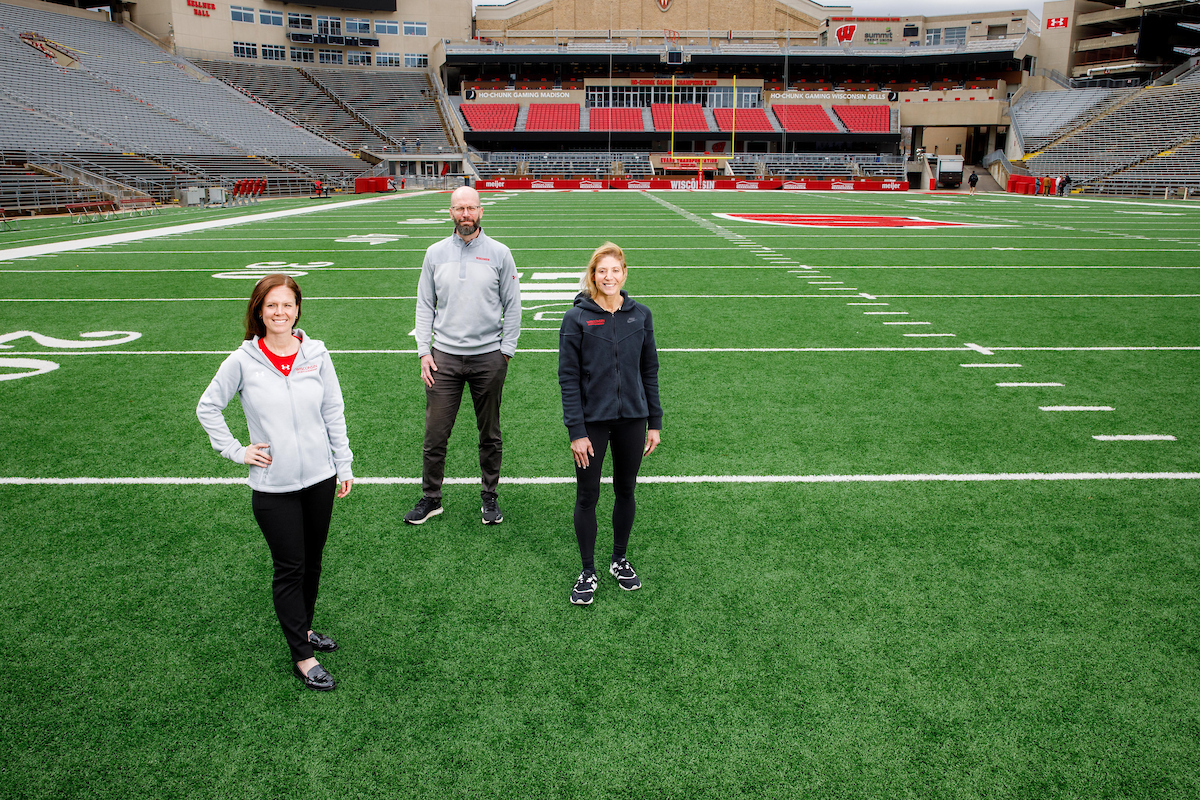
Miller, with Dehnert and Jimenez Soffa: “One of our goals is to be a bridge between research and athletics.”
One April evening, Peter Miller got a text from David Edwards x’19, an offensive lineman for the NFL’s Buffalo Bills, who had a question: Is there any scholarly research about how players mentally frame the pressure they feel during high-stakes games?
“During the AFC championship game, I tried to talk to our guys about pressure,” wrote Edwards, a former Badger football player.
Edwards wanted evidence-based research to take back to his teammates. High-level players expect strong science, not only behind their physical training and rehabilitation, but also regarding the psychological aspects of their game.
“There is a space we’re starting to occupy where there’s a void,” says Miller, a professor of educational leadership and policy analysis. “Highly impactful people are eating this work up.”
That work is the charge of Badger Inquiry on Sport (BIOS), a research initiative launched in 2021 through a partnership between UW athletics and the School of Education. With leadership from Maria Dehnert MS’18, Miller, and Sara Jimenez Soffa PhD’07, BIOS combines UW–Madison’s world-class researchers and its highly regarded Big Ten teams to bring an academic lens to questions about sport.
BIOS is working to deepen the scientific understanding of good coaching, and it partners with the School of Education’s master’s in sports leadership program, which launched in 2021.
“One of our goals is to be a bridge between research and athletics,” Miller says, noting that BIOS plans to help coaches and athletes around the state and across the country. “For a lot of kids, sports are the space where they find the most meaning, where they make the deepest relationships, where they feel most open to learning from an adult.”
Published in the Spring 2026 issue



Comments
No comments posted yet.