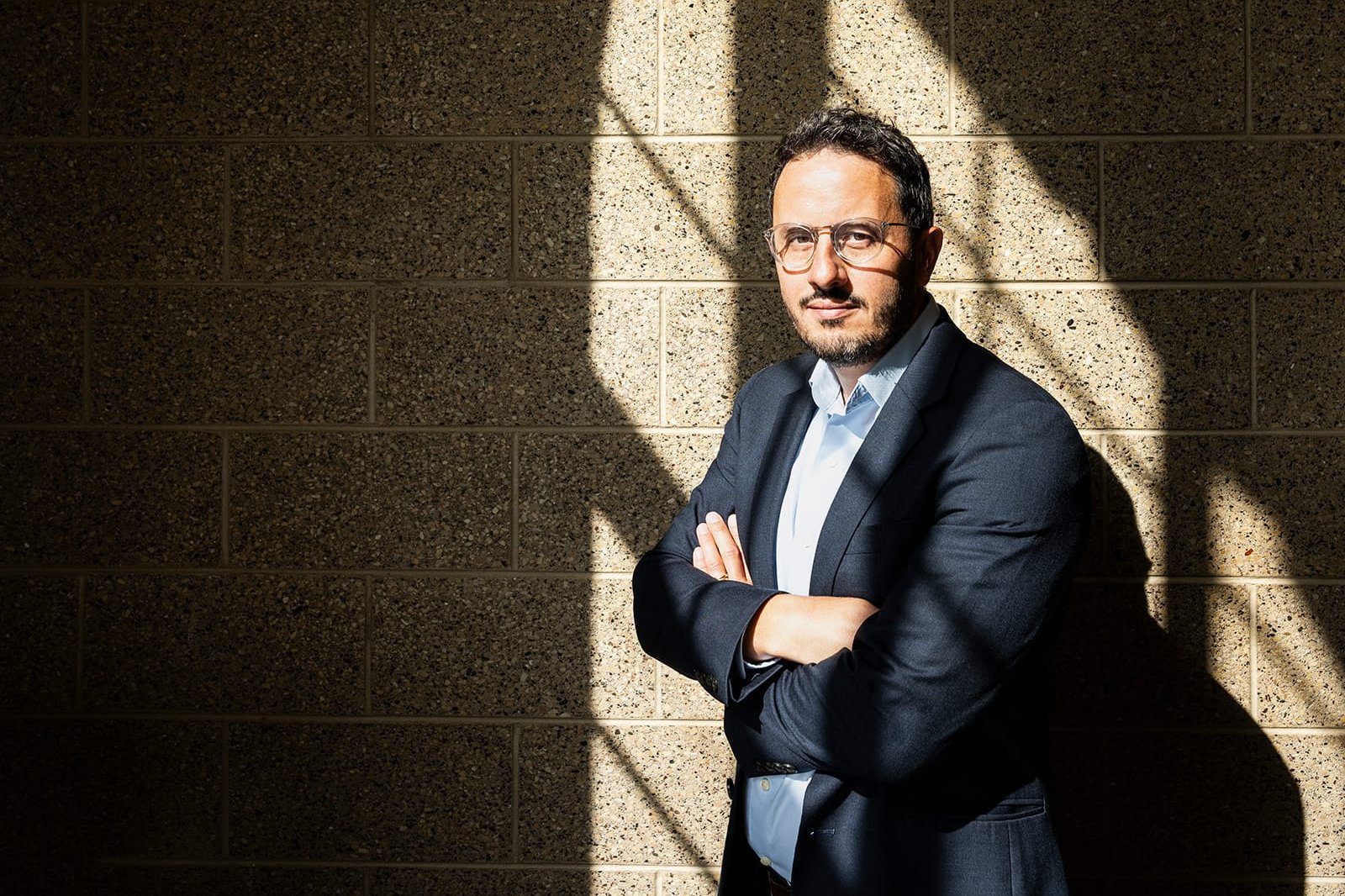
Heading Off Doomsday
UW–Madison professor Sébastien Philippe is improving collective security through nuclear policy research.
Nuclear risk affects everyone, says Sébastien Philippe, so more people should be discussing nuclear weapon policies.
“That’s the thing with nuclear weapons and nuclear war,” he says. “There is essentially no safe place. The work we do here at the UW is really to improve our collective security.”
Philippe is an assistant professor of nuclear engineering and engineering physics, with associate faculty appointments in the La Follette School of Public Affairs and the Department of Political Science. He joined the UW in 2025 to create an interdisciplinary research lab to study nuclear security and arms control. He’s a 2025 MacArthur Fellow and serves on a United Nations panel conducting the organization’s first comprehensive study of the effects of nuclear war in nearly 40 years.
What does your lab do?
We monitor nuclear activities everywhere in the world and develop new technologies and approaches to do that. Another big area of research that we do these days is model the consequences of nuclear weapons use and nuclear war. Over the summer, we hosted a workshop where we brought scholars from political science, scientists, and people who serve in the government to review most-likely scenarios, discuss the types of nuclear events we foresee, and share things we would like to know. We hope to influence nuclear weapons policies, arms control, and long-term disarmament, and to make the world a more peaceful and safer place.
How do politics affect the risk of nuclear weapons being used?
Many of the structures and agreements built since the 1960s and ’70s have now disappeared. There are no longer any limits on the number of nuclear weapons that can be deployed. We see states spending hundreds of billions, if not even trillions, of dollars in building up and refurbishing their nuclear arsenal — the United States included. And we see China building up its nuclear capabilities. When I think about risk, I consider both the probability of something happening and the consequences if it does. Right now, we are seeing governments taking decisions that undermine our long-term ability to reduce either that probability or those consequences.
How can the risk of nuclear war be reduced?
As long as nuclear weapons exist, there will be a chance that they will be used, and the consequences are likely to be devastating. But wherever we can act, we must. We can develop technologies that give policymakers new options for verifying future agreements and that support diplomatic engagement and cooperation. We should also increase transparency and engage actively with our adversaries. To borrow the title of a book edited by former Los Alamos National Laboratory director Siegfried Hecker, we are “doomed to cooperate.”
You encourage people to engage with nuclear policy conversations. What are some ways they can do that?
Nuclear weapon policy is often seen as the exclusive domain of national security experts or the military, but that’s not true. As with every area of public policy, anyone can take an interest and participate in the debate. Voting and understanding what your government is doing in your name — especially in matters of national security — are fundamental ways to stay engaged.
Published in the Winter 2026 issue
Comments
No comments posted yet.