Ever-Green Morgridge Hall
The new home of the College of Computing & Artificial Intelligence is the most sustainable building on the UW–Madison campus.
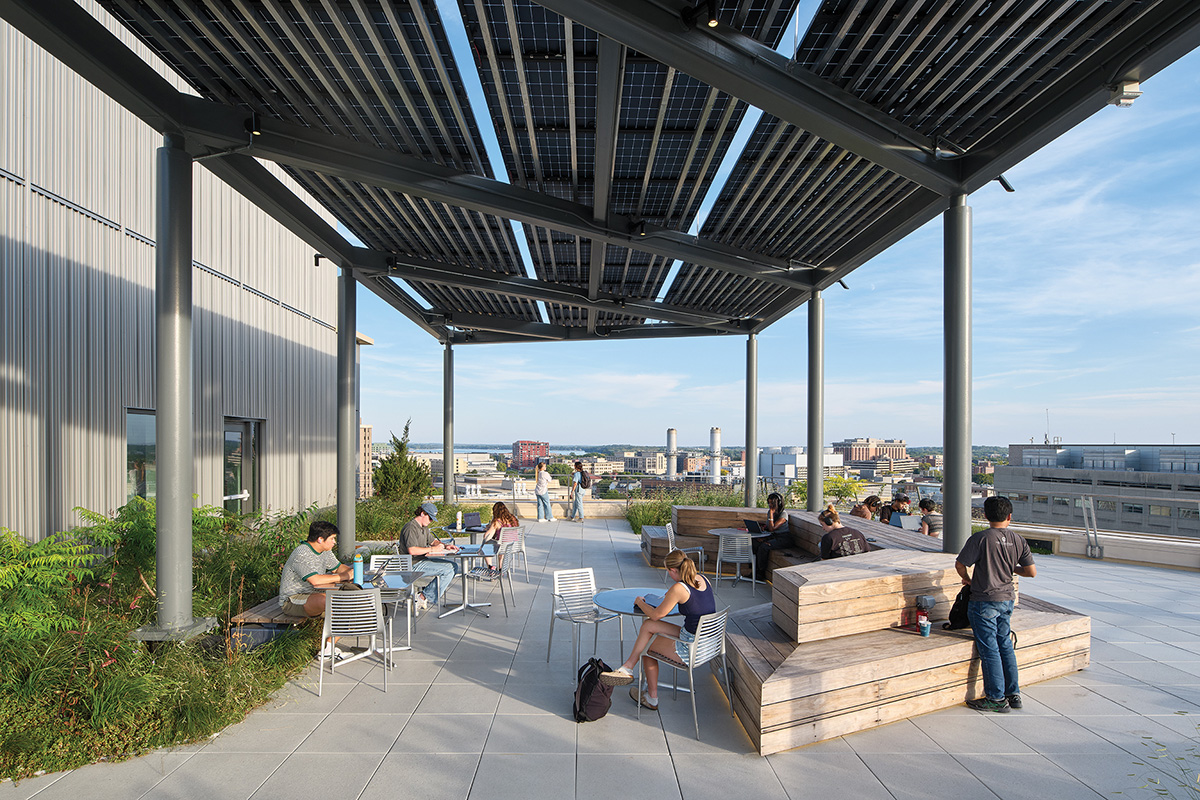
The WARF Centennial Terrace at Morgridge Hall is home to prairie flora, solar panels, and scenic views. Bruce Damonte
In an essay titled “Time to Dig,” Remzi Arpaci-Dusseau, the founding dean of the College of Computing & Artificial Intelligence (CAI), likens the dawning of the age of artificial intelligence to the 20th-century advent of agricultural machinery: sure to shape the future, and dependent on humans in order to do so.
“Not much is certain in this shifting landscape before us,” he writes. “But, as with any meaningful endeavor, there is only one thing we can do next: start digging and plant the seeds for our human-driven future.”
The uncanny parallels between the natural world and the technological one are evident not only in the dean’s vision for the college, but also in its new home. Opened in 2025 and built to last for 100 years, Morgridge Hall is designed to nurture the seeds of this human-driven future — even one created with silicon and code.
Morgridge Hall is the most sustainable academic building on the UW campus. Its high-performance exterior, high-efficiency lighting, rooftop solar panels, and stormwater capture system contribute to a 61 percent reduction in energy consumption and 30 percent reduction in indoor water use compared to common benchmarks. In May, the building received LEED Platinum certification, the highest level of achievement for green building design.
It gets even greener: biophilia, or the human tendency to connect with nature, was a tenet of Morgridge Hall’s design and is evident in the indoor gardens, living green walls, and planted outdoor terraces that make up 25 percent of the building’s site area. Of the plants that populate these spaces, 82 percent are native Wisconsin flora, with savanna and prairie vegetation represented on the third- and seventh-floor terraces, respectively.
The seventh-floor terrace — the WARF Centennial Terrace — features several of Morgridge Hall’s sustainable design elements, including the stormwater capture system, which irrigates the building’s plant life, and the 359 solar panels that generate enough energy to power the equivalent of 182 Wisconsin households a year. Furnished with ample seating and surrounded by sweeping views of Madison, the terrace is also a restorative space for students, faculty, staff, and visitors to work, rest, and recharge.
“Morgridge Hall not only honors Wisconsin’s cultural and natural heritage but also sets a new standard for environmental stewardship and human-centered design,” says Mark Tumiski, principal at LMN Architects, who designed the building.
Human-centered design for a human-driven future — it’s time to dig, and Morgridge Hall is fertile ground for it.
Published in the Fall 2026 issue



Comments
No comments posted yet.