A Micro-Predator in Madison’s Lakes
The spectacular, tentacular P. collini stalks Lake Mendota.
Madison’s serene lakes are home to a deadly, vampire-like hunter with tentacle-like structures that first poison and immobilize prey, then act as straws to suck them dry. This microscopic monster is the predatory single-celled organism Podophyra collini.
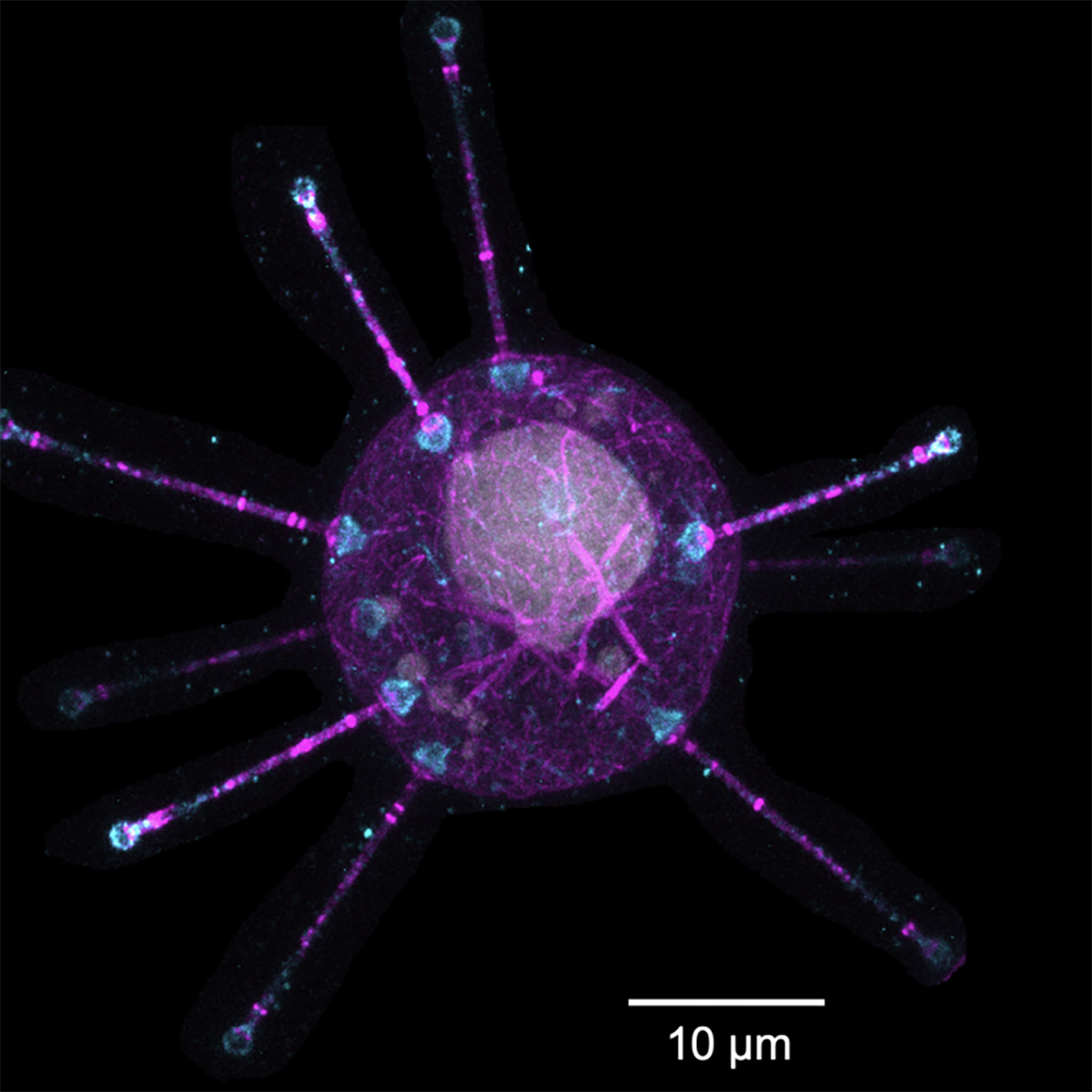
Researchers hope to figure out how, why, and when single-celled organisms adjust their tentacle number. Image courtesy of the Coyle Lab
While many of these organisms retain their original structures and proportions as they grow, P. collini can increase or decrease its number of appendages to suit its environment. In lean times, it sports fewer, longer tentacles that probe the surrounding water in search of prey. When prey is plentiful, it rapidly produces dozens of new tentacles to maximize prey capture.
“Normally, when we think about how biological structures scale, we expect different features to change proportionally: a larger structure should have corresponding increases across all dimensions,” says Zhejing “Maggie” Xu PhD’26. “But our observations reveal that P. collini follows a different scaling logic. Changes are biased toward increasing tentacle number rather than tentacle length.”
Figuring out how, why, and when single-celled organisms adjust their tentacle number has been the quest of Xu and biochemistry assistant professor Scott Coyle. The researchers first watched P. collini under a microscope after a trip to Lake Mendota along UW–Madison’s campus. Their interest was piqued by the morphological differences among individuals.
Coyle, Xu, and other researchers scanned hundreds of thousands of individual P. collini cells to determine the number and spatial distribution of their tentacles under different environmental conditions, including varying the amount of available prey.
“There is a lot of basic research to be done on this organism because the only literature you can find is back in the 1970s and 1980s,” says Xu. “I really feel like I’m communicating through time, talking to people who did research 50 years ago.”
Published in the Winter 2026 issue



Comments
No comments posted yet.