“Excellence Can Become Contagious”
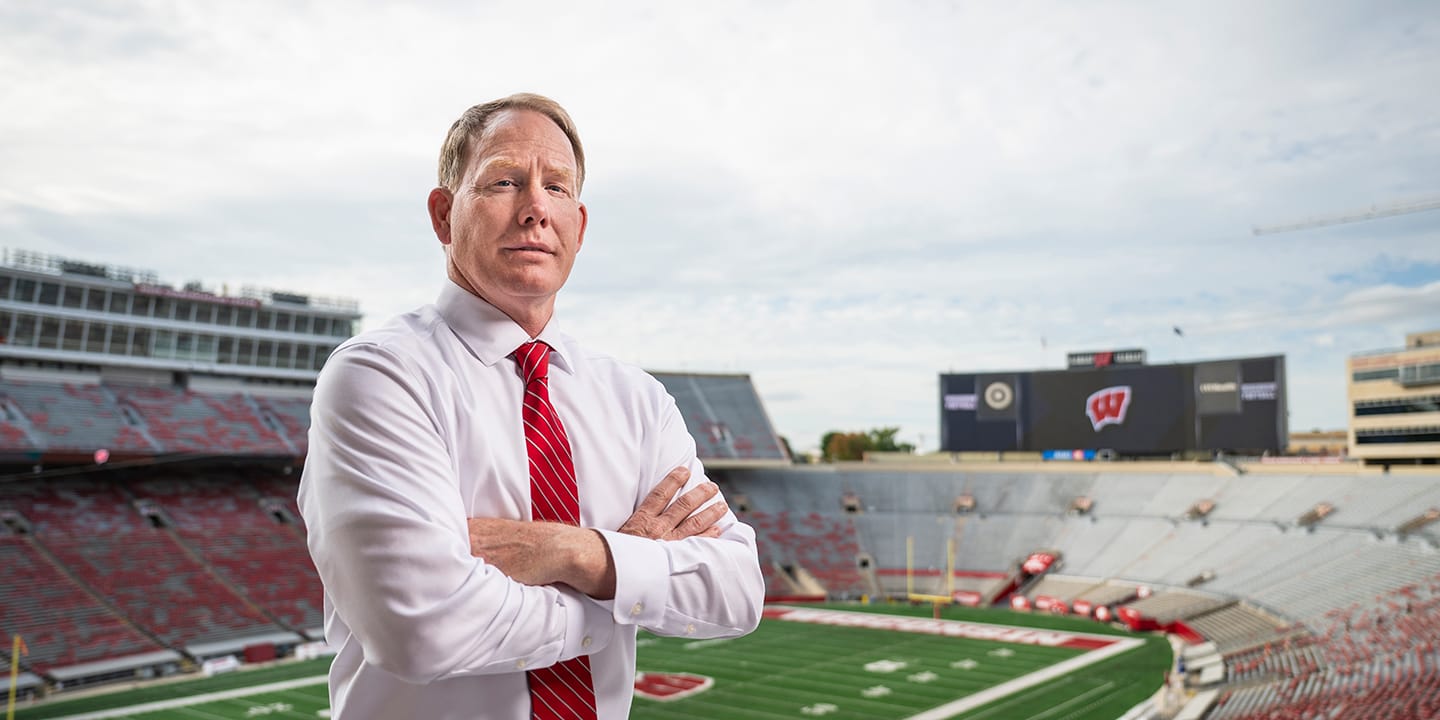
Amid dramatic changes in college sports, new athletic director Shawn Eichorst aims to position UW–Madison as a leader.
A lot has changed in the landscape of college athletics in the 15 years since Shawn Eichorst last worked on campus. What hasn’t changed is that UW–Madison still feels like home.
Eichorst, who started as UW–Madison’s new athletic director in July, has all the credentials of a true Wisconsinite. He grew up in the small village of Lone Rock, played college football at UW–Whitewater, earned his law degree at Marquette, and climbed the administrative ranks at Wisconsin Athletics under Barry Alvarez from 2006 to 2011.
“I know what this university means to people across the state because it has meant so much to me and my family,” he says.
Eichorst’s homecoming follows stops as athletic director at Miami and Nebraska and an eight-year run at Texas, where he served as deputy athletic director and chief operating officer for a department that won the Learfield Directors’ Cup for the overall success of its teams in five of the last six years.
Eichorst will draw on that deep experience and a legal background as he guides UW–Madison through a new era of college athletics, which includes direct revenue sharing and third-party NIL (name, image, likeness) deals for student-athletes; a largely unfettered transfer portal; and ongoing questions around player eligibility.
In a conversation just weeks into the job, an even-keeled Eichorst shared why he believes “Wisconsin has a chance not only to navigate that change, but to be one of the institutions that helps lead through it.”
How does your personal history shape your belief in college athletics?
Growing up down the road in Lone Rock, and as a first-generation college student, I couldn’t have imagined as a young person that these opportunities could be available to someone like me. When I was competing in athletics, education always mattered the most. You took care of your schoolwork for the privilege to compete in athletics, and that led me to the path of being a lifelong learner. Athletics was just the key to unlock the box of opportunity. I always say it to our student-athletes — coming here is a decision they’re making for the next 50 to 60 years, not for one to four years.
You’ve talked about recentering the value of a UW education when it comes to the student-athlete experience. What does that look like?
We absolutely have to be competitive in NIL and in the benefits we provide student-athletes. That is part of college athletics today. But I never want us to undersell the rest of the Wisconsin opportunity. You can come here, compete at the highest level, receive a world-class education, build lifelong relationships, and become part of an alumni network that can change your life long after your playing days are over. That complete experience is incredibly powerful. So we want to lead with the academic piece and articulate how valuable of a decision and investment is being made by the young person, then counterbalance that with the benefits that come behind it.
What did you learn at Texas about sustaining an elite, broad-based program?
The biggest lesson was that excellence can become contagious. You’d see it when athletes from various sports would come together on the training table or at lunch. It was a flywheel of competitiveness and high standards. When people see programs across the department competing for championships, it raises everybody’s expectations. It also reinforced how important alignment is. Great coaches and student-athletes matter most, but they need strong support around them — sports medicine, performance development, academics, facilities, fundraising, and administration. When all of those pieces are working together, special things can happen.
In this new era, what changes do you think are necessary for college athletics?
Some stability would be a very good start. There are different state laws, ongoing litigation, and rules that continue to change. It’s difficult for student-athletes, coaches, and institutions when the framework keeps moving. I’d like to see clearer national standards that protect student-athlete opportunities, allow institutions to compete fairly, and preserve what is special about college athletics. We need a model people can understand and that can actually endure.
You practiced law for a number of years. How has that background helped you?
It taught me how to think through complicated issues, ask questions, and understand risk. That certainly helps in college athletics today because there are legal issues almost everywhere you turn. But the longer I’ve been in leadership, the more I’ve learned that the answer usually isn’t just legal. It’s about people, judgment, relationships, and understanding what is best for the institution.
What will success look like to you in this role three to five years from now?
I’d love for people to look at Wisconsin Athletics and see a department that is competing for championships across the board, providing an extraordinary experience for student-athletes, and making the university and state proud. I also want our student-athletes, coaches, staff, campus, alumni, and fans to feel that we’re building something together. I really believe that when Wisconsin is united — when we all pull in the same direction — there is no limit to what we can accomplish.
Published in the Winter 2026 issue


Comments
No comments posted yet.