Museum, Reimagined
With innovative changes to its gallery space, the Chazen offers a bold new perspective on the collection.
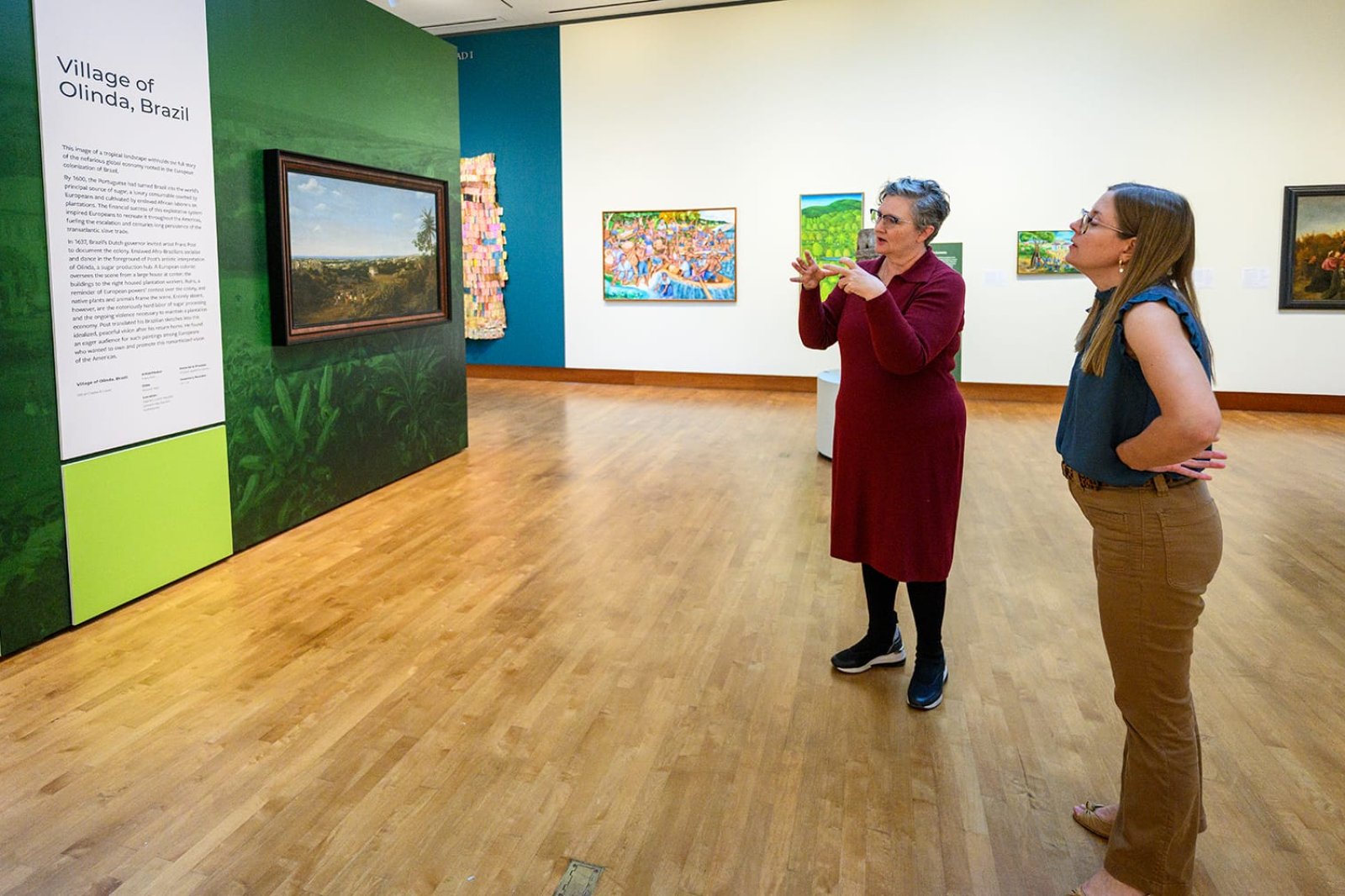
Among the 25,000 works in the Chazen Museum of Art’s collection is a striking 17th-century painting called Village of Olinda, Brazil. Most visitors have never seen it, as it was rarely on view before. Now it’s front and center in one of the Chazen’s newly reimagined galleries — not for what the artist painted, but for what he chose to leave out.
Frans Post is believed to be one of the first European artists to go to the Americas and paint landscapes for wealthy collectors. Although Village of Olinda, Brazil has been in the Chazen’s holdings since 1913, it never quite fit into any of the existing galleries — not really Baroque or contemporary European — and so it spent much of its life out of view.
Now, the painting is on prominent display because of an innovative reinstallation project several years in the making, one that transformed the entire museum. The Chazen no longer organizes its collection by time period, media type, or geography, but instead anchors each new gallery space with a focus object surrounded by thematically connected constellation objects.
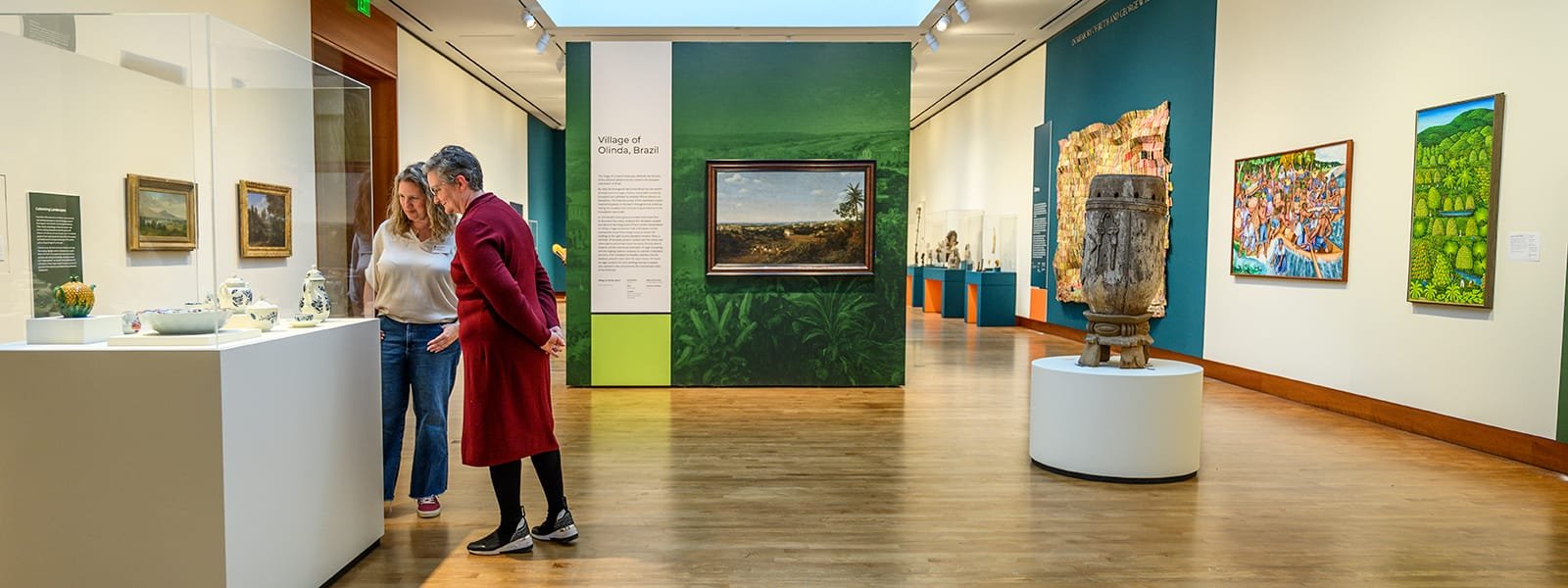
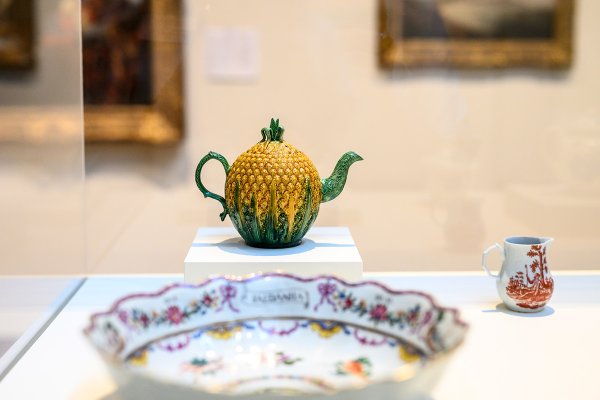
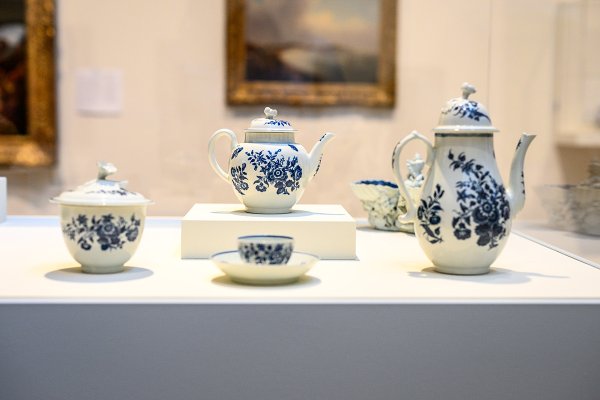
Village of Olinda, Brazil is now surrounded by artworks that add depth and context.
“To me, this painting was just screaming to be a focus object,” says former Chazen curator Janine Yorimoto Boldt, who recognized that it pleasantly depicted a handful of laborers tending the idyllic sugarcane fields in the Americas — but neglected to show the brutal infrastructure of Brazil’s thriving sugar trade, dependent on forced labor by hundreds of thousands of enslaved Afro-Brazilians. The painting is now surrounded by artworks that add depth and context, like an 18th-century porcelain sweetmeat stand that speaks to themes of labor and luxury. In this way, curators can launch powerful conversations.
Village of Olinda, Brazil is a focus object in Gallery XIII, one of 24 new gallery spaces reinstalled across the Chazen’s two buildings. Nearly a quarter of the artworks haven’t been on display since at least 1997, and 16 percent are newly acquired since 2021. In addition to revealing deeply researched, newly discovered connections throughout the entire collection, the reinstallation project debuts bold new paint colors and other design elements customized for each gallery space; explanatory wall texts aimed at making the collection more engaging and accessible; and a new Bloomberg Connects digital guide that offers maps, audio artwork descriptions for low-vision visitors, self-guided tours, and exclusive audio features, including contributions from UW professors.
“From the start,” says Kate Wanberg ’10, exhibition and collection project manager, “the entire team recognized that if we were going to do this, we had to go big.”
An Epiphany
Chazen director Amy Gilman had wanted a reinstallation since taking the helm in 2017, but she just couldn’t decide on the right model. Nothing precisely fit the Chazen’s collection, which has a lot of breadth but not necessarily depth. About 70 percent of artists are represented by only one work, for example, and holdings heavily favor the 19th and 20th centuries. Organized in the traditional way, this rich collection could sometimes appear thin. Additionally, museums all over the country were rethinking their collections, particularly in the wake of 2020’s wave of racial reckoning. They grappled with things like statue removal and how art is acquired, exhibited, and contextualized.
Then, in 2023, two critical things happened: the landmark re:mancipation exhibition and the epiphany that followed.
re:mancipation began with a polarizing 1873 sculpture in the Chazen’s holdings, Thomas Ball’s The Emancipation Group, which depicts Abraham Lincoln towering benevolently over a kneeling, newly freed enslaved person. Rather than simply removing the sculpture, Gilman commissioned New York artist Sanford Biggers and the MASK Consortium to offer an interpretation. The project took two years and evolved into a 3,367-square-foot installation of 42 new, borrowed, and existing artworks that, taken together, recontextualized Ball’s piece. Each new object essentially orbited the original, encouraging viewers to rethink instead of erase.
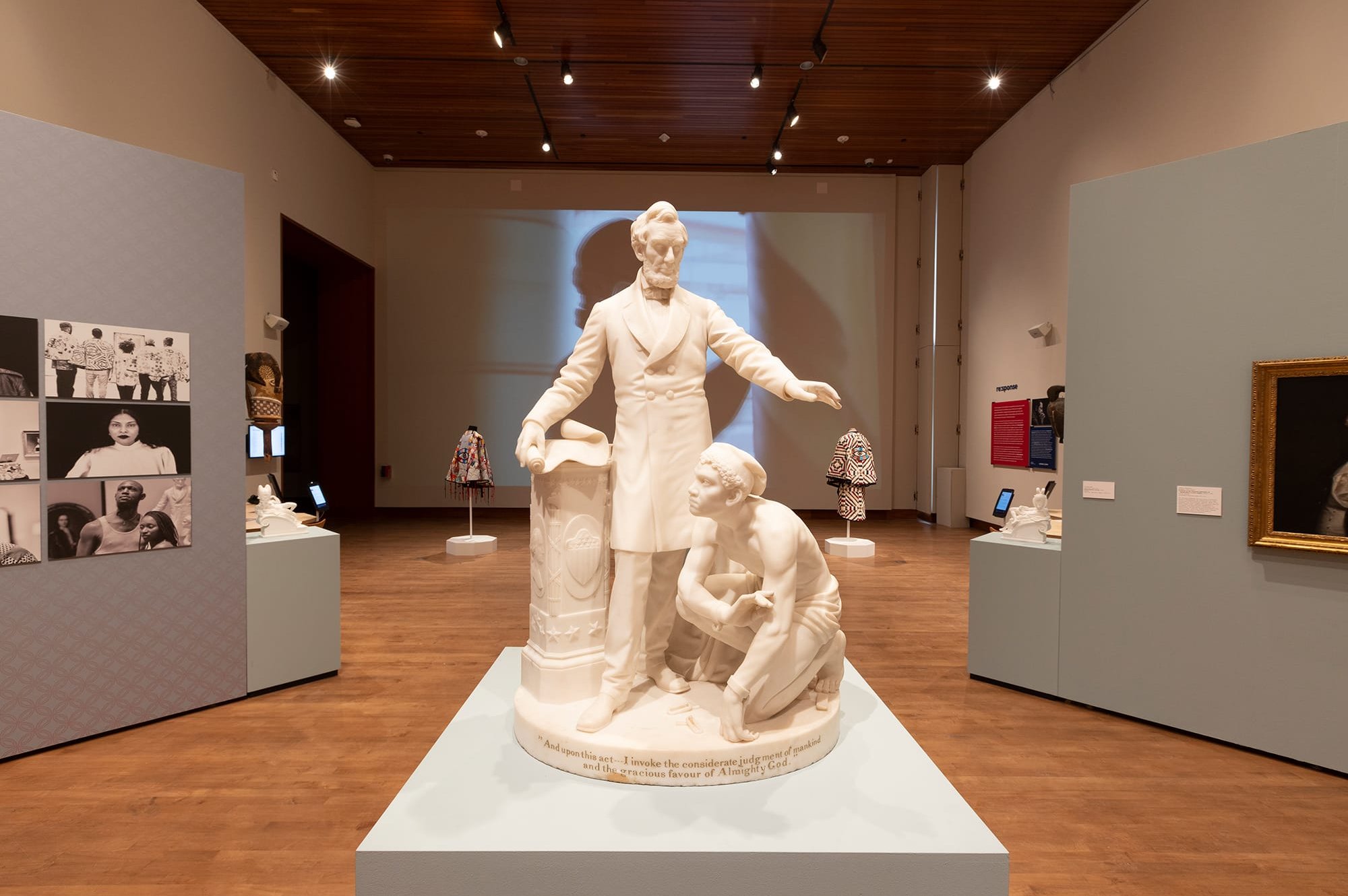
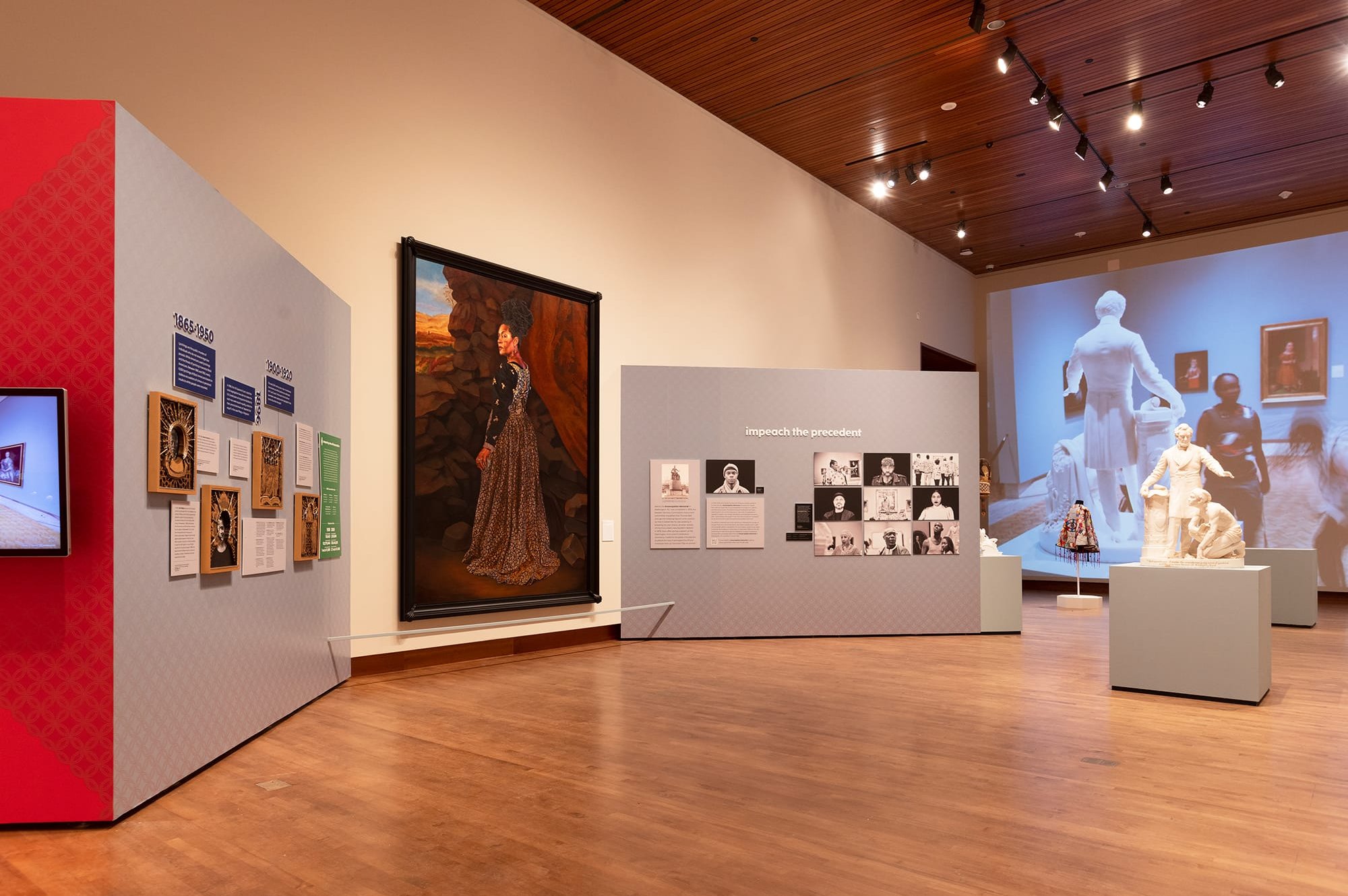
Recontextualizing Thomas Ball’s polarizing sculpture The Emancipation Group inspired the Chazen’s new approach.
A few weeks after the exhibition closed, inspiration struck chief curator Katherine Alcauskas.
“I thought, what if we reorganized the entire collection in the spirit and style of re:mancipation? What if each gallery had a single focus object surrounded by thematically connected constellation objects that together told a deeper story?”
Gilman and the staff were immediately on board. Now they could pull from all areas of the collection, regardless of period or place. They could think outside every box and flip challenges into strengths.
“To me, in that moment was this incredible feeling of joy,” Gilman says, “knowing that we were going to do something that I was already pretty sure had not been done.”
The curators hope the reinstallation will help launch powerful conversations about the Chazen’s collection.
Over the next three years, the staff formed work groups, built mood boards, and embarked on visual mapping exercises. They dove headlong into research, enlisting campus experts and conducting community workshops, particularly around culturally sensitive holdings. And they drafted and revised 24 gallery concepts, refining right down to the precise shade of paint.
It was a big idea, and it fell to Wanberg to execute the nuts and bolts. Over the years, she’d navigated substantial changes at the Chazen, including the museum’s 2011 expansion, but nothing of this scope. Staff members were used to producing two big exhibitions and three smaller exhibitions each year in about 8,000 square feet of space, but now they were tasked with the equivalent of planning 24 simultaneous exhibitions across 50,000 square feet. Wanberg worked to carry out the curators’ visions while managing the deadlines for each gallery, from mood board to final reveal.
An Accident
Throughout the newly reinstalled museum are examples of unfamiliar artworks brought into the light, or of familiar artworks shown in a new light.
Take the 1831 Lady Caroline Montagu portrait, long a guest favorite. For the past 20 years, curators believed the aristocratic Lady Caroline was dressed up in costume as the character Haidée, a Greek pirate’s daughter in Lord Byron’s poem Don Juan. But during the research process, they consulted Nancy Rose Marshall, a UW professor of 19th-century art and visual culture.
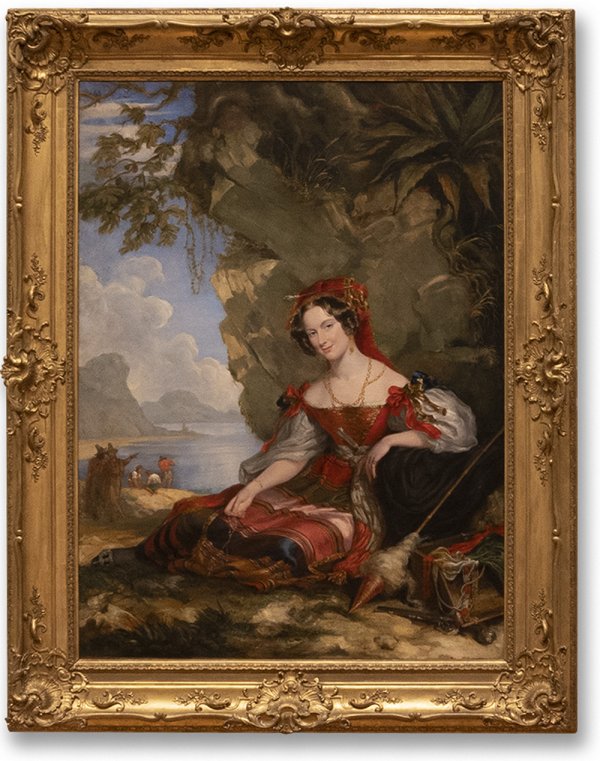
“You know,” Marshall replied, “I’ve always wondered about this costume. Are you sure she’s Haidée? To me she looks more like she might be in the character of a brigand’s wife.”
It turns out Marshall was right. Brigands regularly attacked aristocratic travelers in the Italian countryside but were also romanticized in popular art as folk heroes in the vein of Robin Hood. Now, as a focus object, the painting could bring in new constellation items to prompt conversations around class, costuming in portraiture, and artistic inspiration in literary references. It was one of those discoveries that leveraged university expertise, allowed for research-based change, and cast a popular holding in a new light — all things that staff hopes will continue, supported by the new model.
And then there’s the two-piece walnut Renaissance cabinet, ornately carved with classical European figures. Probably built in France in the 1500s, acquired by Jewish collector Oscar Bondy in 1910, and seized by the Nazis in Vienna in 1938, it had been restituted to the Bondy family before the Chazen purchased it in 1969. For years it was housed with other furniture lining the hallway on the lowest level of the Elvehjem building. But when staff members pulled it from its glass casing, they discovered the Nazi inventory number scrawled on the back — and curator James Wehn realized they’d accidentally found the perfect focus object.
“This was an object that could do so many things,” Wehn says.
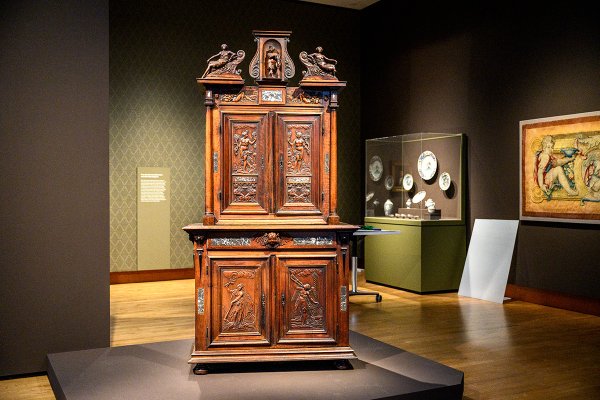
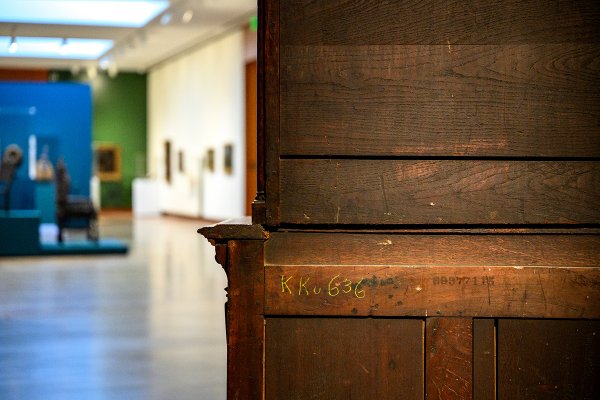
The Renaissance cabinet now tells a deeper story. Visitors can see the Nazi inventory number scrawled on the back.
Today the cabinet — shown in the round — anchors Gallery XIV, surrounded by constellation artworks that connect some of the Chazen’s strongest holdings, like Wiener Werkstätte decorative art related to the Vienna Secession, German Expressionist prints, and a trove of historical medals tracing events and politics from World War I through the rise of the Nazi Party. The cabinet also bears traditional symbols of abundance and power, as do some of the German medals, including those used as Nazi propaganda. To responsibly tell this larger story of art, theft, and fascism, Wehn consulted campus experts from both Jewish and German studies.
“We want to help people understand how images can be adapted and turned into new forms of meaning,” Wehn says.
A Revelation
Gilman had never been particularly attracted to the Chazen’s collection of Chinese export porcelain, which used to be tucked behind glass in one of the Elvehjem building’s pass-through niche spaces. They now hang prominently on the wall in Gallery XII, artfully arranged as they would have been in 17th-century palaces and surrounded by objects that add intriguing context.
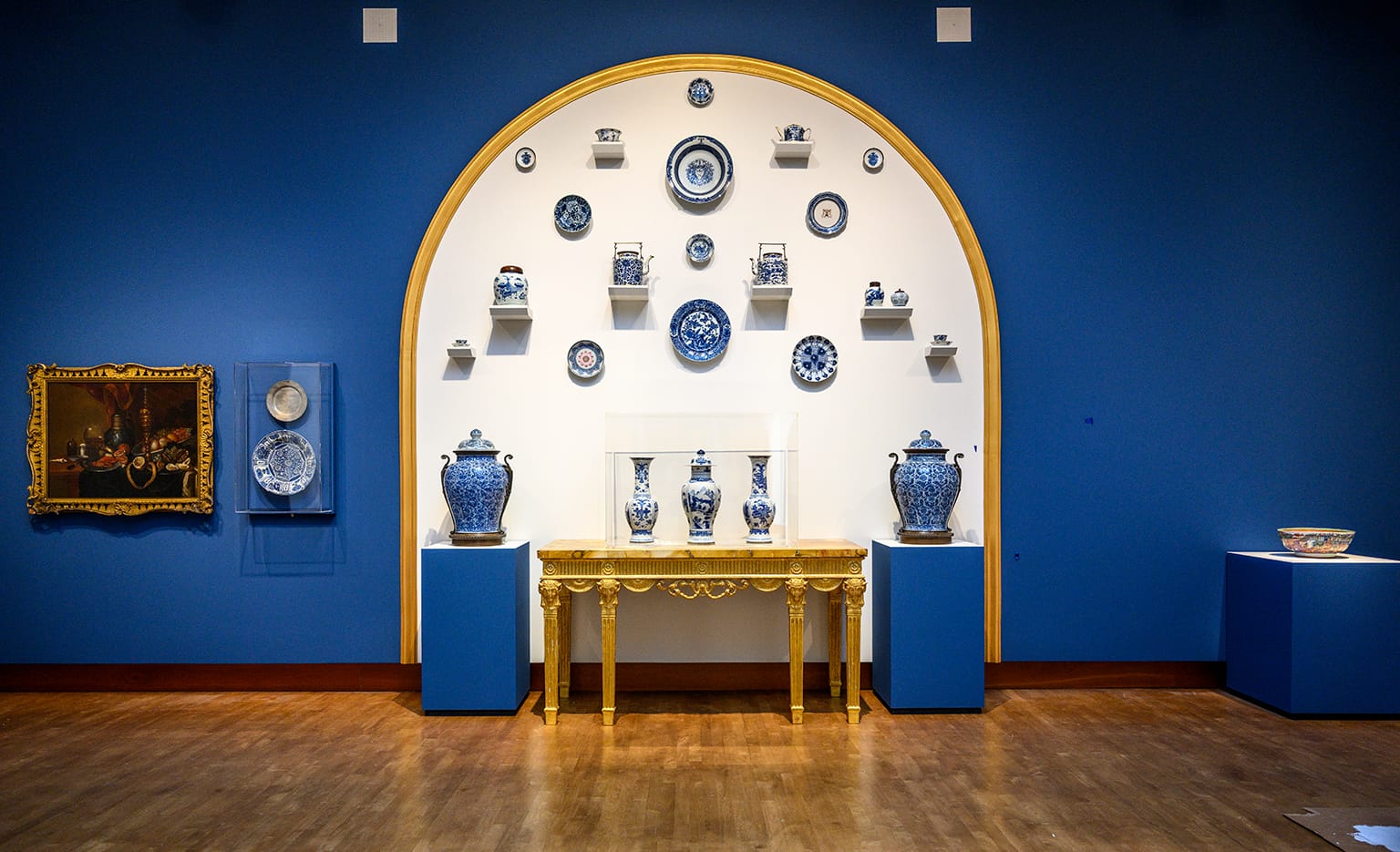
“Now they are deeply fascinating to look at,” Gilman says. “We’ve done that in several of the galleries where you can actually see things that are not typically revealed about the objects. It’s been a revelation to me, and I think it will be for a lot of visitors.”
Gilman hopes that these revelations continue well into the future. This is, after all, a university museum, and college campuses are ripe for experimentation. The Chazen’s reinstallation project has been a teachable moment unto itself.
Maggie Ginsberg ’97 is the writer for UW–Madison’s Division of the Arts.
Published in the Winter 2026 issue.
Comments
No comments posted yet.