Teaching the World to Move
UW–Madison’s dance department — the oldest in America — turns 100.
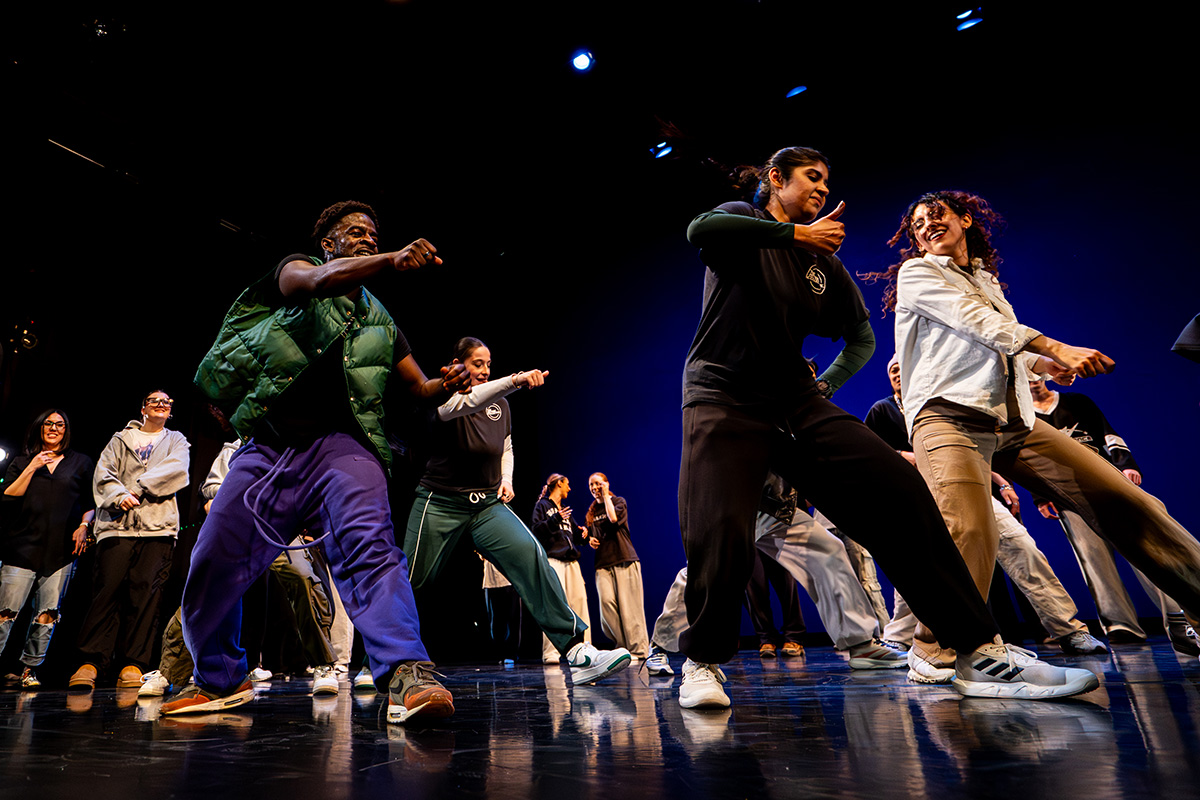
UW dance students and members of the group Hitterz Collective perform at Lathrop Hall during Moonshine 2026, a spring semester event sponsored by the department. For 100 years, the UW has been a leader in dance studies. Xiaomeng Shen
UW–Madison holds a special place in the history of American dance: in 1926, under the direction of Margaret H’Doubler 1910, MA1924, the UW created the nation’s first university-based program for the study of dance as an academic discipline. From that beginning, generations of dancers, choreographers, and instructors have carried the Madison influence to stages and studios around the nation. This year, UW–Madison is honoring a century of dance with a yearlong celebration.
H’Doubler was a coach and physical education instructor, and she revolutionized dance studies by mixing creativity with physiology. She founded Orchesis, the UW’s modern dance troupe, and wrote a seminal textbook, Dance: A Creative Art Experience — and she also famously kept a human skeleton in her classroom to teach her students to appreciate anatomy as much as artistry. A century later, the UW’s dance program is still closely connected with kinesiology.
According to Professor Li Chiao-Ping, the incoming department chair and director of the celebration, the birthday party began in April 2026 and continues through May 2027. It involves a faculty concert, alumni appearances, and visiting artists, including choreographer Tiffany Merritt-Brown ’16. But the program is also receiving something of a birthday gift: a new master of fine arts degree program begins this fall with a cohort of four graduate students. The UW hasn’t had a dance MFA in decades — “not during the career of any of us on the faculty now,” according to Li. The new degree will help the UW reassert its place as the springboard of American dance thinking.
“We can probably trace everyone [involved in dance and dance education today] back to someone who was influenced by the ideas that were innovated here,” Li says.
Published in the Fall 2026 issue



Comments
No comments posted yet.