
Making Crypto Less Cryptic
Brad Chandler’s UW finance class teaches students about what some see as the future of money.
Cryptocurrency tends to incite strong pro and con reactions — often from the same person. Shark Tank investor Mark Cuban told Forbes in 2019 that crypto was “too difficult to use, too easy to hack, way too easy to lose, too hard to understand.” He later purchased a substantial portfolio of the digital currency with a generous allotment to Bitcoin. He has since reverted to a more skeptical position and sold much of it off. Others who have done similar 180s include BlackRock CEO Larry Fink (who reversed his stance on Bitcoin from “an index of money laundering” to “digital gold”) and President Donald Trump, who went from calling crypto a scam in 2021 to attempting to make the United States the “crypto capital of the world.”
Whether you think cryptocurrency is a racket that creates money out of nothing or a brilliant way to sidestep inflation, there’s no doubt that it has seen unprecedented institutional adoption in recent years.
Despite that, many people still don’t have a firm grasp of what it is. That isn’t the case for the students in the Wisconsin School of Business class Finance 765: Cryptocurrencies, Blockchain and Digital Access.
UW–Madison was one of the first universities to offer this type of class when Brad Chandler, who teaches finance at the school, created it in 2018. Since then, it’s evolved from a 1-credit to a 3-credit elective. Chandler says he tries to approach the material from a factual, neutral standpoint. “DeFi [decentralized finance that is not under the control of banks or governments] is an alternative to our traditional system. As finance majors, they need to understand this world.” Chandler adds that “contrasting DeFi with traditional finance teaches us important lessons about both.”
On a February Thursday in Grainger Hall, some 50 students listened to a remote presentation by a legal adviser at Yellow Card, which uses digital assets to expedite cross-border transactions in Africa. Next, each student accessed $20 provided by the business school to set up a personal MetaMask wallet, which offers a way for users to purchase and store crypto. “I’m not giving you funds to YOLO out of class,” Chandler cautioned to appreciative laughter. Class members were then assigned sides to debate whether cryptocurrency is a viable option for unbanked populations in emerging markets.
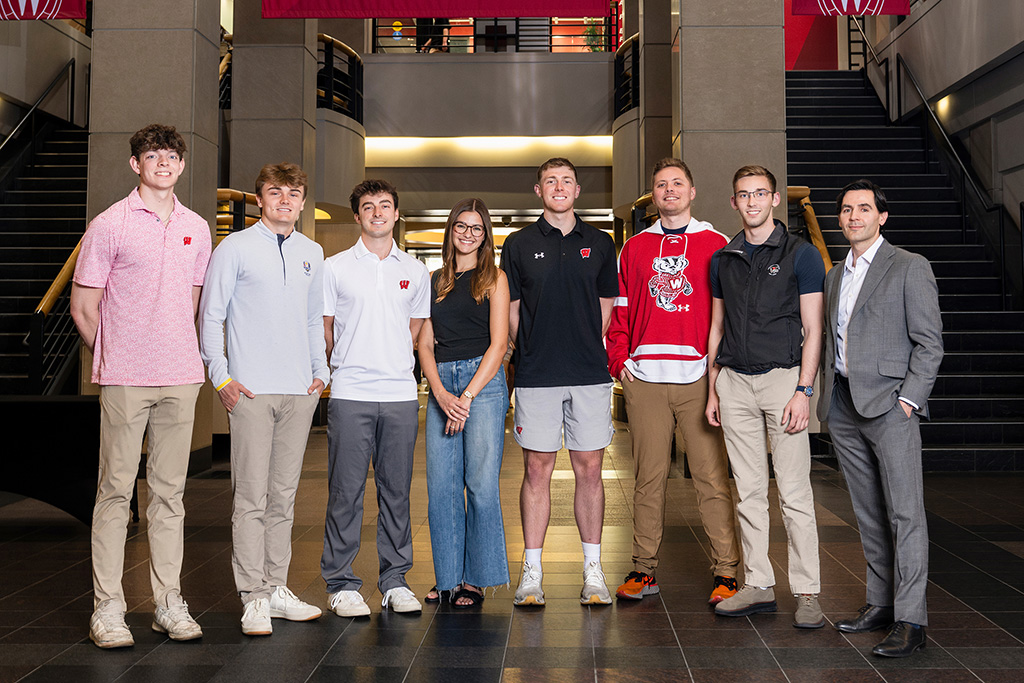
Chandler, far right with class members, has told his students that he doesn’t know everything about the crypto space because it’s so new and changing so rapidly, and that he can learn from them just as well as they can from him.
The Alum
Chandler gives a lot of credit for the class to Chris Kaczmarczyk ’16, who helped him design the curriculum. Kaczmarczyk, who is a principal at the tech-focused venture capital company Third Prime, also assists with recruiting guest speakers and serves as a speaker for the last class to help ground the students in the real world.
“Brad’s course sells out instantly almost every year,” Kaczmarczyk says. He adds that Chandler brings a lot of credibility because he spent several decades in the traditional finance industry, serving as a managing director in the investment banking division for global financial giant Morgan Stanley, so “he understands how the infrastructure works.”
Chandler has seen the shortcomings of traditional finance firsthand, and he became intrigued with the potential for crypto and blockchain technology to help solve some of those problems. Still, Chandler maintains a certain degree of skepticism, saying that he wants to see “a sober assessment of DeFi’s possibilities, not unfounded promises.” But the finance instructor wants students to form their own opinions, so he doesn’t try to steer anyone in one direction or the other.
Kaczmarczyk, on the other hand, is not reluctant to share his position. “At the end of the day, this technology is very useful, right? It’s only going to make things cheaper, faster, and better for all consumers.”
He adds that UW–Madison “definitely punches above its weight” in terms of alumni leaders in the cryptocurrency industry. (See the Badger Blockchain Trailblazers sidebar, below.) “We’ve actually had a lot of movers and shakers in the space, despite its being such a nascent industry.”
Glossary
Altcoins
Any cryptocurrency other than Bitcoin. This includes thousands of other tokens and projects.
Blockchain
A shared digital record (like a public spreadsheet) that tracks transactions. It is stored across many computers, making it hard to change or tamper with.
DeFi (Decentralized Finance)
Financial services (like lending, borrowing, and trading) built on blockchain networks, without traditional banks or intermediaries.
Exchange
A platform where people buy and sell cryptocurrencies. Examples include Coinbase, Binance, and Uniswap.
Fintech
Short for financial technology, this term refers to the use of software, AI, and digital platforms to streamline financial transactions. (The payment app Venmo is one example.)
FUD (Fear, Uncertainty, Doubt)
Negative or alarming information — sometimes exaggerated or misleading — that can cause people to sell or avoid an investment.
HODL
A slang term meaning “hold” (originally a typo). It refers to keeping your crypto long-term instead of selling.
Mining
The process of using computers to validate transactions and add them to a blockchain. Miners are rewarded with new cryptocurrency.
Stablecoins
Cryptocurrencies designed to keep a stable value, usually tied to a currency like the U.S. dollar (e.g., 1 coin ≈ $1).
Staking
Locking up cryptocurrency to help secure a blockchain network and earn rewards in return.
Wallet
A tool that lets you store and use your cryptocurrency. Hot wallets are connected to the internet (easier to use, but more vulnerable to hacking). Cold wallets are offline storage (much safer, but less convenient).
Whale
An individual or entity who owns a large amount of cryptocurrency and can influence market prices.
— Courtesy of Brad Chandler
What Is Crypto?
The financial firm Fidelity Investments offers one of the simpler definitions of the alternative asset: “Crypto is a digital currency, meaning it runs on a virtual network and doesn’t exist in physical form like paper money or coins. Cryptocurrencies are often built using blockchain technology, a shared digital ledger that provides a secure recordkeeping and processing system for all of their transactions.” (See sidebar.)
Or, in the opinion of people such as my 90-year-old aunt Marian, it’s “fake money.”
Bitcoin was the first cryptocurrency, and it was followed by thousands of others, with assets such as Ethereum, XRP, and Solana boasting the largest usage. Bitcoin was famously created by the pseudonymous Satoshi Nakamoto in 2009. Many sources have tried to identify Nakamoto over the years, with one recently naming British crypto entrepreneur Adam Back, and another pointing to the duo of cryptographer Hal Finney and computer scientist Len Sassaman, both now deceased. Nakamoto’s 1.1 million bitcoins have never been sold, and today they have an estimated value between $70 billion and $130 billion, depending on the current price.
Nakamoto centered his innovation on blockchain technology to eliminate the middleman role played by banks, which have traditionally processed and verified payments. Anyone can see the transactions, providing transparency, and the transactions cannot be altered or deleted. Blockchains are also used for things like tracking supply chains, maintaining health care data, and managing public records such as land titles and marriage licenses.
A message encoded in the first block on the blockchain implies that Nakamoto may have been motivated by the banking crisis of 2008, which was triggered by a mortgage crisis and led to bank failures, government bailouts, and the Great Recession. In a white paper, he outlined plans for “a purely peer-to-peer version of electronic cash [that] would allow online payments to be sent directly from one party to another without going through a financial institution.”
Cryptocurrency is notoriously volatile, with Bitcoin swinging from a high of $126,198 per coin in October 2025 and then dipping back to below $60,000 the following spring. But bitcoin billionaires who bought in when the price was in the single and double digits have now become the stuff of legend, inspiring legions of enthusiasts to search for the next big breakout coin in hope of similar windfalls.
Crypto has also famously developed a reputation as a haven for criminal elements because it bypasses traditional banking oversight, making it ideal for money-laundering as well as scamming victims who are not able to get their money back. In the United States, the much-anticipated Digital Asset Market Clarity Act, which had not yet passed at press time, aims to provide greater monitoring of the industry and reduce illicit uses.
The Cautious Investor
Learning about scams “from an objective source” was the main reason Ryan Schwartz ’26 signed up for Chandler’s class. Schwartz, who is seeking a job in corporate restructuring, sees the prevalence of bad actors as “a very big downside” with crypto. But he admits that a significant advantage is how quickly people can make transactions (minutes, compared to bank transactions such as international wire transfers, which can take days). And he also likes the fact that users can avoid the high fees associated with traditional finance.
Schwartz, who graduated with a degree in finance and real estate, was surprised that the course didn’t just cover investing — it also focused on topics such as cryptography, the construction of blockchains, stablecoins (which some say is the most important invention in all of crypto), decentralized lending, and decentralized exchanges.
Overall, Schwartz favors a prudent approach. Before taking the class, he had not personally invested in crypto. “I wanted to complete the course first,” he says. Now that he has graduated, however, he is considering putting a tiny percentage of his future retirement account (only an amount that he would feel comfortable losing) into Bitcoin.
“I like the fact that the class was very discussion-based,” Schwartz says. “We got to hear a wide range of opinions, which is really helpful.”
The True Believer
Keenan Vanden Heuvel MBA’26, who was one of six graduate students in the class, is not so worried about crypto’s criminal element. He counters that “there are bad actors on the internet, but we don’t throw the internet away.”
Vanden Heuvel started investing in crypto five years ago, and those investments have done as well as or better than his traditional holdings. “It’s one of those things where it’s like, man, I should have put all my money into it,” he says. Despite the recent downturn of early 2026, he was still up more than 100 percent. “I think there’s potential for a lot more growth, and it’s still early.”
Vanden Heuvel got into the alternative investments “because the regular markets are only five days a week, like office hours, but crypto is 24/7.” Like many investors, he’s learned to live with the volatility. “It is tough when you see [the value of your holdings] almost cut in half, but after a while, you get calmer about the big ups and downs.”
The May graduate hopes to get a job with a blockchain or crypto company, so he was in his element in Room 1280 Grainger, which is typically filled to capacity for the class’s twice-weekly meetings. He’s impressed that “the university has an actual blockchain class taught by a really great finance professor,” and that it enhanced his understanding of the digital system’s underlying concepts. He was also active in Badger Blockchain, a student organization that Chandler advises, which advocates for emerging finance.
Vanden Heuvel believes that everyone should care about crypto because it’s a growing part of what’s happening in everyday finance. But he thinks that young people are more open to the alternative currency, “because they see that you lose like 1 percent to 2 percent per year to inflation” with conventional cash. Some of the reports that the students read in class, he says, recommended putting 1 percent of retirement portfolios in crypto as a hedge against inflation.
What about people who believe this financial innovation is eventually going to disappear? “I was hearing these arguments when the price of Bitcoin was $2,000,” Vanden Heuvel says. “With all the companies adopting blockchain technology, it’s not going to go away.”
The Beginner
Thomas Dupont ’26 also graduated in May with a major in finance and real estate. He is grateful to Chandler for encouraging him to apply for his job as a credit research analyst and account manager in Chicago, which Dupont was scheduled to start in August. He also appreciates Chandler’s breadth of knowledge. “The class has opened up a totally new world of finance that I didn’t know existed,” he says.
Dupont had not invested in crypto before because he didn’t know enough about it, but he now feels that he has the skills to assess it, and he may include crypto in his retirement account. “I believe that risk is worth taking,” he says. “I can see a world where there is rapid growth, and I wouldn’t want to be left behind.”
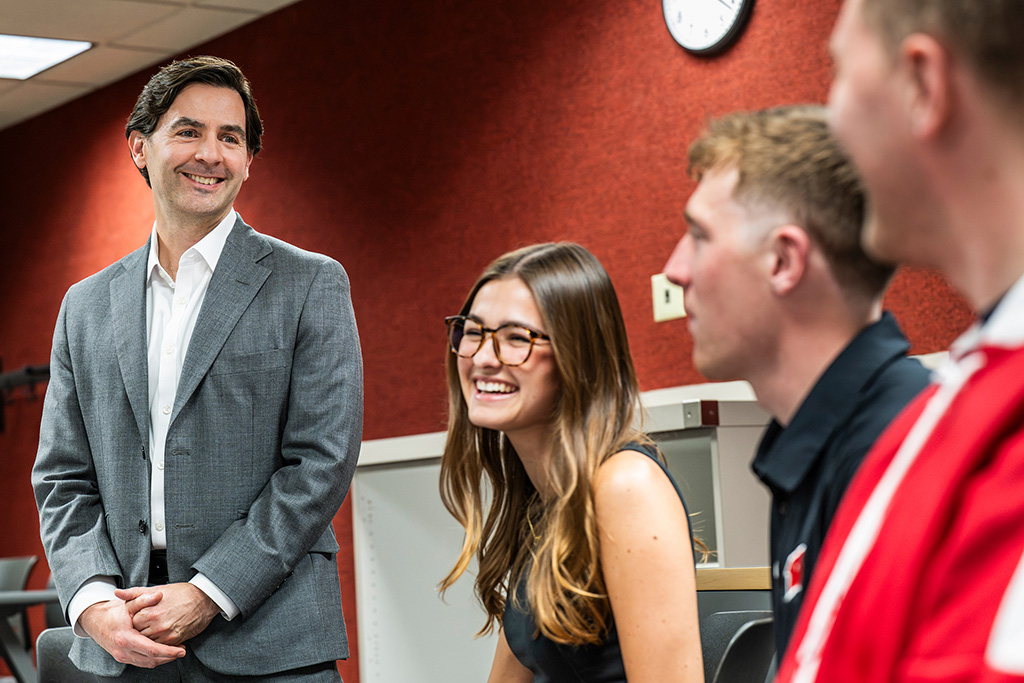
Chandler chats with Emma Wells and Thomas Dupont after class. In addition to crypto, the class covers a number of DeFi products such as stablecoins and decentralized lending and exchanges.
A disadvantage of crypto in Dupont’s eyes, however, is that learning how to access it “tends to be very difficult.” Each student in the class was given a $15 balance to exchange between USDT (a stablecoin, which is designed to maintain a fixed value) and Ethereum on different platforms. “Even in a classroom setting, I found myself asking for help from the people around me, because I couldn’t figure it out,” he says. “I think people might prefer to stick with what they know rather than go through all these hoops that they may or may not understand. … You just kind of need to work through it.”
At the same time, Dupont was happy that the class provided these types of hands-on opportunities so he didn’t have to teach himself. “It would take me so much time to figure all these things out, so having a class like this in college is 100 percent worth it.”
The Lifelong Learner
Emma Wells ’26, a real estate and finance graduate, plans to start a job in multifamily real estate development in Green Bay in September. The class exceeded her expectations. “I really like the structure of the course and the way that we learn and apply as we go.” Crypto has something of a stigma, she says, “but now I’m realizing that a lot of that is just misinformation.”
Another revelation for her was that it’s not just about Bitcoin. “There are a lot of different systems that I think will be integrated into what we currently know as the financial system,” she says. “I think it’s really important to stay current and understand these new technologies as they come out.”
Wells sees the currency’s volatility as a downside, as is another pitfall that they discussed in class: “lack-of-education risk.” Crypto is very complex, she says, and “it’s easy to fall into a trap of thinking that you understand a certain protocol when in reality, you might not.” Novices can lose funds in an impressive variety of ways. Just for starters, they can accidentally send crypto to the wrong address, fall victim to scams, or lose their password — all of which result in irreversible financial losses.
“But it’s not necessarily anyone’s job to teach people about the traditional finance system, either,” Wells says. “So that risk is present in both TradFi and DeFi. It’s your own responsibility to educate yourself about the protocol you’re using.”
Wells admits to being risk-averse and says she’d need to do more research before investing in any crypto. But she thoroughly enjoyed attending the class. “It’s really refreshing to learn about something you know nothing about.”
Niki Denison is coeditor of On Wisconsin. She’s still waiting for the $100 she invested in altcoins in 2024 to turn into generational wealth.
Published in the Fall 2026 issue


Comments
No comments posted yet.