The Case for Constructive Conversation
With the Wisconsin Exchange, Chancellor Jennifer Mnookin makes civil dialogue a campus priority.
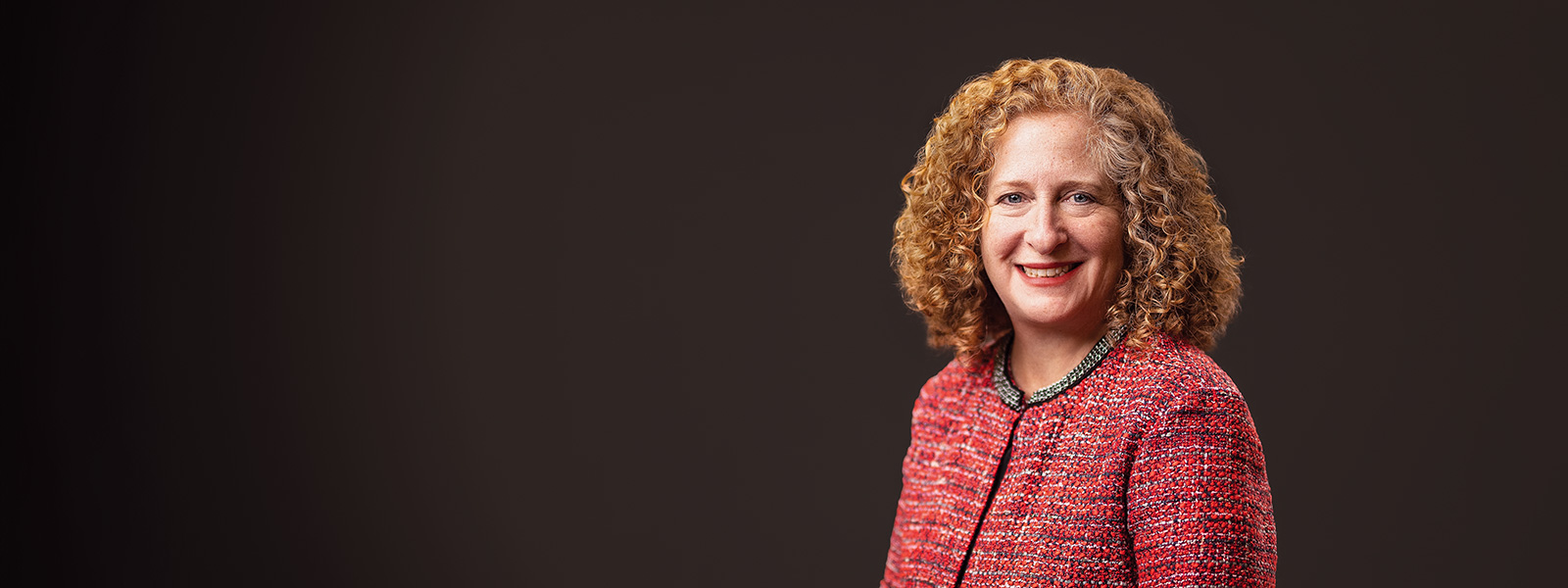
UW Chancellor Jennifer Mnookin has long been passionate about pluralism. Growing up, she often had dinner-table conversations on the subject with her father, an expert in negotiation and conflict resolution. He defined empathy as “working hard to understand the other side’s issues, needs, and perspectives.” And that’s exactly what the chancellor hopes to encourage with a new campus initiative called the Wisconsin Exchange.
Mnookin is departing to head Columbia University at the end of the academic year, but the new campus initiative is up and running. The goal, she says, is “helping students learn to engage productively with others who see the world differently from them.”
How would you describe the Wisconsin Exchange in a nutshell?
With the Wisconsin Exchange, we’re building on existing efforts and creating new opportunities to help students, faculty, and staff learn to engage, live, and lead in a polarized world. We want to make constructive conversation and civil dialogue visible and integral parts of everyday life on campus.
What are the project’s main goals?
I think it’s extremely important for our students and employees to have the opportunity to talk to and learn from people who don’t think the way they do, whether that’s a matter of their identity, their background, or their viewpoint and political differences. We want to enhance the practice of pluralism and civil dialogue as key aspects of the UW–Madison education and experience; build awareness of activities already underway; and identify new learning and engagement opportunities, both in the classroom and beyond. We want to engage the full campus community and extend bridges beyond campus through partnerships with national organizations.
What are some of the most notable programs and curricular tie-ins?
We will have talks and lectures, and some of those may take the form of debates, but some of them won’t. It doesn’t always have to be many views at the same time. We will be growing different kinds of opportunities, including a grant program where students, staff, or faculty can submit their own ideas for initiatives that widen and deepen the presence of viewpoint diversity on campus and foster dialogue across differences.
I also am excited we’re partnering with the Reagan Institute on a Common Ground Forum this spring that will bring, hopefully, well-known, high-level individuals with different views together to have a conversation. A number of our faculty have exciting ideas for curricular aspects to this initiative. We are also starting a postdoctoral program in this space, and will be further expanding the range of available activities and opportunities as the program grows.
Will there be any fun Badger elements?
I certainly hope so! The truth is, we’re just getting started and a big part of that is getting input from our own community. We are engaging students, faculty and staff in events like “Exchange in Action” to get their ideas. And not everything has to be centered on high stakes, controversial, or difficult topics. There can be viewpoint diversity on many topics — one idea recently suggested, that feels very Wisconsin, is a discussion on milk choices, which is a passionate subject for many, and with a range of perspectives.
What existing UW programs will fit into the project?
I’m very proud of what we’ve been doing with our Deliberation Dinners (run by The Discussion Project), which brings undergraduate students with different ideological and political perspectives together six times over the course of a year for a meal and focused discussions, facilitated by a trained instructor, about important and sometimes contentious political issues like gun regulation, school vouchers, or marijuana legalization. It’s now in its third year, and the students who participate in it have overwhelmingly reported enjoying the experience and gaining valuable skills that they are applying in other settings. A variety of pluralism-focused efforts are also underway in schools, colleges, and units across campus.
For example, last year the La Follette School hosted in-person community conversations around the state, with participants holding a variety of political perspectives, to give people the chance to speak to and learn from one another. And the Tommy G. Thompson Center on Public Leadership is hosting a nonpartisan discussion series called Bridging the Divide, which is for students and created by students.
How will the Wisconsin Exchange reach beyond campus?
We are already doing this through our work with national organizations like the Ronald Reagan Center on Civility and Democracy and the Institute for Citizens & Scholars. La Follette’s Main Street Agenda is another example of our work to extend our commitment to pluralism beyond campus, in service to the state. Over time, I would like to see UW–Madison serve as a national model of a flourishing, pluralistic campus and as a thought leader in this space.
Why is this program needed at UW–Madison?
I think universities need to be spaces where ideas embodied by people from different backgrounds, disciplines, and perspectives come together, for the shared purpose of teaching, learning, and producing knowledge. Doing this well won’t always be comfortable, but it’s sometimes in moments of challenge when the most growth and discovery happen. Engaging pluralistically helps us sharpen our own views, and sometimes we might even change our own mind, or realize something we thought was simple is actually more complicated.
Besides that, we are in a moment of a good deal of polarization, nationally, and a commitment to pluralism may help people to find common ground. At UW–Madison, a 2023 survey from the Universities of Wisconsin found that 43 percent of students believed speakers with offensive views should, at least in some circumstances, be disinvited from campus. Yet most students also report that exposure to diverse viewpoints is essential to their education. So, creating both a tolerance for and expectation of a pluralist community seems important to the educational process and important for training citizens and future leaders in our diverse democracy as well.
How will students, faculty, and staff benefit?
Here at UW–Madison, we are, in fact, a large and diverse community. I think we are quite good at helping arriving students — some of whom are understandably a bit intimidated by our size and scale — find their people, their groups. But then I worry that they sometimes stay in those comfort zones a little bit more than I think is in their, and our, long-term interests. We want them to be crossing those boundaries and borders and engaging with each other.
How will the wider world benefit?
National surveys show that 77 percent of Americans report having few or no friends with different political beliefs. That’s a concerning statistic for our polity. Our students are stepping into a world that is both deeply complex and distressingly polarized, and they have the power to do something good in that world. Perhaps especially if they can find ways to work with people they might not always agree with. If you know that you don’t have to agree with someone about everything in order to work with them constructively about something, you will have many more opportunities to make a difference.
How do you define pluralism, and why is it important right now?
Imagine putting together a music group. The members of the group might all be talented musicians but might also come from entirely different musical backgrounds. Some have been practicing since they were kids, some perhaps learned more recently. Some might have spent years studying classical music, others might be self-taught or learned by watching YouTube or jamming with friends in the basement. But the musicians share a goal of creating something better than any one of them could create on their own. And their best chance of doing that comes from respecting what the others bring to the group and finding ways to work together even when they bring quite varied perspectives and experiences to what they are doing together.
What will be unique about the UW–Madison approach to pluralism?
For one, we live, work, teach, research and learn in the purple state of Wisconsin, which is home to a wide range of viewpoints — and that, I think, is a strength for all of us. UW–Madison has tremendous breadth and scale, and the ability to be truly interdisciplinary in the ways that we think and operate. We also possess a wonderful school spirit and a great many people who want to live the Wisconsin Idea and make a positive difference in the world. We can bring all of these elements to bear in our approaches to engaging with one another with respect across our differences.
How does the Wisconsin Exchange fit into UW–Madison tradition?
Open inquiry is central to the university’s values since at least 1894, when President Charles Kendall Adams affirmed its duty to welcome “a vast diversity of views” and to “follow the indications of truth wherever they may lead.” The state of Wisconsin and UW–Madison are home to a wide range of voices, and we see that as a strength that we should lean into and further develop. And of course, in order to “sift and winnow” effectively, you need to consider a variety of perspectives.
What will it take to make the initiative a success?
We’ve invited students, faculty and staff to help shape the future of the initiative. We are having ongoing conversations about our shared aspirations for dialogue and debate at UW–Madison, what a truly pluralistic campus would look like, and what obstacles might stand in our way.
How will you measure success?
That’s a great question and we don’t have a complete answer except to say that this is something we’re thinking deeply about, as it’s important that we engage in efforts to measure and assess what is working well and what is not. We are looking at conducting some baseline research against which we can measure our progress. More to come on this.
How do you see the initiative evolving after the launch?
Some of the faculty on the steering committee already have ideas for courses that they want to develop. Several of our deans are excited and engaged by that as well. We’re also creating a postdoc program, where postdoctoral candidates in a variety of fields, who have an interest in pluralism and engaging across difference, can further enrich our community and also be a cohort of early career-stage scholars working and learning from one another.
How do you think students, faculty, and staff will respond to the Wisconsin Exchange?
We’ve already seen a remarkable response from students with the Deliberation Dinners. We’ve been able to triple the number of students in this program in just two years and still can’t accommodate all of the interest. There are those who believe that learning to engage peacefully and thoughtfully with people whose life experiences and viewpoints differ from our own is optional, or even unwelcome. I disagree. This work is foundational to what we need for our students, our institutions, and our democracy.
Published in the Spring 2026 issue

Comments
Gard Edgarton March 13, 2026
A step in the right direction. I hope the next chancellor will continue and accelerate along this path.