Perfecting Storm Studies
The UW’s Daniel Wright leads a multidisciplinary research center on severe weather.
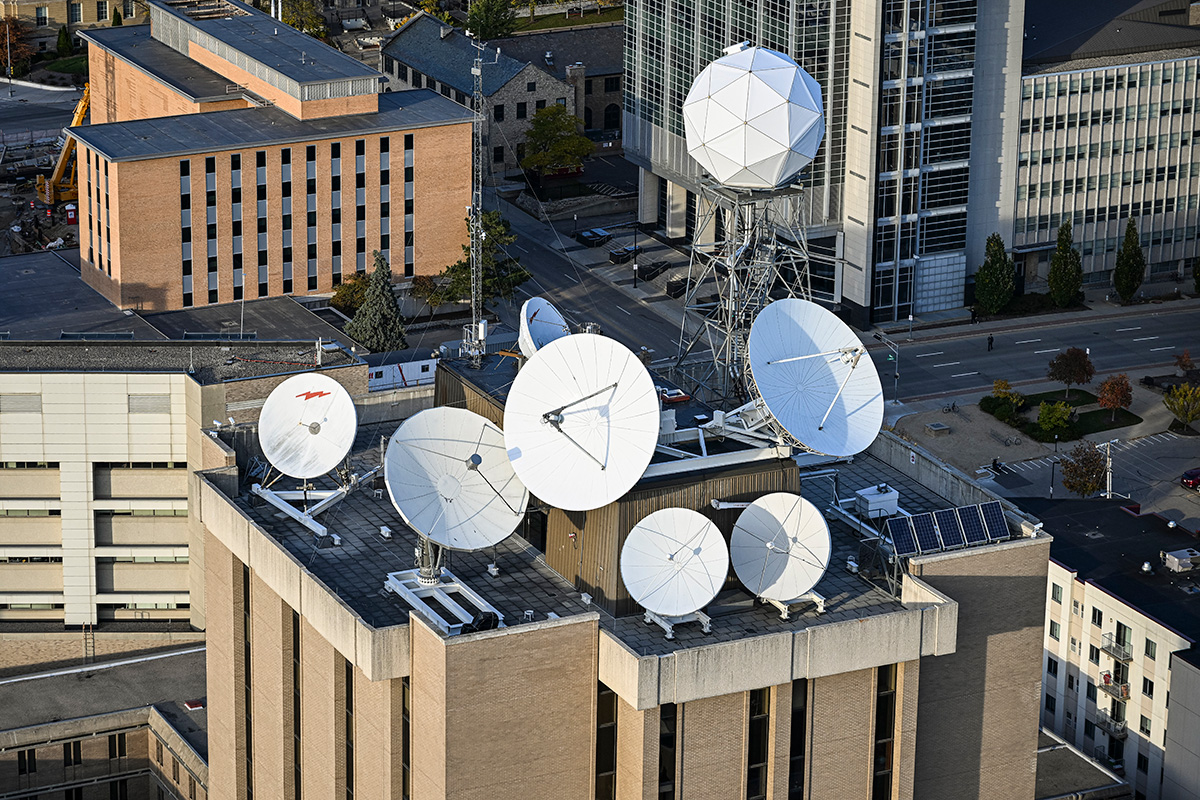
The collaborative center includes nearly two dozen scientists from the fields of atmospheric science, engineering, geography, physics, computer science, actuarial science, and risk and insurance. Jeff Miller
Engineering professor Daniel Wright is adding his expertise in extreme storm prediction research to the new Center for Interdisciplinary Research on Convective Storms (CIRCS), which aims to make society better able to withstand the impacts of severe weather. The collaborative center includes nearly two dozen scientists from the fields of atmospheric science, engineering, geography, physics, computer science, actuarial science, and risk and insurance. Wright is the UW–Madison site director for CIRCS, which will be located at Northern Illinois University.
“We’re mainly going to focus on things like hail and wind damage, but also more upstream questions about seasonal prediction,” Wright says. “For example, that’s trying to see if next summer is going to be at, below, or above average in terms of the number of storms we’re seeing and their severity, and whether these patterns are shifting over time.”
Damage from severe storms has been on the rise in recent decades, driven by changing weather patterns and shifting geographical populations. According to the National Centers for Environmental Information, the United States was buffeted by 190 billion-dollar weather and climate disasters between 2015 and 2024. These events killed more than 6,300 people and caused roughly $1.4 trillion in damage.
Wright developed the StormLab software, which calculates rainfall impacts on different areas. StormLab can create millions of hypothetical, realistic storm scenarios for a wide range of applications, and Wright has recently been working to translate that work to hypothetical hailstorms.
“There are synergies with people in atmospheric sciences who do field observations or use satellites for observations, while we create models,” Wright says. “The idea with this center is that it will bring all of these people together with expertise from across different disciplines to make the research bigger than it would otherwise be.”
Published in the Spring 2026 issue


Comments
No comments posted yet.